Board directs expanded review after audit finds ~$20.4M in sheriff overtime; orders monthly updates and Inspector General analysis
February 10, 2026 | Santa Barbara County, California
This article was created by AI summarizing key points discussed. AI makes mistakes, so for full details and context, please refer to the video of the full meeting. Please report any errors so we can fix them. Report an error »
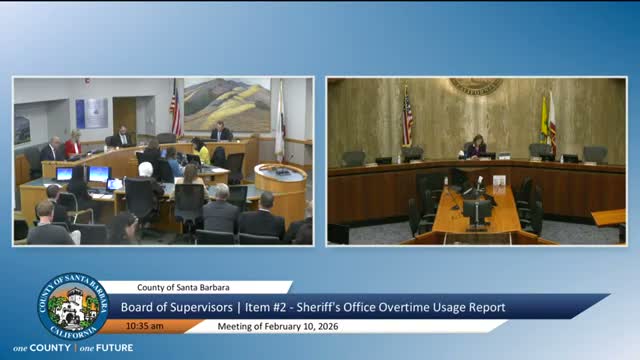
The Santa Barbara County Board of Supervisors on Feb. 10 received a limited‑scope internal audit of the Sheriff’s Office overtime for fiscal year 2024–25 that found overtime totaled approximately $20,400,000 and flagged eight preliminary observations about timekeeping and compensation practices. After extensive public comment and board deliberations, the board directed the Auditor to conduct additional review, asked for monthly administrative updates on overtime for the next six months, requested a comparative review of the other highest overtime departments by Aug. 1, and instructed staff to analyze the Board’s authority under Assembly Bill 1185 to establish an inspector general (IG) for fiscal and administrative oversight.
Assistant County Executive Tanya Heitman summarized the audit background for the board, saying, "In fiscal year 24, 25, overtime totaled approximately $20,400,000," and noted that the auditor's team reviewed about 19,000 timesheets covering roughly 824 employees and expended about 375 hours on the review. The auditor’s memorandum (issued 12/12/2025) included eight preliminary observations and asked for further analysis on several items.
Internal audit chief Joel Boyer detailed common drivers: coding overtime earlier in pay periods, the routine use of paid leave (vacation/sick) to reach overtime thresholds (observed on 36% of timesheets and associated in the memo with roughly $5.9 million of overtime costs), widespread standby and portal‑to‑portal pay practices that increased hours paid, extended mandatory shifts, and the use of comp‑time banks that produced a multiplier effect when accrued hours were later used. Boyer told the board there was "a bit of confusion" about how standby and portal‑to‑portal pay had been interpreted and coded, and recommended improved record keeping and additional auditing to quantify fiscal impacts.
Sheriff Bill Brown said some overtime is structural: he told the board custody and law‑enforcement operations require many hours to staff 24/7 facilities and patrol, and he argued overtime and extra‑help are tools used to bridge staffing gaps created by vacancies and state retirement rules. "If this was an easy problem to fix, it would have been fixed long ago," Brown said, adding his office has implemented steps to limit mandatory custody shifts and improve controls.
Public speakers urged far broader oversight, with many calling for criminal audits, an Inspector General, limits on cooperation with ICE, or redirecting funds to social services and diversion programs. Community groups highlighted the projected general‑fund impact—auditors warned the Sheriff’s overtime was trending toward a projected deficit approaching $9 million for the current fiscal year absent further controls—and asked the board to use its budget authority to protect other county programs.
Action taken: The board voted to: receive and file the report; direct the Auditor Controller to conduct further review into the items flagged in the memo; direct the Auditor to provide monthly administrative reports on overtime for the next six months (A‑items); direct the Auditor to compare overtime practices in the Sheriff’s Office and the four other highest overtime departments and report back by Aug. 1; and direct staff to return with an analysis of the Board’s authority under AB 1185 to create an Inspector General office for fiscal/administrative oversight, including scope, cost and implementation considerations. The motion, made by Supervisor Joan Hartman and seconded by Supervisor Theresa Capes, passed (Supervisor Lavinino absent).
What the follow‑up will show: Auditor staff agreed to produce a monthly administrative report based on payroll records and to prepare the comparative review requested. The board asked that results be returned ahead of the budget process so findings can inform labor negotiations and budget deliberations.
Assistant County Executive Tanya Heitman summarized the audit background for the board, saying, "In fiscal year 24, 25, overtime totaled approximately $20,400,000," and noted that the auditor's team reviewed about 19,000 timesheets covering roughly 824 employees and expended about 375 hours on the review. The auditor’s memorandum (issued 12/12/2025) included eight preliminary observations and asked for further analysis on several items.
Internal audit chief Joel Boyer detailed common drivers: coding overtime earlier in pay periods, the routine use of paid leave (vacation/sick) to reach overtime thresholds (observed on 36% of timesheets and associated in the memo with roughly $5.9 million of overtime costs), widespread standby and portal‑to‑portal pay practices that increased hours paid, extended mandatory shifts, and the use of comp‑time banks that produced a multiplier effect when accrued hours were later used. Boyer told the board there was "a bit of confusion" about how standby and portal‑to‑portal pay had been interpreted and coded, and recommended improved record keeping and additional auditing to quantify fiscal impacts.
Sheriff Bill Brown said some overtime is structural: he told the board custody and law‑enforcement operations require many hours to staff 24/7 facilities and patrol, and he argued overtime and extra‑help are tools used to bridge staffing gaps created by vacancies and state retirement rules. "If this was an easy problem to fix, it would have been fixed long ago," Brown said, adding his office has implemented steps to limit mandatory custody shifts and improve controls.
Public speakers urged far broader oversight, with many calling for criminal audits, an Inspector General, limits on cooperation with ICE, or redirecting funds to social services and diversion programs. Community groups highlighted the projected general‑fund impact—auditors warned the Sheriff’s overtime was trending toward a projected deficit approaching $9 million for the current fiscal year absent further controls—and asked the board to use its budget authority to protect other county programs.
Action taken: The board voted to: receive and file the report; direct the Auditor Controller to conduct further review into the items flagged in the memo; direct the Auditor to provide monthly administrative reports on overtime for the next six months (A‑items); direct the Auditor to compare overtime practices in the Sheriff’s Office and the four other highest overtime departments and report back by Aug. 1; and direct staff to return with an analysis of the Board’s authority under AB 1185 to create an Inspector General office for fiscal/administrative oversight, including scope, cost and implementation considerations. The motion, made by Supervisor Joan Hartman and seconded by Supervisor Theresa Capes, passed (Supervisor Lavinino absent).
What the follow‑up will show: Auditor staff agreed to produce a monthly administrative report based on payroll records and to prepare the comparative review requested. The board asked that results be returned ahead of the budget process so findings can inform labor negotiations and budget deliberations.
View the Full Meeting & All Its Details
This article offers just a summary. Unlock complete video, transcripts, and insights as a Founder Member.
✓
Watch full, unedited meeting videos
✓
Search every word spoken in unlimited transcripts
✓
AI summaries & real-time alerts (all government levels)
✓
Permanent access to expanding government content
30-day money-back guarantee
