Planning staff: proposed 8‑unit middle‑housing project at 1216 Callaway St. may be out of scale with Mechanicsville
February 10, 2026 | Knox County, Tennessee
This article was created by AI summarizing key points discussed. AI makes mistakes, so for full details and context, please refer to the video of the full meeting. Please report any errors so we can fix them. Report an error »
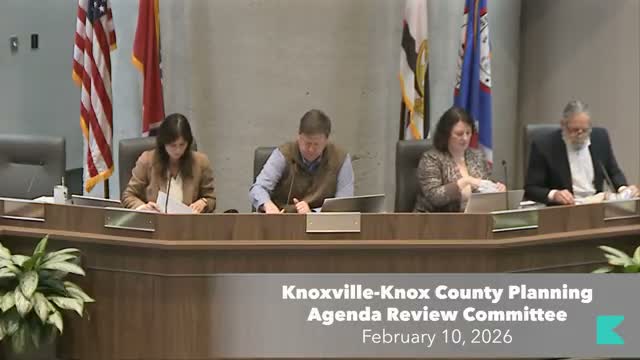
Samuel presented an appeal of a staff determination for a middle‑housing application at 1216 Callaway St. in Mechanicsville. "The property in question is 1216 Callaway Street," Samuel stated, and staff said the lot is roughly 75 by 135 feet (over 10,000 sq ft) in a block dominated by one‑story single‑family houses and a two‑story duplex at the corner.
The applicant proposes an asymmetric U‑shaped 2.5‑story structure containing eight dwelling units separated by party walls. Staff reported the proposed building footprint is about 3,370 sq ft and a building area near 5,000 sq ft (excluding porches), which staff said is markedly larger than the average floor area on the block and roughly 2.3 times larger in footprint than most existing houses on the same block face.
Staff advised the commission that Article 4.6 (middle housing) intends to permit multi‑unit forms that are comparable in footprint, height and setback to the surrounding single‑family pattern. Because staff concluded this proposal is outsized for the immediate context and noted contradictions with multiple zoning sections (listed in the case package), they recommended that the commission evaluate compatibility focusing on footprint, height, setbacks and whether the proposal would be injurious to neighborhood character or public welfare.
Why it matters: middle‑housing rules were intended to expand housing options while preserving neighborhood scale; commissioners must weigh those policy goals against immediate contextual compatibility.
What happens next: the planning commission will consider the appeal and must articulate reasons if it reaches a decision different from staff on similar future cases.
The applicant proposes an asymmetric U‑shaped 2.5‑story structure containing eight dwelling units separated by party walls. Staff reported the proposed building footprint is about 3,370 sq ft and a building area near 5,000 sq ft (excluding porches), which staff said is markedly larger than the average floor area on the block and roughly 2.3 times larger in footprint than most existing houses on the same block face.
Staff advised the commission that Article 4.6 (middle housing) intends to permit multi‑unit forms that are comparable in footprint, height and setback to the surrounding single‑family pattern. Because staff concluded this proposal is outsized for the immediate context and noted contradictions with multiple zoning sections (listed in the case package), they recommended that the commission evaluate compatibility focusing on footprint, height, setbacks and whether the proposal would be injurious to neighborhood character or public welfare.
Why it matters: middle‑housing rules were intended to expand housing options while preserving neighborhood scale; commissioners must weigh those policy goals against immediate contextual compatibility.
What happens next: the planning commission will consider the appeal and must articulate reasons if it reaches a decision different from staff on similar future cases.
Don't Miss a Word: See the Full Meeting!
Go beyond summaries. Unlock every video, transcript, and key insight with a Founder Membership.
✓
Get instant access to full meeting videos
✓
Search and clip any phrase from complete transcripts
✓
Receive AI-powered summaries & custom alerts
✓
Enjoy lifetime, unrestricted access to government data
30-day money-back guarantee
