Simmons Farm concept plan: developer to fund intersection realignment; staff recommends flasher rather than full turn lane
February 10, 2026 | Knox County, Tennessee
This article was created by AI summarizing key points discussed. AI makes mistakes, so for full details and context, please refer to the video of the full meeting. Please report any errors so we can fix them. Report an error »
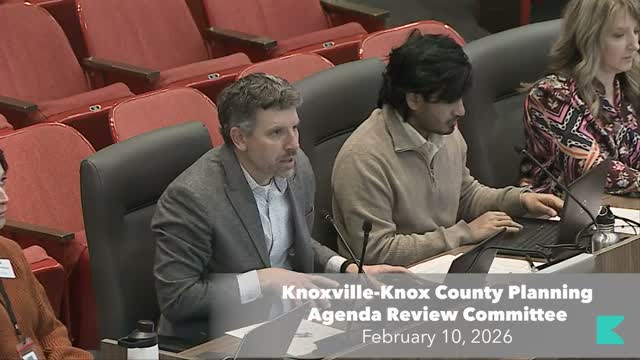
Staff presented the Simmons Farm concept plan (SD 26 C) on Roberts Road and summarized why the revised plan differs from the earlier approval. The main east portion of the subdivision largely remains the same; the rear portion now shows seven larger estate lots and one large open space lot, and the applicant’s revised materials identify a wetland not previously shown.
On traffic mitigation, staff noted TDOT previously found a left‑turn lane warranted under its standards while the county’s warrants do not necessarily require one. Speaker 6 explained, "the modification to the condition is to not install a left turn lane, but to install advanced warning flashers," describing a radar‑activated flasher that would sense side‑street traffic and warn drivers on the mainline to address the visibility issue at the Emery/Roberts intersection. Staff also reiterated an existing condition requiring participation by the developer in a county project to realign the Washington Pike/Roberts Road intersection.
Commissioners pressed staff on connectivity and pedestrian access; they noted Roberts Road lacks sidewalks and raised concerns about ADA access between adjacent subdivisions. Staff said the adjacent neighborhood preferred not to connect and that the project has two access points. Commissioners also questioned how common area lots (stormwater ponds and buffers) would be platted and whether a lot labeled on a concept plat (Lot 17) could be later converted to a buildable lot; staff agreed to review tax‑ID and platting practices and report back.
Why it matters: the plan affects local traffic, wetland protection and neighborhood connectivity; the proposed mitigation (flashers vs. lane construction) is a material change to prior conditions of approval.
What happens next: staff recommended approval with conditions; commissioners asked follow‑up questions about platting language, pedestrian access and how the developer’s participation in realignment will be secured.
On traffic mitigation, staff noted TDOT previously found a left‑turn lane warranted under its standards while the county’s warrants do not necessarily require one. Speaker 6 explained, "the modification to the condition is to not install a left turn lane, but to install advanced warning flashers," describing a radar‑activated flasher that would sense side‑street traffic and warn drivers on the mainline to address the visibility issue at the Emery/Roberts intersection. Staff also reiterated an existing condition requiring participation by the developer in a county project to realign the Washington Pike/Roberts Road intersection.
Commissioners pressed staff on connectivity and pedestrian access; they noted Roberts Road lacks sidewalks and raised concerns about ADA access between adjacent subdivisions. Staff said the adjacent neighborhood preferred not to connect and that the project has two access points. Commissioners also questioned how common area lots (stormwater ponds and buffers) would be platted and whether a lot labeled on a concept plat (Lot 17) could be later converted to a buildable lot; staff agreed to review tax‑ID and platting practices and report back.
Why it matters: the plan affects local traffic, wetland protection and neighborhood connectivity; the proposed mitigation (flashers vs. lane construction) is a material change to prior conditions of approval.
What happens next: staff recommended approval with conditions; commissioners asked follow‑up questions about platting language, pedestrian access and how the developer’s participation in realignment will be secured.
View the Full Meeting & All Its Details
This article offers just a summary. Unlock complete video, transcripts, and insights as a Founder Member.
✓
Watch full, unedited meeting videos
✓
Search every word spoken in unlimited transcripts
✓
AI summaries & real-time alerts (all government levels)
✓
Permanent access to expanding government content
30-day money-back guarantee
