Vacaville Council Introduces Sidewalk Vending Ordinance, Directs County Coordination
February 11, 2026 | Vacaville City, Solano County, California
This article was created by AI summarizing key points discussed. AI makes mistakes, so for full details and context, please refer to the video of the full meeting. Please report any errors so we can fix them. Report an error »
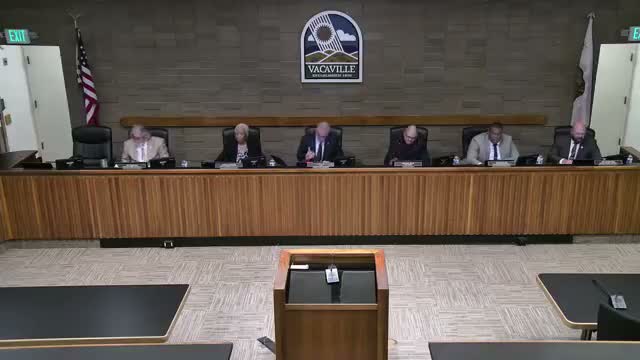
The Vacaville City Council introduced a local ordinance to regulate sidewalk vending on Feb. 10, adopting a package of time, place and manner restrictions consistent with state law and asking staff to pursue a formal enforcement agreement with Solano County.
City staff told the council the draft ordinance distinguishes sidewalk vendors—who operate on pedestrian paths and sidewalks and are covered by SB 946 (the Safe Sidewalk Vending Act) and SB 972—from other pop-up or tent vendors in parking lots or private property. Staff said the city can issue administrative citations for sidewalk-vending violations but must rely on the county for food-safety enforcement. “All we can do for sidewalk vending specifically is issue administrative citations,” staff said during the presentation, noting state limits on criminal penalties.
The ordinance would require sidewalk vendors to hold a city sidewalk-vending permit, conspicuously display their permits, maintain an ADA-compliant path of travel, keep areas around vendors clean, and observe locational limits (for example, not vending at bus stops, medians, red curbs or within 10 feet of building entrances). Stationary vendors would be barred in residential zones and within 300 feet of an exclusively residential zone; mobile push-cart vendors would remain allowed in residential areas under state law but subject to hours and other local rules. The draft also establishes buffers (for example, a 500-foot zone around specially permitted events) to protect permitted festival areas and to reduce conflicts with event organizers.
Council members pressed staff on enforcement practicality. One councilmember said the state’s decriminalization limits the city’s “teeth,” because the ordinance allows only administrative fines and, for vendors with no identifying documentation, police and code officers will have limited immediate options. Staff explained the ordinance front-loads identity and business information during permitting and that the county’s environmental health office is the authority on food-safety permits; the county has reviewed the draft and indicated willingness to coordinate enforcement and more frequent food-safety inspections.
The council debated whether to allow residential-area vendors to operate later than the proposed 9 a.m.–6 p.m. window. An amendment to extend residential hours to 9 p.m. failed; a subsequent motion to introduce the ordinance as drafted passed. The council’s direction was to proceed with introduction and second reading, to make the CEQA findings needed for the ordinance, to take no additional enforcement delay beyond the statutory waiting period, and to pursue a formalized mutual-enforcement arrangement with Solano County for health inspections.
The city will return with the ordinance for a second reading and adoption on a later agenda, and staff will report back on the proposed county arrangement and on any requested refinements to permit or fee processes.
City staff told the council the draft ordinance distinguishes sidewalk vendors—who operate on pedestrian paths and sidewalks and are covered by SB 946 (the Safe Sidewalk Vending Act) and SB 972—from other pop-up or tent vendors in parking lots or private property. Staff said the city can issue administrative citations for sidewalk-vending violations but must rely on the county for food-safety enforcement. “All we can do for sidewalk vending specifically is issue administrative citations,” staff said during the presentation, noting state limits on criminal penalties.
The ordinance would require sidewalk vendors to hold a city sidewalk-vending permit, conspicuously display their permits, maintain an ADA-compliant path of travel, keep areas around vendors clean, and observe locational limits (for example, not vending at bus stops, medians, red curbs or within 10 feet of building entrances). Stationary vendors would be barred in residential zones and within 300 feet of an exclusively residential zone; mobile push-cart vendors would remain allowed in residential areas under state law but subject to hours and other local rules. The draft also establishes buffers (for example, a 500-foot zone around specially permitted events) to protect permitted festival areas and to reduce conflicts with event organizers.
Council members pressed staff on enforcement practicality. One councilmember said the state’s decriminalization limits the city’s “teeth,” because the ordinance allows only administrative fines and, for vendors with no identifying documentation, police and code officers will have limited immediate options. Staff explained the ordinance front-loads identity and business information during permitting and that the county’s environmental health office is the authority on food-safety permits; the county has reviewed the draft and indicated willingness to coordinate enforcement and more frequent food-safety inspections.
The council debated whether to allow residential-area vendors to operate later than the proposed 9 a.m.–6 p.m. window. An amendment to extend residential hours to 9 p.m. failed; a subsequent motion to introduce the ordinance as drafted passed. The council’s direction was to proceed with introduction and second reading, to make the CEQA findings needed for the ordinance, to take no additional enforcement delay beyond the statutory waiting period, and to pursue a formalized mutual-enforcement arrangement with Solano County for health inspections.
The city will return with the ordinance for a second reading and adoption on a later agenda, and staff will report back on the proposed county arrangement and on any requested refinements to permit or fee processes.
Don't Miss a Word: See the Full Meeting!
Go beyond summaries. Unlock every video, transcript, and key insight with a Founder Membership.
✓
Get instant access to full meeting videos
✓
Search and clip any phrase from complete transcripts
✓
Receive AI-powered summaries & custom alerts
✓
Enjoy lifetime, unrestricted access to government data
30-day money-back guarantee
