Defender General warns of lawyer shortages, caseload growth and modest funding gap
February 11, 2026 | Judiciary, HOUSE OF REPRESENTATIVES, Committees, Legislative , Vermont
This article was created by AI summarizing key points discussed. AI makes mistakes, so for full details and context, please refer to the video of the full meeting. Please report any errors so we can fix them. Report an error »
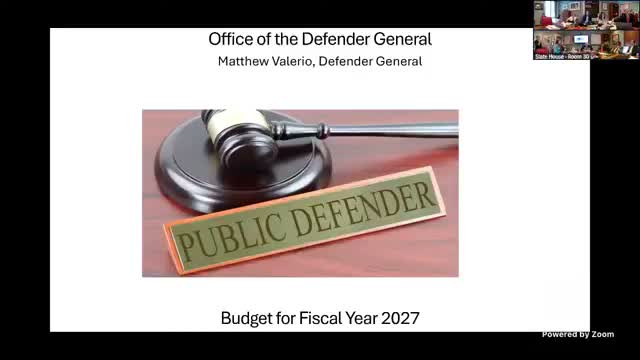
Defender General Matt Valery told the House appropriations committee on Feb. 10 that the office’s FY27 request largely continues current services but that the Defender General’s Office (DGO) faces increasing caseloads, recruitment and retention challenges, and several unfunded needs that together create a modest budget gap.
Valery described the DGO’s two‑part structure: primary public defense (staff and contract offices covering roughly 60 percent of the state caseload) and assigned counsel/conflict services. He reiterated that primary public defender contracts were moved to four‑year terms to reduce annual uncertainty and that the governor’s recommendation continues the current service level while funding negotiated contract increases.
Why this matters: Valery said caseloads have risen recently (he cited an 11 percent increase for fiscal year 2025 over 2024 in overall cases and a trend that added about 6.7 percent on top of prior increases). He also warned that fewer lawyers are willing to do public defense or conflict contracts, particularly in Chittenden County and more rural counties, creating operational stress and greater reliance on caseload‑relief contracts and ad hoc assignments.
On costs and recruitment: Valery highlighted several pressures: investigators and other third‑party services are paid about $50 an hour in Vermont (noted as low compared with neighboring states); rent increases negotiated by Buildings & General Services complicate facility budgeting; and private‑sector starting salaries for new lawyers greatly exceed public defense compensation, making recruitment difficult. “Our starting salary is 63,000,” Valery said, then explained the office is hiring at higher rates; he noted private‑sector entry salaries he described at about $200,000 in a cited example.
Backlog and efficiency: Valery showed data indicating the backlog of open cases fell from more than 14,000 to about 9,000 by January 2026, while caseloads remain elevated; he also argued that assigned‑counsel conflict contracts are the most efficient delivery model and that ad hoc counsel is substantially more expensive and lower quality because courts must find ‘‘warm bodies’’ at short notice.
Unfunded needs and vacancy assumption: Valery flagged two recurring unfunded issues: the public defender special fund often carries spending authority that exceeds actual collections, creating a recurring shortfall, and a vacancy savings assumption of $610,000 in the recommended budget that he called unrealistic (he estimated realistic vacancy savings at about $300,000). He said the combination of those factors and contract pressures sum to the gap the office is seeking to close with additional funding requests.
Requested adjustments and tradeoffs: Valery said the office is asking for additional funds (he characterized the gap in the hundreds of thousands, noting about $500,000 above the governor’s recommend in places) to fund contract increases, in‑person training base funding and to reduce reliance on vacancy holding. If those increases are not approved, Valery said the office will rely on vacancy holds and other internal levers to balance the budget.
Committee members asked about contract design and benefits for part‑time contractors and the difficulty courts sometimes create by treating contractors like full‑time employees. Valery said the office offers non‑monetary benefits such as free training but that the market remains challenging.
Valery closed by saying that while the office is close to the governor’s recommendation, the combination of caseload increases and workforce shortfalls makes modest additional funding both necessary and urgent for service quality and continuity.
Valery described the DGO’s two‑part structure: primary public defense (staff and contract offices covering roughly 60 percent of the state caseload) and assigned counsel/conflict services. He reiterated that primary public defender contracts were moved to four‑year terms to reduce annual uncertainty and that the governor’s recommendation continues the current service level while funding negotiated contract increases.
Why this matters: Valery said caseloads have risen recently (he cited an 11 percent increase for fiscal year 2025 over 2024 in overall cases and a trend that added about 6.7 percent on top of prior increases). He also warned that fewer lawyers are willing to do public defense or conflict contracts, particularly in Chittenden County and more rural counties, creating operational stress and greater reliance on caseload‑relief contracts and ad hoc assignments.
On costs and recruitment: Valery highlighted several pressures: investigators and other third‑party services are paid about $50 an hour in Vermont (noted as low compared with neighboring states); rent increases negotiated by Buildings & General Services complicate facility budgeting; and private‑sector starting salaries for new lawyers greatly exceed public defense compensation, making recruitment difficult. “Our starting salary is 63,000,” Valery said, then explained the office is hiring at higher rates; he noted private‑sector entry salaries he described at about $200,000 in a cited example.
Backlog and efficiency: Valery showed data indicating the backlog of open cases fell from more than 14,000 to about 9,000 by January 2026, while caseloads remain elevated; he also argued that assigned‑counsel conflict contracts are the most efficient delivery model and that ad hoc counsel is substantially more expensive and lower quality because courts must find ‘‘warm bodies’’ at short notice.
Unfunded needs and vacancy assumption: Valery flagged two recurring unfunded issues: the public defender special fund often carries spending authority that exceeds actual collections, creating a recurring shortfall, and a vacancy savings assumption of $610,000 in the recommended budget that he called unrealistic (he estimated realistic vacancy savings at about $300,000). He said the combination of those factors and contract pressures sum to the gap the office is seeking to close with additional funding requests.
Requested adjustments and tradeoffs: Valery said the office is asking for additional funds (he characterized the gap in the hundreds of thousands, noting about $500,000 above the governor’s recommend in places) to fund contract increases, in‑person training base funding and to reduce reliance on vacancy holding. If those increases are not approved, Valery said the office will rely on vacancy holds and other internal levers to balance the budget.
Committee members asked about contract design and benefits for part‑time contractors and the difficulty courts sometimes create by treating contractors like full‑time employees. Valery said the office offers non‑monetary benefits such as free training but that the market remains challenging.
Valery closed by saying that while the office is close to the governor’s recommendation, the combination of caseload increases and workforce shortfalls makes modest additional funding both necessary and urgent for service quality and continuity.
Don't Miss a Word: See the Full Meeting!
Go beyond summaries. Unlock every video, transcript, and key insight with a Founder Membership.
✓
Get instant access to full meeting videos
✓
Search and clip any phrase from complete transcripts
✓
Receive AI-powered summaries & custom alerts
✓
Enjoy lifetime, unrestricted access to government data
30-day money-back guarantee
