Newport Beach council adopts expanded safety enhancement zones, keeps mandatory revocation for certain short-term lodging crimes
February 11, 2026 | Newport Beach City, Orange County, California
This article was created by AI summarizing key points discussed. AI makes mistakes, so for full details and context, please refer to the video of the full meeting. Please report any errors so we can fix them. Report an error »
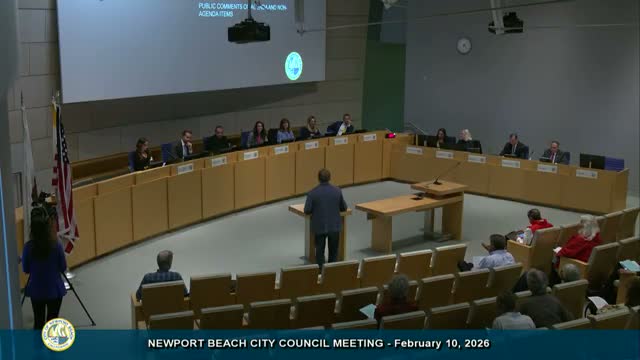
The Newport Beach City Council voted unanimously to adopt changes expanding Safety Enhancement Zones and to retain a mandatory revocation provision for short-term lodging permits tied to a limited list of serious offenses.
Supporters of the measure and several council members said the ordinance targets a narrow set of crimes that impose extraordinary burdens on police and public safety. City Attorney Harp explained the drafting intent: "It was basically inserted so that it'd be mandatory to revoke a short-term lodging permit, but only if certain crimes are committed," and said revocation would follow only when a violation is proved by a preponderance of the evidence.
Short-term rental operators and community members pressed for more discretion. Todd Preece, speaking for the Newport Beach Short Term Rental Alliance, asked the council to change the word 'shall' to 'may' in the revocation provision so staff could exercise discretion before removing a business permit: "It does give the city the ability to still move forward with that revocation. But it doesn't mandate that it happen. It allows for short-term rental owners who live and operate in Newport to have some dialogue with the city."
Residents and commenters also raised issues with the staff report's data and notification language. Carmen Rosson said the report omitted arrest and citation breakdowns by geography and questioned how the city would hold property owners responsible for behavior occurring outside private property. Several speakers urged changing the ordinance's public-notice timing so an effective-date notice is posted the day before—not on—the effective date.
During the dais discussion, some members expressed confidence in staff to limit enforcement to the most egregious cases while ensuring a remedy process for mistakes. Councilmember Grant said the mandatory language "addresses pretty grievous kind of incidences" and sought confirmation that a preponderance-of-evidence standard and an appeal or remedy would be available if a revocation were based on mistaken facts. Harp replied that the mandatory revocation applies only when the ordinance's listed crimes are proved beyond a preponderance of the evidence.
The council incorporated a change to the general-notice timing into the motion and approved the ordinance unanimously. The ordinance as adopted keeps the mandatory revocation for specified, serious crimes tied to short-term lodging but directs staff to clarify noticing language, geographic scope, and the administrative process for establishing and contesting revocation.
Supporters of the measure and several council members said the ordinance targets a narrow set of crimes that impose extraordinary burdens on police and public safety. City Attorney Harp explained the drafting intent: "It was basically inserted so that it'd be mandatory to revoke a short-term lodging permit, but only if certain crimes are committed," and said revocation would follow only when a violation is proved by a preponderance of the evidence.
Short-term rental operators and community members pressed for more discretion. Todd Preece, speaking for the Newport Beach Short Term Rental Alliance, asked the council to change the word 'shall' to 'may' in the revocation provision so staff could exercise discretion before removing a business permit: "It does give the city the ability to still move forward with that revocation. But it doesn't mandate that it happen. It allows for short-term rental owners who live and operate in Newport to have some dialogue with the city."
Residents and commenters also raised issues with the staff report's data and notification language. Carmen Rosson said the report omitted arrest and citation breakdowns by geography and questioned how the city would hold property owners responsible for behavior occurring outside private property. Several speakers urged changing the ordinance's public-notice timing so an effective-date notice is posted the day before—not on—the effective date.
During the dais discussion, some members expressed confidence in staff to limit enforcement to the most egregious cases while ensuring a remedy process for mistakes. Councilmember Grant said the mandatory language "addresses pretty grievous kind of incidences" and sought confirmation that a preponderance-of-evidence standard and an appeal or remedy would be available if a revocation were based on mistaken facts. Harp replied that the mandatory revocation applies only when the ordinance's listed crimes are proved beyond a preponderance of the evidence.
The council incorporated a change to the general-notice timing into the motion and approved the ordinance unanimously. The ordinance as adopted keeps the mandatory revocation for specified, serious crimes tied to short-term lodging but directs staff to clarify noticing language, geographic scope, and the administrative process for establishing and contesting revocation.
Don't Miss a Word: See the Full Meeting!
Go beyond summaries. Unlock every video, transcript, and key insight with a Founder Membership.
✓
Get instant access to full meeting videos
✓
Search and clip any phrase from complete transcripts
✓
Receive AI-powered summaries & custom alerts
✓
Enjoy lifetime, unrestricted access to government data
30-day money-back guarantee
