Norwalk mayor and CFO outline strained FY2026–27 budget as council demands line‑by‑line access
February 11, 2026 | Norwalk City, Fairfield, Connecticut
This article was created by AI summarizing key points discussed. AI makes mistakes, so for full details and context, please refer to the video of the full meeting. Please report any errors so we can fix them. Report an error »
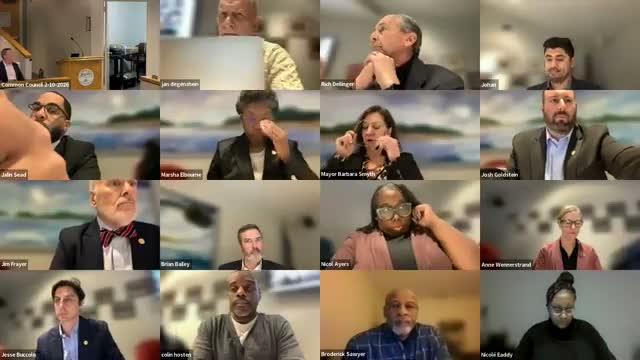
Norwalk’s mayor and chief financial officer presented a recommended FY2026–27 operating budget Feb. 10 that officials said is being driven chiefly by three factors: rising employee health‑care costs, the simultaneous timing of six collective bargaining agreements and the effects of a periodic property revaluation.
Mayor Barbara C. Smith said the budget year will be “challenging” and that the administration is seeking to protect city services and school funding while looking for ways to mitigate the tax burden. She told the council she included the $4.5 million the city added to schools last year in the FY27 base, so the board of education’s proposed 4% increase is on top of that commitment.
CFO Jared Schmidt gave the council a detailed revenue and spending picture, saying property taxes represent roughly 89% of projected revenue for FY27 and flagging several near‑term constraints: investment income is expected to fall compared with last year, grants and ARPA balances have diminished, and final pension figures were still awaited. To blunt immediate tax impacts, Schmidt said the budget uses a $3 million citywide “salary lapse” (an unallocated negative), draws $7 million from fund balance (down from an $8 million planned draw in FY26) and applies $5 million of accumulated bond premium in FY27 on a stepped schedule.
Schmidt also highlighted a multi‑year phase‑in tied to the revaluation process that is intended to soften the tax shift and noted that healthcare costs were budgeted to rise roughly 13–14% in the coming year.
During public participation, resident Nick Zersan urged officials to act early to resolve what he described as a roughly $6 million gap affecting the school budget, warning that uncertainty had driven teachers away last year and asking the council not to wait until a crisis.
Council members pressed the administration for more granular materials. Multiple councilors said the line‑by‑line budget book posted online lacked department narratives and was difficult to use for the level of oversight the charter requires; several requested printed copies and access to the full budget book so they can evaluate tradeoffs and service impacts before setting a budget cap later in the process.
The mayor reminded the public that the finance committee will hold a public hearing on Thursday and that a public hearing on the budget cap is scheduled for late March, with the council required to set the operating cap no later than April 21.
What’s next: The Finance & Claims Committee public hearing is scheduled for Feb. 12; councilors requested printed, line‑by‑line budget books in advance of further deliberations.
Mayor Barbara C. Smith said the budget year will be “challenging” and that the administration is seeking to protect city services and school funding while looking for ways to mitigate the tax burden. She told the council she included the $4.5 million the city added to schools last year in the FY27 base, so the board of education’s proposed 4% increase is on top of that commitment.
CFO Jared Schmidt gave the council a detailed revenue and spending picture, saying property taxes represent roughly 89% of projected revenue for FY27 and flagging several near‑term constraints: investment income is expected to fall compared with last year, grants and ARPA balances have diminished, and final pension figures were still awaited. To blunt immediate tax impacts, Schmidt said the budget uses a $3 million citywide “salary lapse” (an unallocated negative), draws $7 million from fund balance (down from an $8 million planned draw in FY26) and applies $5 million of accumulated bond premium in FY27 on a stepped schedule.
Schmidt also highlighted a multi‑year phase‑in tied to the revaluation process that is intended to soften the tax shift and noted that healthcare costs were budgeted to rise roughly 13–14% in the coming year.
During public participation, resident Nick Zersan urged officials to act early to resolve what he described as a roughly $6 million gap affecting the school budget, warning that uncertainty had driven teachers away last year and asking the council not to wait until a crisis.
Council members pressed the administration for more granular materials. Multiple councilors said the line‑by‑line budget book posted online lacked department narratives and was difficult to use for the level of oversight the charter requires; several requested printed copies and access to the full budget book so they can evaluate tradeoffs and service impacts before setting a budget cap later in the process.
The mayor reminded the public that the finance committee will hold a public hearing on Thursday and that a public hearing on the budget cap is scheduled for late March, with the council required to set the operating cap no later than April 21.
What’s next: The Finance & Claims Committee public hearing is scheduled for Feb. 12; councilors requested printed, line‑by‑line budget books in advance of further deliberations.
Don't Miss a Word: See the Full Meeting!
Go beyond summaries. Unlock every video, transcript, and key insight with a Founder Membership.
✓
Get instant access to full meeting videos
✓
Search and clip any phrase from complete transcripts
✓
Receive AI-powered summaries & custom alerts
✓
Enjoy lifetime, unrestricted access to government data
30-day money-back guarantee
