Committee adopts changes to EV-storage bill after wide-ranging testimony on fire risk and costs
February 10, 2026 | 2026 Legislature FL, Florida
This article was created by AI summarizing key points discussed. AI makes mistakes, so for full details and context, please refer to the video of the full meeting. Please report any errors so we can fix them. Report an error »
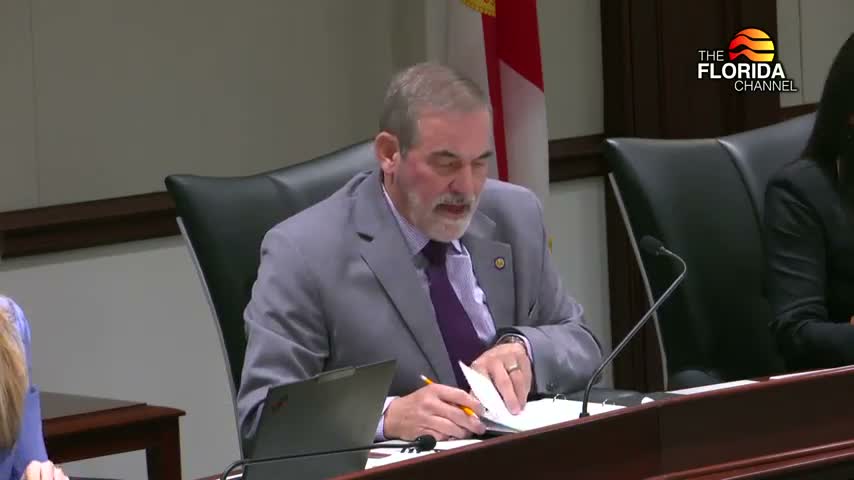
Senator Burgess presented CS/CS/SB 260 as a bill to clarify rules for storing electric vehicles (EVs) that may be damaged or present a fire risk while housed in towing yards. The committee took up an amendment that removed language related to crash-site cleanup and limited the daily administrative fee to apply only until a local agency inspects and verifies there is no fire danger.
Industry and public-safety witnesses described both risks and operational burdens. Jeff Sharkey, representing Tesla, said the company has experience from Hurricane Ian and that "thermal runaway" in damaged batteries can create unique fire risks, and that recent amendments had moved his position from opposed to informational. Michael Carlsen of the Personal Insurance Federation of Florida asked for data about how many EVs are towed nonconsensually, how long they remain in storage, and whether they have fire damage; he urged a specific time limitation so towers and ratepayers are not burdened indefinitely.
Fire investigators and firefighters supported the bill's safety focus. Metro Dade Fire investigator Richard Andrews said isolating damaged EVs reduces secondary loss, unnecessary deployment of fire resources and environmental runoff from firefighting, and firefighter Stephen Boussay described prolonged reignition risks and thermal-cell temperatures that complicate storage.
Towing and mobility representatives said local conditions vary and urged allowing counties or municipalities to set rates that reflect local land and space constraints rather than a single statewide multiplier. Senator Burgess said the proposal aims to ensure fair compensation for tow operators asked to reserve additional space when EVs must be kept apart for safety.
After debate and discussion of possible data calls and time limits, the committee adopted the amendment narrowing the bill and reported CS/CS/SB 260 favorably.
Provenance: Sponsor remarks, amendment explanation, multiple witness statements and the committee roll call (topic intro SEG 1199; topic finish SEG 1611).
Industry and public-safety witnesses described both risks and operational burdens. Jeff Sharkey, representing Tesla, said the company has experience from Hurricane Ian and that "thermal runaway" in damaged batteries can create unique fire risks, and that recent amendments had moved his position from opposed to informational. Michael Carlsen of the Personal Insurance Federation of Florida asked for data about how many EVs are towed nonconsensually, how long they remain in storage, and whether they have fire damage; he urged a specific time limitation so towers and ratepayers are not burdened indefinitely.
Fire investigators and firefighters supported the bill's safety focus. Metro Dade Fire investigator Richard Andrews said isolating damaged EVs reduces secondary loss, unnecessary deployment of fire resources and environmental runoff from firefighting, and firefighter Stephen Boussay described prolonged reignition risks and thermal-cell temperatures that complicate storage.
Towing and mobility representatives said local conditions vary and urged allowing counties or municipalities to set rates that reflect local land and space constraints rather than a single statewide multiplier. Senator Burgess said the proposal aims to ensure fair compensation for tow operators asked to reserve additional space when EVs must be kept apart for safety.
After debate and discussion of possible data calls and time limits, the committee adopted the amendment narrowing the bill and reported CS/CS/SB 260 favorably.
Provenance: Sponsor remarks, amendment explanation, multiple witness statements and the committee roll call (topic intro SEG 1199; topic finish SEG 1611).
Don't Miss a Word: See the Full Meeting!
Go beyond summaries. Unlock every video, transcript, and key insight with a Founder Membership.
✓
Get instant access to full meeting videos
✓
Search and clip any phrase from complete transcripts
✓
Receive AI-powered summaries & custom alerts
✓
Enjoy lifetime, unrestricted access to government data
30-day money-back guarantee
