Senator urges Senate to block Treasury rule said to give $10.3 billion in corporate tax relief
February 10, 2026 | Senate Committee on Finance, Senate Committees, U.S. Senate, Legislative, Federal
This article was created by AI summarizing key points discussed. AI makes mistakes, so for full details and context, please refer to the video of the full meeting. Please report any errors so we can fix them. Report an error »
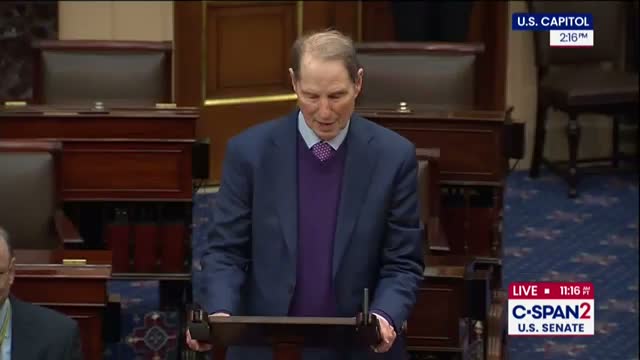
An unnamed senator on the Senate floor urged colleagues to support a resolution to overturn a Treasury rule he said would hand $10.3 billion in tax relief to the largest corporations and private equity firms.
"The Trump administration treats the US Treasury Department like make a wish for Corporations and Private Equity," the senator said, criticizing the administration's approach to tax rulemaking. He said the question before the chamber is whether corporations with profits above $1,000,000,000 in a single year should be required to pay a minimum tax of 15%.
The senator cited what he described as a Joint Committee on Taxation estimate that the Treasury change would amount to a $10,300,000,000 benefit to corporations and private equity. He said the change was made through administrative rulemaking rather than through legislation and identified the rule in the transcript as "IRS notice 20 25 dash 28" (normalized here as IRS Notice 2025-28). According to the senator, the notice rewrites how income from partnerships is counted and allows firms to choose among six methods for attributing that income.
"Essentially, these firms get to play a game of choose your own tax rate," he said, arguing the rule encourages corporations to use layered partnership structures to reduce taxable income rather than create jobs or invest in new operations. He added that similar techniques have driven reported corporate tax rates down to single digits or zero.
The senator framed the resolution as a measured step, not a bid to "clobber" corporations, but as a request for a modest minimum contribution: "A 15% tax rate that a lot of people wouldn't even consider to be actually a fair share for these big corporations," he said.
Earlier in the speech the senator asked unanimous consent to grant floor privileges to two members of his finance team, Zeb Brown and Candace Morrissey; the chamber responded, "Without objection." Near the end of his remarks he said, "I now move to proceed to calendar" and recited a calendar reference from the transcript; the record ends without a recorded vote or further proceedings on that motion.
The senator repeatedly tied his appeal to broader budgetary and economic concerns, saying families are "buried under the rising cost of living" while, he asserted, recent changes and legislation have favored large firms. He cited other large figures in the transcript — including a referenced $1,000,000,000,000 in recent tax changes and a $100,000,000,000 figure tied to basis-shifting — as part of a broader argument that the policy environment has been tilted toward big business.
Next steps were not recorded in the provided transcript: the senator said a vote would occur "very soon," but the excerpt ends before a vote tally or formal outcome was entered on the floor.
"The Trump administration treats the US Treasury Department like make a wish for Corporations and Private Equity," the senator said, criticizing the administration's approach to tax rulemaking. He said the question before the chamber is whether corporations with profits above $1,000,000,000 in a single year should be required to pay a minimum tax of 15%.
The senator cited what he described as a Joint Committee on Taxation estimate that the Treasury change would amount to a $10,300,000,000 benefit to corporations and private equity. He said the change was made through administrative rulemaking rather than through legislation and identified the rule in the transcript as "IRS notice 20 25 dash 28" (normalized here as IRS Notice 2025-28). According to the senator, the notice rewrites how income from partnerships is counted and allows firms to choose among six methods for attributing that income.
"Essentially, these firms get to play a game of choose your own tax rate," he said, arguing the rule encourages corporations to use layered partnership structures to reduce taxable income rather than create jobs or invest in new operations. He added that similar techniques have driven reported corporate tax rates down to single digits or zero.
The senator framed the resolution as a measured step, not a bid to "clobber" corporations, but as a request for a modest minimum contribution: "A 15% tax rate that a lot of people wouldn't even consider to be actually a fair share for these big corporations," he said.
Earlier in the speech the senator asked unanimous consent to grant floor privileges to two members of his finance team, Zeb Brown and Candace Morrissey; the chamber responded, "Without objection." Near the end of his remarks he said, "I now move to proceed to calendar" and recited a calendar reference from the transcript; the record ends without a recorded vote or further proceedings on that motion.
The senator repeatedly tied his appeal to broader budgetary and economic concerns, saying families are "buried under the rising cost of living" while, he asserted, recent changes and legislation have favored large firms. He cited other large figures in the transcript — including a referenced $1,000,000,000,000 in recent tax changes and a $100,000,000,000 figure tied to basis-shifting — as part of a broader argument that the policy environment has been tilted toward big business.
Next steps were not recorded in the provided transcript: the senator said a vote would occur "very soon," but the excerpt ends before a vote tally or formal outcome was entered on the floor.
View the Full Meeting & All Its Details
This article offers just a summary. Unlock complete video, transcripts, and insights as a Founder Member.
✓
Watch full, unedited meeting videos
✓
Search every word spoken in unlimited transcripts
✓
AI summaries & real-time alerts (all government levels)
✓
Permanent access to expanding government content
30-day money-back guarantee
