Residents urge El Dorado County supervisors to rescind consolidated public‑comment policy, citing Brown Act limits
February 10, 2026 | El Dorado County, California
This article was created by AI summarizing key points discussed. AI makes mistakes, so for full details and context, please refer to the video of the full meeting. Please report any errors so we can fix them. Report an error »
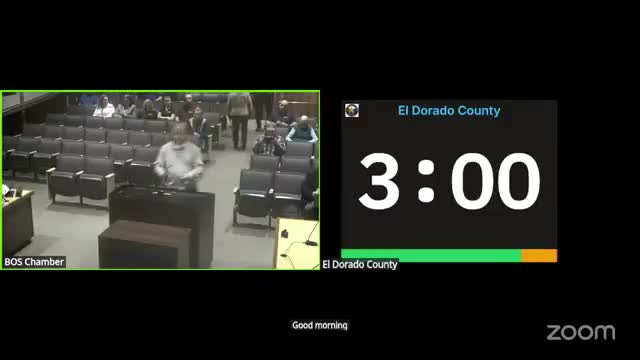
Dozens of residents told the El Dorado County Board of Supervisors on Feb. 10 that a recently adopted policy consolidating public comment into a single block for non‑hearing agenda items undermines the Brown Act and stops the public from responding to information revealed during staff presentations and board deliberations.
Lee Tannenbaum, speaking for the Taxpayers Association of El Dorado County, said a petition of more than 150 residents sought immediate reversal of the change because it forces speakers to address items before hearing staff reports and then forecloses comment once discussion begins. “Under the new policy, public comment on non‑hearing agenda items is consolidated into a single 3 minute period held before staff presentations and before board discussion begins,” Tannenbaum said, adding that the public is “locked out” from responding to clarifications or corrections that arise during deliberations.
Candidate Gina Posey and other speakers echoed that argument, citing Government Code section 54954.2 and court decisions as the basis for saying residents must be allowed to address a legislative body before or during its consideration of an item. Posey told the board the change was adopted as an “experiment” and that staff provided no analysis or options when it was initially agendized.
Supporters of item consolidation have said the change was intended to improve meeting efficiency and reduce repeated testimony on the same points. County staff and board members said they had heard public concerns and would work with staff to consider next steps. The board took no formal roll‑call action to rescind the change at the Feb. 10 meeting.
Why it matters: The Brown Act establishes the timing and manner in which members of the public may address local legislative bodies. Speakers argued that item‑by‑item comment is the norm in most California counties and that allowing comment only in consolidated windows prevents meaningful public participation and can raise legal risk for the county.
What’s next: Several speakers asked the board to direct staff to bring the policy back for earlier consideration or to rescind the consolidation. Chair said staff would be engaged to follow up; no deadline was set at the meeting.
Lee Tannenbaum, speaking for the Taxpayers Association of El Dorado County, said a petition of more than 150 residents sought immediate reversal of the change because it forces speakers to address items before hearing staff reports and then forecloses comment once discussion begins. “Under the new policy, public comment on non‑hearing agenda items is consolidated into a single 3 minute period held before staff presentations and before board discussion begins,” Tannenbaum said, adding that the public is “locked out” from responding to clarifications or corrections that arise during deliberations.
Candidate Gina Posey and other speakers echoed that argument, citing Government Code section 54954.2 and court decisions as the basis for saying residents must be allowed to address a legislative body before or during its consideration of an item. Posey told the board the change was adopted as an “experiment” and that staff provided no analysis or options when it was initially agendized.
Supporters of item consolidation have said the change was intended to improve meeting efficiency and reduce repeated testimony on the same points. County staff and board members said they had heard public concerns and would work with staff to consider next steps. The board took no formal roll‑call action to rescind the change at the Feb. 10 meeting.
Why it matters: The Brown Act establishes the timing and manner in which members of the public may address local legislative bodies. Speakers argued that item‑by‑item comment is the norm in most California counties and that allowing comment only in consolidated windows prevents meaningful public participation and can raise legal risk for the county.
What’s next: Several speakers asked the board to direct staff to bring the policy back for earlier consideration or to rescind the consolidation. Chair said staff would be engaged to follow up; no deadline was set at the meeting.
Don't Miss a Word: See the Full Meeting!
Go beyond summaries. Unlock every video, transcript, and key insight with a Founder Membership.
✓
Get instant access to full meeting videos
✓
Search and clip any phrase from complete transcripts
✓
Receive AI-powered summaries & custom alerts
✓
Enjoy lifetime, unrestricted access to government data
30-day money-back guarantee
