City Council hearing warns arts sector is being priced out as artists, venues decline
February 10, 2026 | New York City Council, New York City, New York County, New York
This article was created by AI summarizing key points discussed. AI makes mistakes, so for full details and context, please refer to the video of the full meeting. Please report any errors so we can fix them. Report an error »
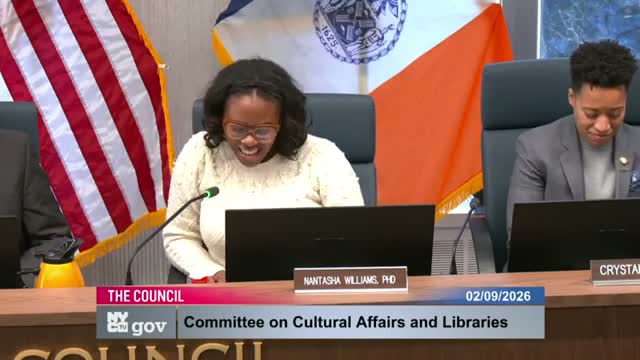
The New York City Council’s Committee on Cultural Affairs, Libraries, and International Intergroup Relations held an oversight hearing on affordability in the arts, where policy researchers, city cultural officials and dozens of cultural organizations warned that rising costs are driving artists and cultural organizations out of the city.
"Since 2019 New York has seen an 18.8% decline in dancers, an 8% drop in actors and a 3% decrease in musicians," Eli Dvorkin, editorial and policy director at the Center for an Urban Future, told the committee, citing the nonprofit’s Creative New York 2025 report. "Taken together, these trends point to a structural shift in the cultural sector that is unlikely to reverse without deliberate policy action."
Dvorkin outlined six priorities he said the City Council could advance: a "city of yes for artists" land‑use package to integrate affordable artist space into rezonings, an artist‑preference standard for affordable housing, a portable benefits pilot for freelancers, pooled insurance purchasing to lower costs for small venues, a biennial artist survey to improve data, and a five‑borough cultural festival to expand paid opportunities.
Council Member Natasha Williams, the committee chair, opened the hearing by reviewing Create NYC — the 2015 cultural plan created under Local Law 46 — and said the committee wanted an update on how the Department of Cultural Affairs (DCLA) had implemented affordability strategies in its 2019 action plan.
Audrey St. Clair, assistant commissioner for program services at DCLA, described agency programs she said already address affordability: the Cultural Development Fund (CDF), which provides grants to about 1,100 cultural nonprofits; Materials for the Arts (MFTA), which distributes free supplies to organizations; and Create in Place, a centralized initiative launched in December 2024 to provide technical assistance and interagency coordination on cultural real estate. "Create in Place represents a meaningful response to affordability pressures," St. Clair said, and cited the Wild Project preservation as an example of the program’s interventions.
But witnesses and council members said DCLA cannot shoulder the problem alone. "This is a cross‑agency affordability challenge and it requires a citywide response," Dvorkin said, arguing that agencies with housing, economic development and procurement authority must be engaged.
Speakers from large cultural institutions and smaller community groups emphasized recurring themes: the loss of small and mid‑sized venues (the report notes nearly 50 arts venues closed since 2020), shrinking employment in multiple creative fields, shrinking grant budgets for long‑standing neighborhood groups, delays in city contract reimbursements, and the difficulty of offering benefits to a freelance workforce.
Unions, teaching artists and service organizations urged policy tools that would stabilize incomes and access to benefits. "Piloting a portable benefits program or a pooled insurance program for smaller organizations could alleviate some of these barriers," said Kimberly Olson of the New York City Arts and Education Roundtable. Representatives of New 42, Carnegie Hall, BAM and others called for sustained operating support and timely payments from city contracting processes.
Advocates also urged legislative fixes. Lucy Sexton of New Yorkers for Culture & Arts called on the council to remove the ban on occupation‑specific housing so that an artist preference could be used without violating existing local law. Several witnesses urged the council to reintroduce and pass a pending artist‑housing bill.
The hearing closed with multiple concrete asks: multi‑year regranting contracts for borough arts councils, dedicated capital and operating investments for small organizations, a city‑backed study on portable benefits, and changes to city leasing rules to allow longer lease terms that can attract private investment for long‑term affordable creative space.
The committee did not take final votes on legislation during the hearing; council members and agency officials said they would continue working with advocates and administration partners on next steps.
"Since 2019 New York has seen an 18.8% decline in dancers, an 8% drop in actors and a 3% decrease in musicians," Eli Dvorkin, editorial and policy director at the Center for an Urban Future, told the committee, citing the nonprofit’s Creative New York 2025 report. "Taken together, these trends point to a structural shift in the cultural sector that is unlikely to reverse without deliberate policy action."
Dvorkin outlined six priorities he said the City Council could advance: a "city of yes for artists" land‑use package to integrate affordable artist space into rezonings, an artist‑preference standard for affordable housing, a portable benefits pilot for freelancers, pooled insurance purchasing to lower costs for small venues, a biennial artist survey to improve data, and a five‑borough cultural festival to expand paid opportunities.
Council Member Natasha Williams, the committee chair, opened the hearing by reviewing Create NYC — the 2015 cultural plan created under Local Law 46 — and said the committee wanted an update on how the Department of Cultural Affairs (DCLA) had implemented affordability strategies in its 2019 action plan.
Audrey St. Clair, assistant commissioner for program services at DCLA, described agency programs she said already address affordability: the Cultural Development Fund (CDF), which provides grants to about 1,100 cultural nonprofits; Materials for the Arts (MFTA), which distributes free supplies to organizations; and Create in Place, a centralized initiative launched in December 2024 to provide technical assistance and interagency coordination on cultural real estate. "Create in Place represents a meaningful response to affordability pressures," St. Clair said, and cited the Wild Project preservation as an example of the program’s interventions.
But witnesses and council members said DCLA cannot shoulder the problem alone. "This is a cross‑agency affordability challenge and it requires a citywide response," Dvorkin said, arguing that agencies with housing, economic development and procurement authority must be engaged.
Speakers from large cultural institutions and smaller community groups emphasized recurring themes: the loss of small and mid‑sized venues (the report notes nearly 50 arts venues closed since 2020), shrinking employment in multiple creative fields, shrinking grant budgets for long‑standing neighborhood groups, delays in city contract reimbursements, and the difficulty of offering benefits to a freelance workforce.
Unions, teaching artists and service organizations urged policy tools that would stabilize incomes and access to benefits. "Piloting a portable benefits program or a pooled insurance program for smaller organizations could alleviate some of these barriers," said Kimberly Olson of the New York City Arts and Education Roundtable. Representatives of New 42, Carnegie Hall, BAM and others called for sustained operating support and timely payments from city contracting processes.
Advocates also urged legislative fixes. Lucy Sexton of New Yorkers for Culture & Arts called on the council to remove the ban on occupation‑specific housing so that an artist preference could be used without violating existing local law. Several witnesses urged the council to reintroduce and pass a pending artist‑housing bill.
The hearing closed with multiple concrete asks: multi‑year regranting contracts for borough arts councils, dedicated capital and operating investments for small organizations, a city‑backed study on portable benefits, and changes to city leasing rules to allow longer lease terms that can attract private investment for long‑term affordable creative space.
The committee did not take final votes on legislation during the hearing; council members and agency officials said they would continue working with advocates and administration partners on next steps.
Don't Miss a Word: See the Full Meeting!
Go beyond summaries. Unlock every video, transcript, and key insight with a Founder Membership.
✓
Get instant access to full meeting videos
✓
Search and clip any phrase from complete transcripts
✓
Receive AI-powered summaries & custom alerts
✓
Enjoy lifetime, unrestricted access to government data
30-day money-back guarantee
