Laurens County council adopts changes to open-space residential rules after lengthy debate; two members oppose
February 10, 2026 | Laurens County, South Carolina
This article was created by AI summarizing key points discussed. AI makes mistakes, so for full details and context, please refer to the video of the full meeting. Please report any errors so we can fix them. Report an error »
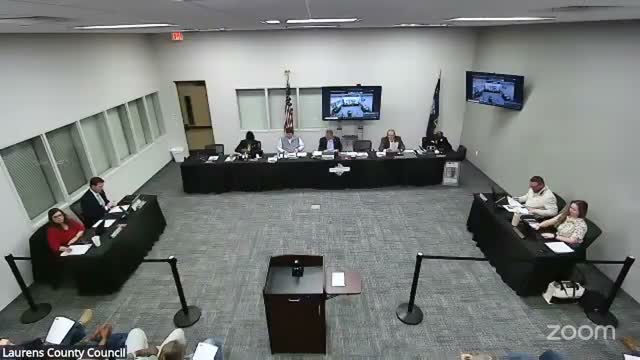
Laurens County Council voted on Feb. 9 to amend its open-space residential development ordinance (Ord. 991), adopting a package of changes that include a revised method for calculating maximum density and a reduction in the minimum required open space from 50% to 40%.
The council opened a public hearing on the ordinance and heard sustained public comment and council discussion about density, buffers and infrastructure. A resident who identified concerns with recent preliminary approvals said the proposed ‘two homes per acre’ language under consideration would allow substantially more housing on several example tracts, increasing vehicle trips and pressure on county roads and emergency services.
County staff recommended against Amendment 11, which would have set maximum density at a flat 2 homes per acre for an entire parcel rather than using the ordinance’s yield-plan approach. Staff told the council that Amendment 11 “would allow buffers and other undevelopable land be counted towards determining max density leading to absurd and dangerous results,” and no affirmative motion was made to adopt it.
The council approved Amendment 12, which clarified the ordinance’s reference to maximum density by using the existing yield-plan approach (a cap linked to the number of homes allowed under a conventional build plus a small percentage). Amendment 13, proposing to set setbacks by reference to the International Building Code rather than fixed side-yard dimensions, received staff opposition and no action.
Council member Filson’s Amendment 14 — which reduced required minimum open space from 50% (40% natural, 10% common) to 40% (30% natural, 10% common) — was adopted after debate over tradeoffs between encouraging development and protecting rural infrastructure and neighborhood character. Two council members, Yance and Carroll, were recorded in opposition to Amendment 14 and the final third-reading vote on Ord. 991.
The ordinance as amended retains a yield-plan-based cap on units (staff emphasized the cap does not increase allowed unit counts by default) while changing open-space composition and some definitional language. Council members speaking in favor said the package is a compromise that balances growth and flexibility; opponents warned the changes could increase density in areas with scarce infrastructure.
The council concluded third reading and approved Ord. 991 with the adopted amendments; the ordinance will be implemented according to the county’s normal ordinance schedule unless additional administrative steps are required.
The council’s actions on Ord. 991 followed a broader agenda that included multiple industrial project approvals and administrative items. The council adjourned after routine comments and acknowledgements.
The ordinance package and staff packet were presented during the hearing; council directed that the record reflect the amendments considered and the votes taken.
The council opened a public hearing on the ordinance and heard sustained public comment and council discussion about density, buffers and infrastructure. A resident who identified concerns with recent preliminary approvals said the proposed ‘two homes per acre’ language under consideration would allow substantially more housing on several example tracts, increasing vehicle trips and pressure on county roads and emergency services.
County staff recommended against Amendment 11, which would have set maximum density at a flat 2 homes per acre for an entire parcel rather than using the ordinance’s yield-plan approach. Staff told the council that Amendment 11 “would allow buffers and other undevelopable land be counted towards determining max density leading to absurd and dangerous results,” and no affirmative motion was made to adopt it.
The council approved Amendment 12, which clarified the ordinance’s reference to maximum density by using the existing yield-plan approach (a cap linked to the number of homes allowed under a conventional build plus a small percentage). Amendment 13, proposing to set setbacks by reference to the International Building Code rather than fixed side-yard dimensions, received staff opposition and no action.
Council member Filson’s Amendment 14 — which reduced required minimum open space from 50% (40% natural, 10% common) to 40% (30% natural, 10% common) — was adopted after debate over tradeoffs between encouraging development and protecting rural infrastructure and neighborhood character. Two council members, Yance and Carroll, were recorded in opposition to Amendment 14 and the final third-reading vote on Ord. 991.
The ordinance as amended retains a yield-plan-based cap on units (staff emphasized the cap does not increase allowed unit counts by default) while changing open-space composition and some definitional language. Council members speaking in favor said the package is a compromise that balances growth and flexibility; opponents warned the changes could increase density in areas with scarce infrastructure.
The council concluded third reading and approved Ord. 991 with the adopted amendments; the ordinance will be implemented according to the county’s normal ordinance schedule unless additional administrative steps are required.
The council’s actions on Ord. 991 followed a broader agenda that included multiple industrial project approvals and administrative items. The council adjourned after routine comments and acknowledgements.
The ordinance package and staff packet were presented during the hearing; council directed that the record reflect the amendments considered and the votes taken.
Don't Miss a Word: See the Full Meeting!
Go beyond summaries. Unlock every video, transcript, and key insight with a Founder Membership.
✓
Get instant access to full meeting videos
✓
Search and clip any phrase from complete transcripts
✓
Receive AI-powered summaries & custom alerts
✓
Enjoy lifetime, unrestricted access to government data
30-day money-back guarantee
