City manager warns of $16M wastewater liability and low reserves; council urged to plan for 2–3 year fiscal stress
February 10, 2026 | East Point, Fulton County, Georgia
This article was created by AI summarizing key points discussed. AI makes mistakes, so for full details and context, please refer to the video of the full meeting. Please report any errors so we can fix them. Report an error »
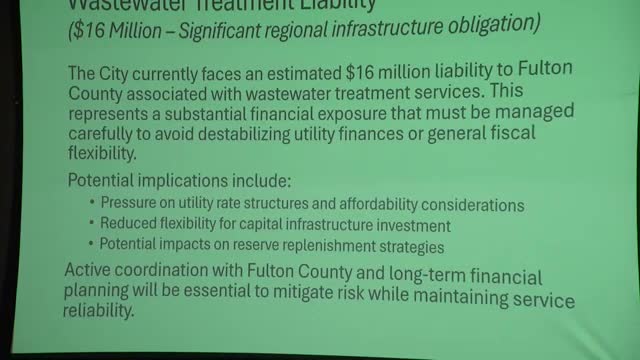
City Manager Jones presented a fiscal outlook focused on internal fiscal pressures that could affect service reliability and long-term capital planning.
Jones said the city faces a substantial liability tied to regional wastewater treatment: the most recent audit identified a $16,000,000 wastewater-treatment exposure connected to Fulton County services. Jones told council that the city will need coordinated long-term financial planning with Fulton County and an explicit strategy in the upcoming utility-rate study.
On reserves, Jones said the recommended healthy balance for the water enterprise is about $8.5 million, and recent projections show the city roughly $2.5 million below that benchmark. “That creates some concerns,” he said, noting that strained reserves reduce the ability to flatten rate impacts and to address emergency infrastructure needs.
Jones also described operational headwinds: closing vacancies has improved continuity but increased personnel costs, and infrastructure inflation is raising project budgets (he cited a recreation-center cost increase of about $10 million for a project not yet under construction). He urged the council to identify benchmark peer cities and said staff would provide more comparable data and one-on-one briefings with council members.
Council members pressed for more granular numbers and earlier distribution of presentation materials so members could review the data before meetings. Several asked staff to supply a multi-year fiscal impact analysis and the demographic counts needed to model policy choices, such as the proposed change to senior homestead exemptions.
Jones said staff will return with more detailed fund-balance and comparative analytics and urged the council to prioritize reserve replenishment and to expect budget tradeoffs in the coming fiscal cycles.
Jones said the city faces a substantial liability tied to regional wastewater treatment: the most recent audit identified a $16,000,000 wastewater-treatment exposure connected to Fulton County services. Jones told council that the city will need coordinated long-term financial planning with Fulton County and an explicit strategy in the upcoming utility-rate study.
On reserves, Jones said the recommended healthy balance for the water enterprise is about $8.5 million, and recent projections show the city roughly $2.5 million below that benchmark. “That creates some concerns,” he said, noting that strained reserves reduce the ability to flatten rate impacts and to address emergency infrastructure needs.
Jones also described operational headwinds: closing vacancies has improved continuity but increased personnel costs, and infrastructure inflation is raising project budgets (he cited a recreation-center cost increase of about $10 million for a project not yet under construction). He urged the council to identify benchmark peer cities and said staff would provide more comparable data and one-on-one briefings with council members.
Council members pressed for more granular numbers and earlier distribution of presentation materials so members could review the data before meetings. Several asked staff to supply a multi-year fiscal impact analysis and the demographic counts needed to model policy choices, such as the proposed change to senior homestead exemptions.
Jones said staff will return with more detailed fund-balance and comparative analytics and urged the council to prioritize reserve replenishment and to expect budget tradeoffs in the coming fiscal cycles.
Don't Miss a Word: See the Full Meeting!
Go beyond summaries. Unlock every video, transcript, and key insight with a Founder Membership.
✓
Get instant access to full meeting videos
✓
Search and clip any phrase from complete transcripts
✓
Receive AI-powered summaries & custom alerts
✓
Enjoy lifetime, unrestricted access to government data
30-day money-back guarantee
