Saint Charles County Council Hears Hours of Comment on Proposed Trailside Farm Community Improvement District
February 10, 2026 | St. Charles County, Missouri
This article was created by AI summarizing key points discussed. AI makes mistakes, so for full details and context, please refer to the video of the full meeting. Please report any errors so we can fix them. Report an error »
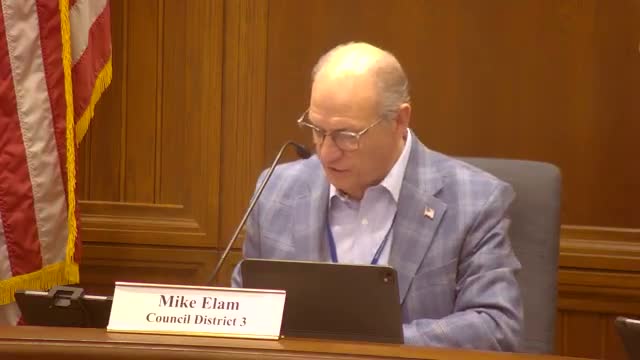
The Saint Charles County Council on Feb. 9 received more than two hours of public testimony and presentations on a proposed Community Improvement District (CID) for the Trailside Farm subdivision, and introduced an ordinance (Bill 54-65) to create the district.
Supporters said the CID would fund road and utility improvements, parks and trails and a new connection of Perry Kate Boulevard to Highway N that would provide a second access point near nearby churches and schools. “There are no taxes that will be imposed by the CID. The special assessments on the property owners within the district, but no other county residents are going to pay any taxes,” said Drew Weber, attorney for the applicant, who supplied the petition’s cost estimate of $6,855,274 and said the CID petition includes a five-year plan and exhibits describing the assessments.
Opponents said the tool is inappropriate for primarily residential development and raised questions about notice and long-term cost to homeowners. “This is highway robbery,” said Arnie Denoff, a county public advocate, who alleged the petition would shift costs onto future residents and cited chapter 67 of the Missouri Revised Statutes. Denoff argued the project could require assessments he characterized as totaling "about $6,860,000" and said the petition’s financing could translate into assessments he summarized as "$1,550 per year on each residential lot and $5,000 per year for any commercial lots," and warned of potential litigation if statutory notice requirements were not met.
Several nearby landowners and representatives of Emmanuel Lutheran Church and School urged approval because of safety and utility benefits. Becky Hoskins, chair of Emmanuel’s board, told the council the project would reduce a single, difficult entrance for more than 550 students and allow access to a new signal at Perry Kate Boulevard. Tom Ruff, who also spoke for the church, said connecting to public utilities would replace an existing large septic system that he called a concern for the congregation.
During a question-and-answer period, council members pressed the applicant on whether the project included tax-increment financing, Chapter 100 incentives or a sales tax; Weber said none applied and reiterated that assessments would apply only to property owners inside the CID and would be recorded so buyers would see them in title work. Weber also said the proposed district was designed to finance specific improvements and that the current proposal reduces the originally approved dwelling units from 531 to 470.
Council members clarified procedure and terminology during the meeting. Councilman Swanson stressed that the CID assessment functions as an additional assessment on future property owners rather than a countywide tax: “This is an assessment just like an HOA,” he said, adding that the recording process would make the obligation visible to purchasers.
The council closed the public hearing and placed Bill 54-65, the ordinance to create the Trailside Farm Community Improvement District, on the agenda for introduction; the body did not take a final vote on the ordinance at this meeting. Separate measures on the consent agenda and two bills for final passage — including a supplemental agreement for the Josephville Road project and a cybersecurity grant appropriation — were approved by the council during the same session. Another bill (Bill 54-66) concerning supplemental appropriations to the Transportation Planning Fund was moved and tabled.
Next steps: the CID ordinance was introduced; staff and council will receive additional questions and may return the bill for further debate and a roll-call vote at a future meeting. The public record for the CID petition and the exhibits referenced by the applicant are on file with county staff, and council members said assessments would be recorded with deeds and disclosed in title work for purchasers.
Supporters said the CID would fund road and utility improvements, parks and trails and a new connection of Perry Kate Boulevard to Highway N that would provide a second access point near nearby churches and schools. “There are no taxes that will be imposed by the CID. The special assessments on the property owners within the district, but no other county residents are going to pay any taxes,” said Drew Weber, attorney for the applicant, who supplied the petition’s cost estimate of $6,855,274 and said the CID petition includes a five-year plan and exhibits describing the assessments.
Opponents said the tool is inappropriate for primarily residential development and raised questions about notice and long-term cost to homeowners. “This is highway robbery,” said Arnie Denoff, a county public advocate, who alleged the petition would shift costs onto future residents and cited chapter 67 of the Missouri Revised Statutes. Denoff argued the project could require assessments he characterized as totaling "about $6,860,000" and said the petition’s financing could translate into assessments he summarized as "$1,550 per year on each residential lot and $5,000 per year for any commercial lots," and warned of potential litigation if statutory notice requirements were not met.
Several nearby landowners and representatives of Emmanuel Lutheran Church and School urged approval because of safety and utility benefits. Becky Hoskins, chair of Emmanuel’s board, told the council the project would reduce a single, difficult entrance for more than 550 students and allow access to a new signal at Perry Kate Boulevard. Tom Ruff, who also spoke for the church, said connecting to public utilities would replace an existing large septic system that he called a concern for the congregation.
During a question-and-answer period, council members pressed the applicant on whether the project included tax-increment financing, Chapter 100 incentives or a sales tax; Weber said none applied and reiterated that assessments would apply only to property owners inside the CID and would be recorded so buyers would see them in title work. Weber also said the proposed district was designed to finance specific improvements and that the current proposal reduces the originally approved dwelling units from 531 to 470.
Council members clarified procedure and terminology during the meeting. Councilman Swanson stressed that the CID assessment functions as an additional assessment on future property owners rather than a countywide tax: “This is an assessment just like an HOA,” he said, adding that the recording process would make the obligation visible to purchasers.
The council closed the public hearing and placed Bill 54-65, the ordinance to create the Trailside Farm Community Improvement District, on the agenda for introduction; the body did not take a final vote on the ordinance at this meeting. Separate measures on the consent agenda and two bills for final passage — including a supplemental agreement for the Josephville Road project and a cybersecurity grant appropriation — were approved by the council during the same session. Another bill (Bill 54-66) concerning supplemental appropriations to the Transportation Planning Fund was moved and tabled.
Next steps: the CID ordinance was introduced; staff and council will receive additional questions and may return the bill for further debate and a roll-call vote at a future meeting. The public record for the CID petition and the exhibits referenced by the applicant are on file with county staff, and council members said assessments would be recorded with deeds and disclosed in title work for purchasers.
View the Full Meeting & All Its Details
This article offers just a summary. Unlock complete video, transcripts, and insights as a Founder Member.
✓
Watch full, unedited meeting videos
✓
Search every word spoken in unlimited transcripts
✓
AI summaries & real-time alerts (all government levels)
✓
Permanent access to expanding government content
30-day money-back guarantee
