Commission debates routing dark-fiber revenue to commissioners' fund, asks staff to revise cash-reserve policy
February 10, 2026 | Marshfield, Wood County, Wisconsin
This article was created by AI summarizing key points discussed. AI makes mistakes, so for full details and context, please refer to the video of the full meeting. Please report any errors so we can fix them. Report an error »
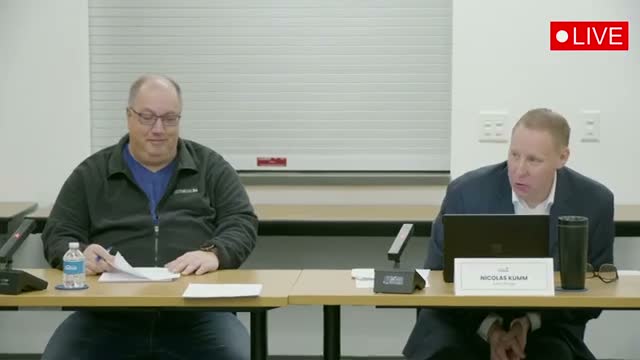
At a regular commission meeting, members spent the bulk of their discussion reviewing a revised cash-reserve policy for the commission's unregulated dark-fiber utility and debating whether the utility should feed a commission-designated discretionary fund.
Commissioner Natasha proposed adding a new subsection (referred to in the meeting as “3.6”) that would explicitly direct a percentage of annual profits and a portion of interest on cash balances into a commissioners' fund for community projects. “I would propose that we add … 3.6 that would say funding the commissioner’s fund,” Natasha said during the discussion.
Staff responded that the draft contains an "overfunded" bullet intended to provide flexibility to move excess dollars but acknowledged the language was intentionally broad so future commissions would not be constrained by overly prescriptive rules. “The third bullet there was meant to cover that to provide you flexibility, yet not be too detailed to hamstring future commissions,” staff said.
Members debated the practical scale of any transfer. Commissioners used a simplified example in which gross revenue might be roughly $200,000 and directing 10% of that would produce about $20,000 a year into a fund; staff and commissioners noted it would take multiple years at that pace to assemble sums large enough for major grants. One commissioner pointed to existing balances in related funds as part of the rationale for occasional community grants.
A second, related exchange focused on the draft’s reserve metric. Staff explained the 1.5× replacement-value target was derived from a consultant’s replacement-value estimate and a chosen multiplier; several commissioners questioned whether 1.5× was necessary and suggested narrowing or changing the "on track" band that determines when excess is available. “I’m not saying it’s 2.2 — it could be whatever you decide. That’s how we came up with that number,” staff explained about the 1.5 metric.
Commissioners also discussed alternatives to seeding a standing fund, including approving transfers ad hoc when project requests appear or embedding a small fee into future rates (compared to a parks-and-rec-style fee). Some favored flexibility to support worthwhile community projects without permanently constraining future commissions.
Because the draft policy aims to balance market assessment and cash-reserve considerations, staff said they would rework the document to explicitly reference the commission-designated/economic development fund, strengthen the market-assessment language, and return the revised policy at the next meeting.
Next steps: staff will rewrite the draft to reflect commissioners’ comments and return it to the commission at its next scheduled meeting for further deliberation.
Commissioner Natasha proposed adding a new subsection (referred to in the meeting as “3.6”) that would explicitly direct a percentage of annual profits and a portion of interest on cash balances into a commissioners' fund for community projects. “I would propose that we add … 3.6 that would say funding the commissioner’s fund,” Natasha said during the discussion.
Staff responded that the draft contains an "overfunded" bullet intended to provide flexibility to move excess dollars but acknowledged the language was intentionally broad so future commissions would not be constrained by overly prescriptive rules. “The third bullet there was meant to cover that to provide you flexibility, yet not be too detailed to hamstring future commissions,” staff said.
Members debated the practical scale of any transfer. Commissioners used a simplified example in which gross revenue might be roughly $200,000 and directing 10% of that would produce about $20,000 a year into a fund; staff and commissioners noted it would take multiple years at that pace to assemble sums large enough for major grants. One commissioner pointed to existing balances in related funds as part of the rationale for occasional community grants.
A second, related exchange focused on the draft’s reserve metric. Staff explained the 1.5× replacement-value target was derived from a consultant’s replacement-value estimate and a chosen multiplier; several commissioners questioned whether 1.5× was necessary and suggested narrowing or changing the "on track" band that determines when excess is available. “I’m not saying it’s 2.2 — it could be whatever you decide. That’s how we came up with that number,” staff explained about the 1.5 metric.
Commissioners also discussed alternatives to seeding a standing fund, including approving transfers ad hoc when project requests appear or embedding a small fee into future rates (compared to a parks-and-rec-style fee). Some favored flexibility to support worthwhile community projects without permanently constraining future commissions.
Because the draft policy aims to balance market assessment and cash-reserve considerations, staff said they would rework the document to explicitly reference the commission-designated/economic development fund, strengthen the market-assessment language, and return the revised policy at the next meeting.
Next steps: staff will rewrite the draft to reflect commissioners’ comments and return it to the commission at its next scheduled meeting for further deliberation.
Don't Miss a Word: See the Full Meeting!
Go beyond summaries. Unlock every video, transcript, and key insight with a Founder Membership.
✓
Get instant access to full meeting videos
✓
Search and clip any phrase from complete transcripts
✓
Receive AI-powered summaries & custom alerts
✓
Enjoy lifetime, unrestricted access to government data
30-day money-back guarantee
