Cookeville council approves first reading allowing subdivision of commercial units, members press for shared-parking protections
February 09, 2026 | Cookeville City, Putnam County, Tennessee
This article was created by AI summarizing key points discussed. AI makes mistakes, so for full details and context, please refer to the video of the full meeting. Please report any errors so we can fix them. Report an error »
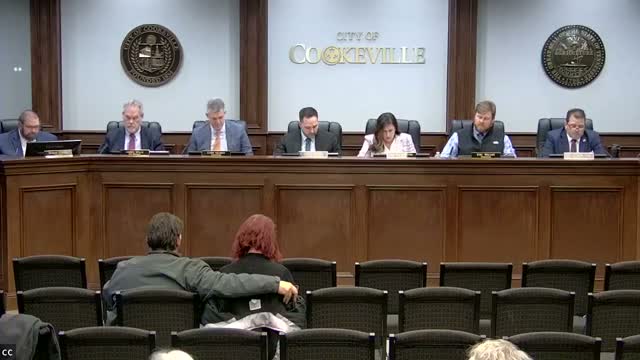
Cookeville City Council voted 5-0 on first reading Jan. 15 to amend the city’s zoning code so certain commercial developments may be subdivided into individually owned lots, a change planners said would allow individual ownership within commercial centers while preserving parking and maintenance controls.
Planning Division staff member Mister Ward told the council the amendment would permit subdivision in CL (local commercial) and CG (general commercial) districts for newly built commercial developments that meet zoning and building-code requirements and that receive a certificate of occupancy after Jan. 1, 2026. "These modifications would restrict commercial subdivisions on individual lots to newly built commercial developments designed and constructed to meet the zoning and building code requirements and receiving a certificate of occupancy after 01/01/2026," Ward said.
Ward said the ordinance also requires a commercial owners association (COA) agreement to remain in place after final plat recording, and that shared-parking arrangements and parking easements must be shown on the final plat when shared parking is used. Council discussion centered on how parking would be handled if individual units own parcels without guaranteed access to shared spaces. An unidentified council member (S7) argued that "shared parking is a necessity in order to maximize the space," warning that without shared agreements "you're gonna park on the street" and that individual ownership could leave other lots overparked.
Planning staff responded that the proposed amendment already includes provisions to address shared parking and that parking requirements continue to be set based on use during the planning review process. Ward explained the city applies formulaic parking standards — for example, one space per 250 square feet for certain uses — and that uses such as restaurants are calculated by occupancy. He said applicable covenants and easements would be required at final platting to govern shared parking where used.
The council opened the public hearing on the ordinance and heard no speakers. Vice Mayor Eldridge moved to advance the ordinance on first reading; the motion was seconded by Councilman Gilbert and carried on a 5-0 vote.
Why it matters: allowing subdivision of commercial units could create more opportunities for individual ownership of retail and office spaces, changing how commercial centers are managed and maintained. The COA and parking-easement requirements are intended to protect shared infrastructure and public access.
The council approved the amendment on first reading after the public hearing and will follow the city's ordinance process for subsequent consideration.
Planning Division staff member Mister Ward told the council the amendment would permit subdivision in CL (local commercial) and CG (general commercial) districts for newly built commercial developments that meet zoning and building-code requirements and that receive a certificate of occupancy after Jan. 1, 2026. "These modifications would restrict commercial subdivisions on individual lots to newly built commercial developments designed and constructed to meet the zoning and building code requirements and receiving a certificate of occupancy after 01/01/2026," Ward said.
Ward said the ordinance also requires a commercial owners association (COA) agreement to remain in place after final plat recording, and that shared-parking arrangements and parking easements must be shown on the final plat when shared parking is used. Council discussion centered on how parking would be handled if individual units own parcels without guaranteed access to shared spaces. An unidentified council member (S7) argued that "shared parking is a necessity in order to maximize the space," warning that without shared agreements "you're gonna park on the street" and that individual ownership could leave other lots overparked.
Planning staff responded that the proposed amendment already includes provisions to address shared parking and that parking requirements continue to be set based on use during the planning review process. Ward explained the city applies formulaic parking standards — for example, one space per 250 square feet for certain uses — and that uses such as restaurants are calculated by occupancy. He said applicable covenants and easements would be required at final platting to govern shared parking where used.
The council opened the public hearing on the ordinance and heard no speakers. Vice Mayor Eldridge moved to advance the ordinance on first reading; the motion was seconded by Councilman Gilbert and carried on a 5-0 vote.
Why it matters: allowing subdivision of commercial units could create more opportunities for individual ownership of retail and office spaces, changing how commercial centers are managed and maintained. The COA and parking-easement requirements are intended to protect shared infrastructure and public access.
The council approved the amendment on first reading after the public hearing and will follow the city's ordinance process for subsequent consideration.
View the Full Meeting & All Its Details
This article offers just a summary. Unlock complete video, transcripts, and insights as a Founder Member.
✓
Watch full, unedited meeting videos
✓
Search every word spoken in unlimited transcripts
✓
AI summaries & real-time alerts (all government levels)
✓
Permanent access to expanding government content
30-day money-back guarantee
