Committee advances multiple bills in package aimed at Mexican wolf and predator policy despite strong opposition from conservation groups
February 09, 2026 | 2026 Legislature Arizona, Arizona
This article was created by AI summarizing key points discussed. AI makes mistakes, so for full details and context, please refer to the video of the full meeting. Please report any errors so we can fix them. Report an error »
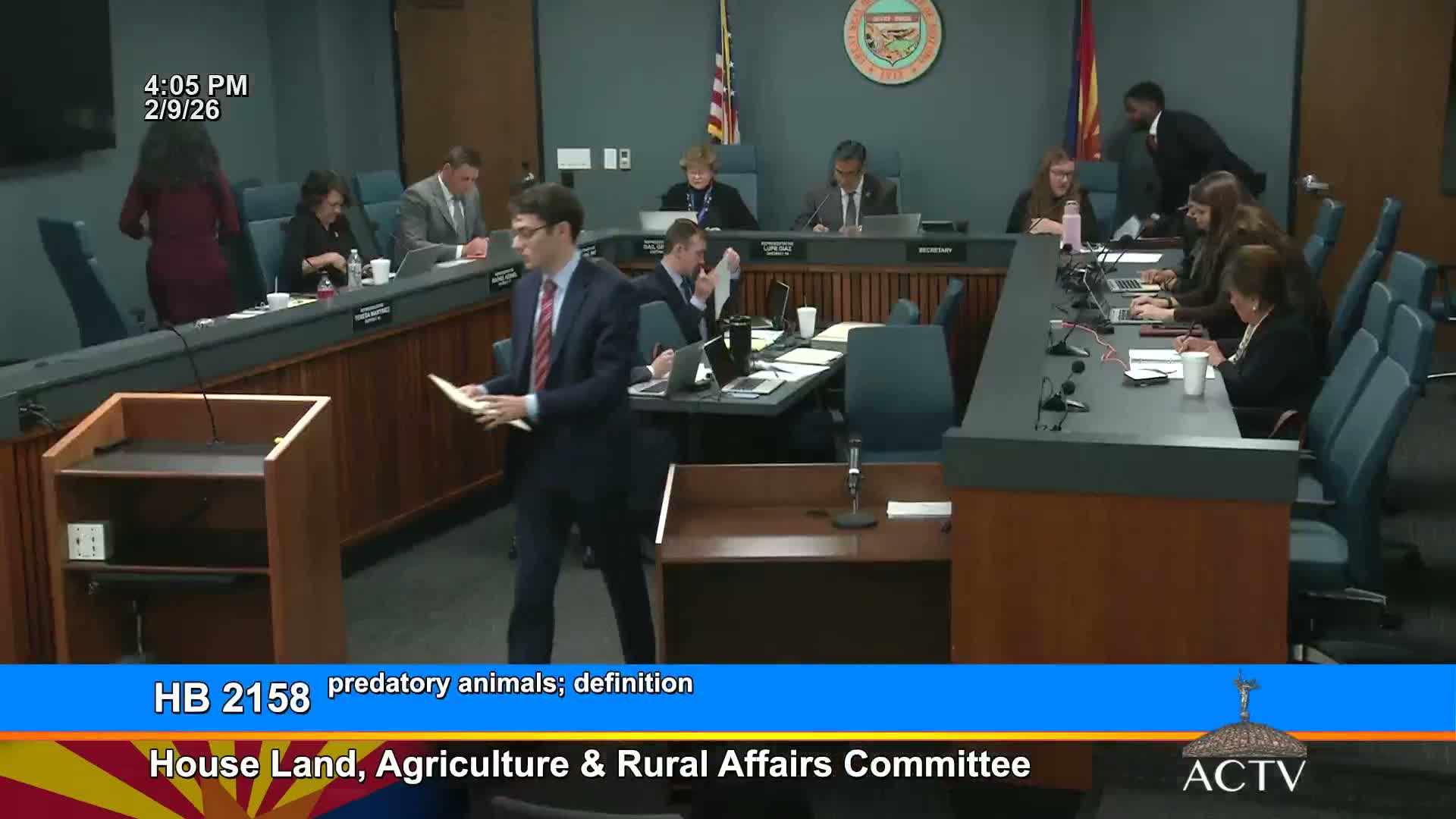
A coordinated set of bills and a concurrent memorial dealing with predator classification and Mexican gray wolf policy moved out of the Arizona House Rural Affairs Committee on Feb. 4 after lengthened debate and extensive public testimony.
HB 21-58 would expand the definition of "predatory animals" to include bears, cougars/mountain lions and wolves; HB 21-59 would authorize Game and Fish to issue limited landowner permits and create a voluntary incentive program allowing humane trapping for Mexican wolves under certain circumstances; HB 27-87 would prohibit state agencies and employees from using state personnel or funds to enforce, administer, or cooperate with the federal Mexican wolf reintroduction program; and House Concurrent Memorial 2006 urges Congress and federal agencies to reform the Endangered Species Act and related federal rules.
Arizona Game and Fish staff and commissioners repeatedly told the committee they prefer science-based management and warned the measures would remove tools — such as tagging, permit data collection and quota-based harvest — that the department uses to monitor populations and defend hunting programs in the face of litigation. Jim DeVos of Game and Fish said classifying big-game species as "predatory" removes permit mechanisms that provide data critical to population management and to defending hunting in courts and public debate.
Conservation and animal-welfare groups urged rejection. Brianna Romero of Humane World for Animals told members HB 21-58 and HB 21-59 would strip safeguards, lower penalties for illegal killing, and could fuel unregulated methods such as traps, snares and aerial gunning. "With only 124 Mexican gray wolves in Arizona, every individual matters," Romero said about HB 21-87 testimony. Sandy Barr of the Sierra Club warned HB 27-87 would prevent collaboration, reduce information-sharing, and jeopardize recovery.
Proponents — including several ranchers and supporters in rural districts — framed the package as protecting livestock, property and state sovereignty. Sponsors emphasized the bills are designed to give landowners tools to protect animals and livelihoods and to put pressure on the federal government to assume full financial and operational responsibility for wolf recovery.
The committee returned all four measures with a do-pass recommendation by committee votes (each recorded in the actions list). Members' explanations of vote reflected a balance between protecting ranching livelihoods and concerns about constitutionality, science-based management and potential litigation. Next steps: the measures proceed to the House rules and possible floor debate where legal and technical amendments may be considered.
HB 21-58 would expand the definition of "predatory animals" to include bears, cougars/mountain lions and wolves; HB 21-59 would authorize Game and Fish to issue limited landowner permits and create a voluntary incentive program allowing humane trapping for Mexican wolves under certain circumstances; HB 27-87 would prohibit state agencies and employees from using state personnel or funds to enforce, administer, or cooperate with the federal Mexican wolf reintroduction program; and House Concurrent Memorial 2006 urges Congress and federal agencies to reform the Endangered Species Act and related federal rules.
Arizona Game and Fish staff and commissioners repeatedly told the committee they prefer science-based management and warned the measures would remove tools — such as tagging, permit data collection and quota-based harvest — that the department uses to monitor populations and defend hunting programs in the face of litigation. Jim DeVos of Game and Fish said classifying big-game species as "predatory" removes permit mechanisms that provide data critical to population management and to defending hunting in courts and public debate.
Conservation and animal-welfare groups urged rejection. Brianna Romero of Humane World for Animals told members HB 21-58 and HB 21-59 would strip safeguards, lower penalties for illegal killing, and could fuel unregulated methods such as traps, snares and aerial gunning. "With only 124 Mexican gray wolves in Arizona, every individual matters," Romero said about HB 21-87 testimony. Sandy Barr of the Sierra Club warned HB 27-87 would prevent collaboration, reduce information-sharing, and jeopardize recovery.
Proponents — including several ranchers and supporters in rural districts — framed the package as protecting livestock, property and state sovereignty. Sponsors emphasized the bills are designed to give landowners tools to protect animals and livelihoods and to put pressure on the federal government to assume full financial and operational responsibility for wolf recovery.
The committee returned all four measures with a do-pass recommendation by committee votes (each recorded in the actions list). Members' explanations of vote reflected a balance between protecting ranching livelihoods and concerns about constitutionality, science-based management and potential litigation. Next steps: the measures proceed to the House rules and possible floor debate where legal and technical amendments may be considered.
View the Full Meeting & All Its Details
This article offers just a summary. Unlock complete video, transcripts, and insights as a Founder Member.
✓
Watch full, unedited meeting videos
✓
Search every word spoken in unlimited transcripts
✓
AI summaries & real-time alerts (all government levels)
✓
Permanent access to expanding government content
30-day money-back guarantee
