State agencies report tightened OHV grant controls, reclaimed funds and increased law‑enforcement grants
February 09, 2026 | 2026 Legislature Arizona, Arizona
This article was created by AI summarizing key points discussed. AI makes mistakes, so for full details and context, please refer to the video of the full meeting. Please report any errors so we can fix them. Report an error »
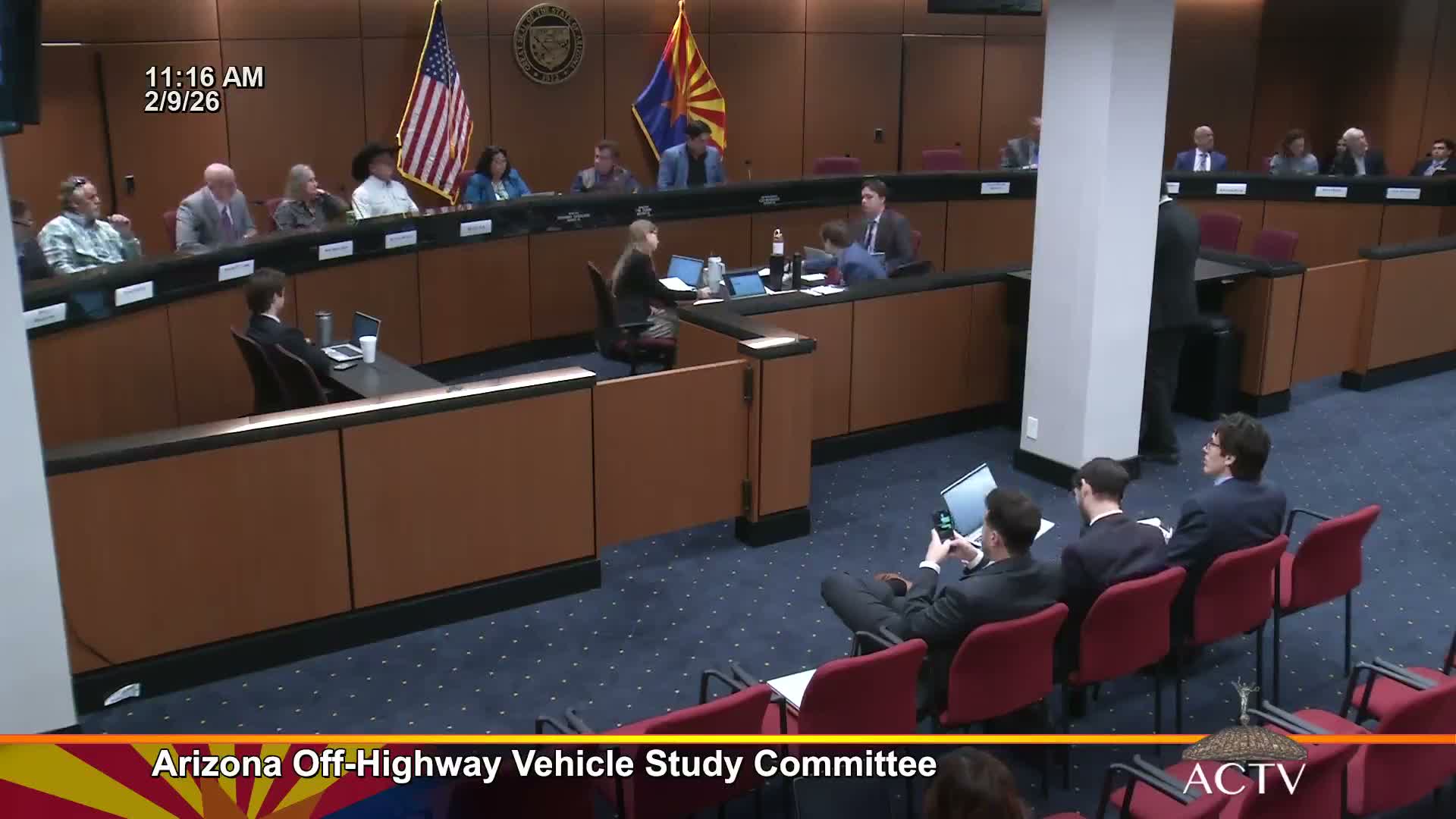
Arizona State Parks, the Arizona Game and Fish Department and the Arizona Department of Transportation told the Off‑Highway Vehicle Study Committee that the state has tightened grant oversight and redirected funds to mitigation, enforcement and education.
An unidentified State Parks presenter summarized the Off Highway Vehicle (OHV) fund distribution and current balances, saying 60% of fund revenue is allocated to State Parks, 35% to Game and Fish and 5% to the State Land Department. The presenter said the fund shows roughly $7.7 million in unspent cash, about $12 million in awarded grant obligations and $2.3 million in pending awards, leaving about $3.57 million available after obligations. The presenter said closeout of older awards reclaimed nearly $4 million for re‑distribution and that the board increased delegated emergency project authority from $100,000 to $250,000 to speed small mitigation and trail maintenance work.
"We closed out 95 grants…that brought back almost $4,000,000 back into the fund to be redispersed out in future grants," the presenter said (presentation by an identified parks representative in the record).
Game and Fish’s OHV law enforcement coordinator, Micah White, told the committee the agency has focused on education and enforcement since the new decal and course requirements took effect. White said ADOT has recorded about 149,000 course completions and Game and Fish about 15,000 over the last 13 months, and officers report improved behavior and substantially higher helmet compliance among youth.
White also said law enforcement demand has risen and that the department removed a match requirement for law‑enforcement grants, increased per‑grant authorization up to $750,000 (multi‑year) and currently has 51% of open grants earmarked for law enforcement to support staffing, hours and equipment. "51% of all the currently open grants right now are law enforcement," White said.
The agencies described a newly formed mitigation working group that includes federal and state land managers, private landowners and nongovernmental organizations to accelerate mitigation projects when federal partners lack staff to apply for grants. State Parks noted examples of recent mitigation projects: fencing and signage in Bulldog Canyon (Tonto National Forest) ~ $90,000, Charleau Gap trail/crossing work ~ $100,000, and a Windmill Mountain Ranch mitigation project pending tribal consultation (~$155,000).
ADOT’s title and registration specialist, Reline Whitmer, explained the decal eligibility rules and the required safety course (a 10‑minute video and 20 multiple‑choice items with a no‑fail format). Whitmer said the department and Game and Fish share course completion data and that ADOT has issued 137 of the new 30‑day nonresident OHV permits since the permit’s September effective date.
Committee members pressed the agencies for more precise data on how many machines would be affected by a proposed weight‑class change, how much revenue a different weight threshold would move between funds, and what level of recurring funding would be required to stabilize multi‑year law enforcement hires. Agencies said those numbers will require VIN and registration research and a fiscal‑note analysis.
The meeting concluded with committee members urging continued stakeholder collaboration and with a formal committee recommendation to study and evaluate the appropriate funding levels and strategies to secure mitigation, enforcement and education resources.
An unidentified State Parks presenter summarized the Off Highway Vehicle (OHV) fund distribution and current balances, saying 60% of fund revenue is allocated to State Parks, 35% to Game and Fish and 5% to the State Land Department. The presenter said the fund shows roughly $7.7 million in unspent cash, about $12 million in awarded grant obligations and $2.3 million in pending awards, leaving about $3.57 million available after obligations. The presenter said closeout of older awards reclaimed nearly $4 million for re‑distribution and that the board increased delegated emergency project authority from $100,000 to $250,000 to speed small mitigation and trail maintenance work.
"We closed out 95 grants…that brought back almost $4,000,000 back into the fund to be redispersed out in future grants," the presenter said (presentation by an identified parks representative in the record).
Game and Fish’s OHV law enforcement coordinator, Micah White, told the committee the agency has focused on education and enforcement since the new decal and course requirements took effect. White said ADOT has recorded about 149,000 course completions and Game and Fish about 15,000 over the last 13 months, and officers report improved behavior and substantially higher helmet compliance among youth.
White also said law enforcement demand has risen and that the department removed a match requirement for law‑enforcement grants, increased per‑grant authorization up to $750,000 (multi‑year) and currently has 51% of open grants earmarked for law enforcement to support staffing, hours and equipment. "51% of all the currently open grants right now are law enforcement," White said.
The agencies described a newly formed mitigation working group that includes federal and state land managers, private landowners and nongovernmental organizations to accelerate mitigation projects when federal partners lack staff to apply for grants. State Parks noted examples of recent mitigation projects: fencing and signage in Bulldog Canyon (Tonto National Forest) ~ $90,000, Charleau Gap trail/crossing work ~ $100,000, and a Windmill Mountain Ranch mitigation project pending tribal consultation (~$155,000).
ADOT’s title and registration specialist, Reline Whitmer, explained the decal eligibility rules and the required safety course (a 10‑minute video and 20 multiple‑choice items with a no‑fail format). Whitmer said the department and Game and Fish share course completion data and that ADOT has issued 137 of the new 30‑day nonresident OHV permits since the permit’s September effective date.
Committee members pressed the agencies for more precise data on how many machines would be affected by a proposed weight‑class change, how much revenue a different weight threshold would move between funds, and what level of recurring funding would be required to stabilize multi‑year law enforcement hires. Agencies said those numbers will require VIN and registration research and a fiscal‑note analysis.
The meeting concluded with committee members urging continued stakeholder collaboration and with a formal committee recommendation to study and evaluate the appropriate funding levels and strategies to secure mitigation, enforcement and education resources.
View the Full Meeting & All Its Details
This article offers just a summary. Unlock complete video, transcripts, and insights as a Founder Member.
✓
Watch full, unedited meeting videos
✓
Search every word spoken in unlimited transcripts
✓
AI summaries & real-time alerts (all government levels)
✓
Permanent access to expanding government content
30-day money-back guarantee
