Manufacturers back raising OHV cutoff to 3,500 lb; committee asks for fiscal and unit counts before action
February 09, 2026 | 2026 Legislature Arizona, Arizona
This article was created by AI summarizing key points discussed. AI makes mistakes, so for full details and context, please refer to the video of the full meeting. Please report any errors so we can fix them. Report an error »
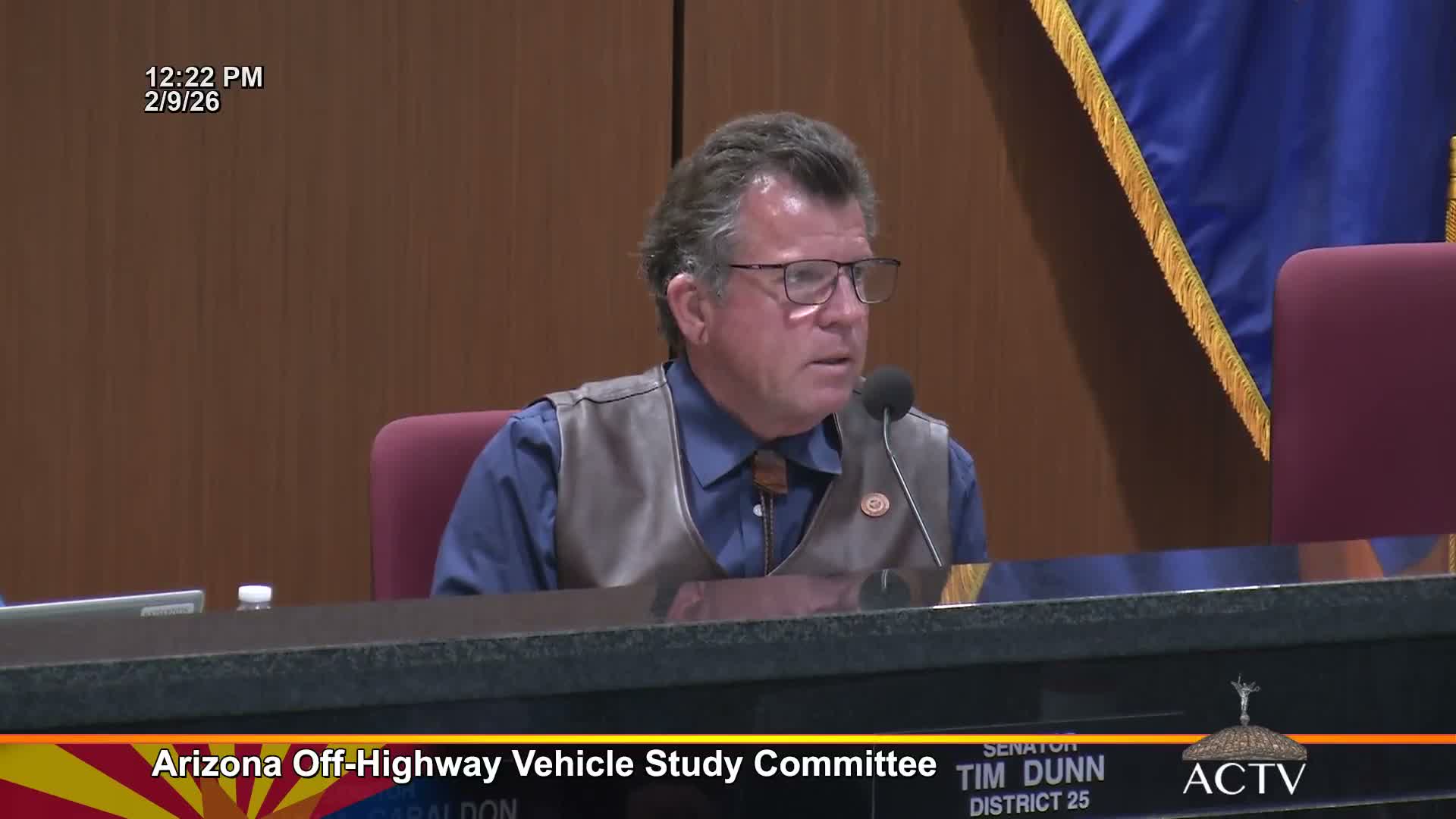
Senate staff and industry representatives told the Off‑Highway Vehicle Study Committee that market trends—and rider demand for enclosed, electrified and more capable machines—are increasing OHV weights, and that many states use a 3,500‑pound cutoff. Committee members pressed for data on how many machines would qualify under a new threshold and asked ADOT to prepare a fiscal note before the legislature advances any change.
Skylin Flores, a legislative research intern for the Senate Natural Resources Committee, summarized relevant bills and the current proposal: SB1576 (2024) established new safety and age requirements and education proof; SB1517 (2025) created a 30‑day temporary registration for out‑of‑state titled OHVs; and SB1519 (introduced in 2026) would raise the maximum unladen weight for OHV classification from 2,500 to 3,500 pounds and add a fourth class that carries a reduced vehicle license tax set at 50% of the full VLT for that mid‑weight band.
"The bill in its current form would increase the maximum unladen weight from 2,500 pounds to 3,500 pounds," Flores said, laying out the proposed reclassification and the potential fee structure.
Industry witnesses said the change reflects a national market shift. David (Polaris product development) said manufacturers are responding to consumer demand for comfort, safety and electric capability, which add weight. JR Birx of Polaris said the industry has discussed 3,500 lb as an appropriate ceiling and that manufacturers are willing to partner on funding and mitigation projects. "If that means that that $25 OHV decal captures everything...that money can then go back into those places where it can do the most good," Birx said, urging cooperation to channel funds to mitigation and enforcement.
Committee members repeatedly asked ADOT whether the department can quantify how many vehicles would move into the OHV class under a 3,500 lb threshold and what revenue impact a change would cause; ADOT’s Reline Whitmer said VIN lookups and research would be necessary and that staff would request a fiscal note. Several members said park and enforcement needs might justify some fee or structural change but emphasized that data must precede policy.
Public testimony from the Arizona Farm Bureau urged balanced investments in mitigation, enforcement and education to protect private lands. After public comment the committee approved a motion directing staff to evaluate appropriate funding levels and strategies to secure resources for mitigation and enforcement; the motion passed by voice vote.
The meeting adjourned with members asking staff to return with a fiscal note and precise counts of affected vehicles to inform future committee recommendations and votes.
Skylin Flores, a legislative research intern for the Senate Natural Resources Committee, summarized relevant bills and the current proposal: SB1576 (2024) established new safety and age requirements and education proof; SB1517 (2025) created a 30‑day temporary registration for out‑of‑state titled OHVs; and SB1519 (introduced in 2026) would raise the maximum unladen weight for OHV classification from 2,500 to 3,500 pounds and add a fourth class that carries a reduced vehicle license tax set at 50% of the full VLT for that mid‑weight band.
"The bill in its current form would increase the maximum unladen weight from 2,500 pounds to 3,500 pounds," Flores said, laying out the proposed reclassification and the potential fee structure.
Industry witnesses said the change reflects a national market shift. David (Polaris product development) said manufacturers are responding to consumer demand for comfort, safety and electric capability, which add weight. JR Birx of Polaris said the industry has discussed 3,500 lb as an appropriate ceiling and that manufacturers are willing to partner on funding and mitigation projects. "If that means that that $25 OHV decal captures everything...that money can then go back into those places where it can do the most good," Birx said, urging cooperation to channel funds to mitigation and enforcement.
Committee members repeatedly asked ADOT whether the department can quantify how many vehicles would move into the OHV class under a 3,500 lb threshold and what revenue impact a change would cause; ADOT’s Reline Whitmer said VIN lookups and research would be necessary and that staff would request a fiscal note. Several members said park and enforcement needs might justify some fee or structural change but emphasized that data must precede policy.
Public testimony from the Arizona Farm Bureau urged balanced investments in mitigation, enforcement and education to protect private lands. After public comment the committee approved a motion directing staff to evaluate appropriate funding levels and strategies to secure resources for mitigation and enforcement; the motion passed by voice vote.
The meeting adjourned with members asking staff to return with a fiscal note and precise counts of affected vehicles to inform future committee recommendations and votes.
Don't Miss a Word: See the Full Meeting!
Go beyond summaries. Unlock every video, transcript, and key insight with a Founder Membership.
✓
Get instant access to full meeting videos
✓
Search and clip any phrase from complete transcripts
✓
Receive AI-powered summaries & custom alerts
✓
Enjoy lifetime, unrestricted access to government data
30-day money-back guarantee
