Witness tells House panel sanctuary permit rules hinder undersea cable routing; urges committee to advance H.R. 261
February 09, 2026 | House Committee on Natural Resources, House Committee, House, Legislative, Federal
This article was created by AI summarizing key points discussed. AI makes mistakes, so for full details and context, please refer to the video of the full meeting. Please report any errors so we can fix them. Report an error »
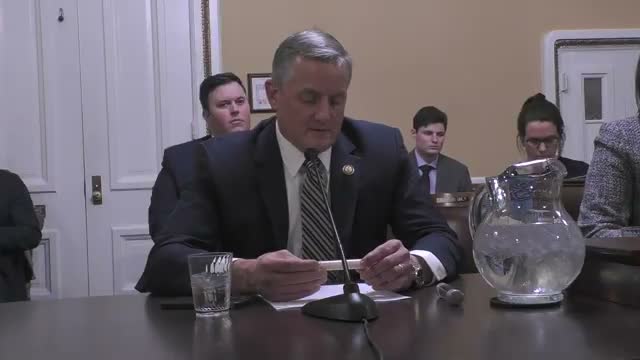
A witness testifying before the House Committee on Natural Resources told Chairwoman Fox that current special-use permit requirements for National Marine Sanctuaries have created barriers to routing undersea telecommunications cables and urged the committee to advance H.R. 261 to streamline permitting.
The witness described the physical construction of undersea cables — an outer protective layer surrounding multiple fiber strands — and demonstrated a section of cable in the hearing. The witness said the example shown contains eight fiber strands and told the committee that manufacturers can make cables with up to 40 strands. "These cables are small, yet they carry approximately 95% of the global Internet traffic," the witness said. The witness characterized those fibers as carrying very large volumes of data and said demand for capacity will only increase.
The testimony emphasized the regulatory environment. The witness said numerous environmental statutes within the committee’s jurisdiction apply to undersea cable projects, including the National Environmental Policy Act, the Endangered Species Act, the Marine Mammal Protection Act, the Coastal Zone Management Act, and the Magnuson-Stevens Act. The witness stated that the required permitting processes are thorough and intended to protect marine resources but argued that an additional special-use permit under the National Marine Sanctuaries Act has proved "unworkable." According to the witness, the typical lifespan of an undersea cable is roughly 25 years, while the speaker said the special-use permit term is only five years, a mismatch the witness said has deterred new cable routes through sanctuaries.
The witness further asserted that, as a result, national marine sanctuaries have become de facto no-go zones for new cable routes in some regions, which has concentrated landing areas and, the witness said, increased risks to infrastructure. The witness described H.R. 261 as the proposed remedy: it would prohibit the Secretary of Commerce from requiring a special-use permit under the National Marine Sanctuaries Act for an undersea cable route through a sanctuary if the applicant has an applicable license or permit already in effect. The witness said the bill also would eliminate the five-year timeline for special-use permits for other activities in sanctuaries.
The witness urged the committee to report an appropriate rule so H.R. 261 could be considered on the House floor and invoked an executive order addressing reductions in anti-competitive regulatory barriers. The transcript does not record any committee response or subsequent action during this hearing.
The committee's next procedural step to advance H.R. 261 was not recorded in the provided testimony.
The witness described the physical construction of undersea cables — an outer protective layer surrounding multiple fiber strands — and demonstrated a section of cable in the hearing. The witness said the example shown contains eight fiber strands and told the committee that manufacturers can make cables with up to 40 strands. "These cables are small, yet they carry approximately 95% of the global Internet traffic," the witness said. The witness characterized those fibers as carrying very large volumes of data and said demand for capacity will only increase.
The testimony emphasized the regulatory environment. The witness said numerous environmental statutes within the committee’s jurisdiction apply to undersea cable projects, including the National Environmental Policy Act, the Endangered Species Act, the Marine Mammal Protection Act, the Coastal Zone Management Act, and the Magnuson-Stevens Act. The witness stated that the required permitting processes are thorough and intended to protect marine resources but argued that an additional special-use permit under the National Marine Sanctuaries Act has proved "unworkable." According to the witness, the typical lifespan of an undersea cable is roughly 25 years, while the speaker said the special-use permit term is only five years, a mismatch the witness said has deterred new cable routes through sanctuaries.
The witness further asserted that, as a result, national marine sanctuaries have become de facto no-go zones for new cable routes in some regions, which has concentrated landing areas and, the witness said, increased risks to infrastructure. The witness described H.R. 261 as the proposed remedy: it would prohibit the Secretary of Commerce from requiring a special-use permit under the National Marine Sanctuaries Act for an undersea cable route through a sanctuary if the applicant has an applicable license or permit already in effect. The witness said the bill also would eliminate the five-year timeline for special-use permits for other activities in sanctuaries.
The witness urged the committee to report an appropriate rule so H.R. 261 could be considered on the House floor and invoked an executive order addressing reductions in anti-competitive regulatory barriers. The transcript does not record any committee response or subsequent action during this hearing.
The committee's next procedural step to advance H.R. 261 was not recorded in the provided testimony.
Don't Miss a Word: See the Full Meeting!
Go beyond summaries. Unlock every video, transcript, and key insight with a Founder Membership.
✓
Get instant access to full meeting videos
✓
Search and clip any phrase from complete transcripts
✓
Receive AI-powered summaries & custom alerts
✓
Enjoy lifetime, unrestricted access to government data
30-day money-back guarantee
