House passes changes to civil definitions for harm and emergency evaluation amid debate over safeguards for people with disabilities
February 09, 2026 | House of Representatives, Committees, Legislative, New Mexico
This article was created by AI summarizing key points discussed. AI makes mistakes, so for full details and context, please refer to the video of the full meeting. Please report any errors so we can fix them. Report an error »
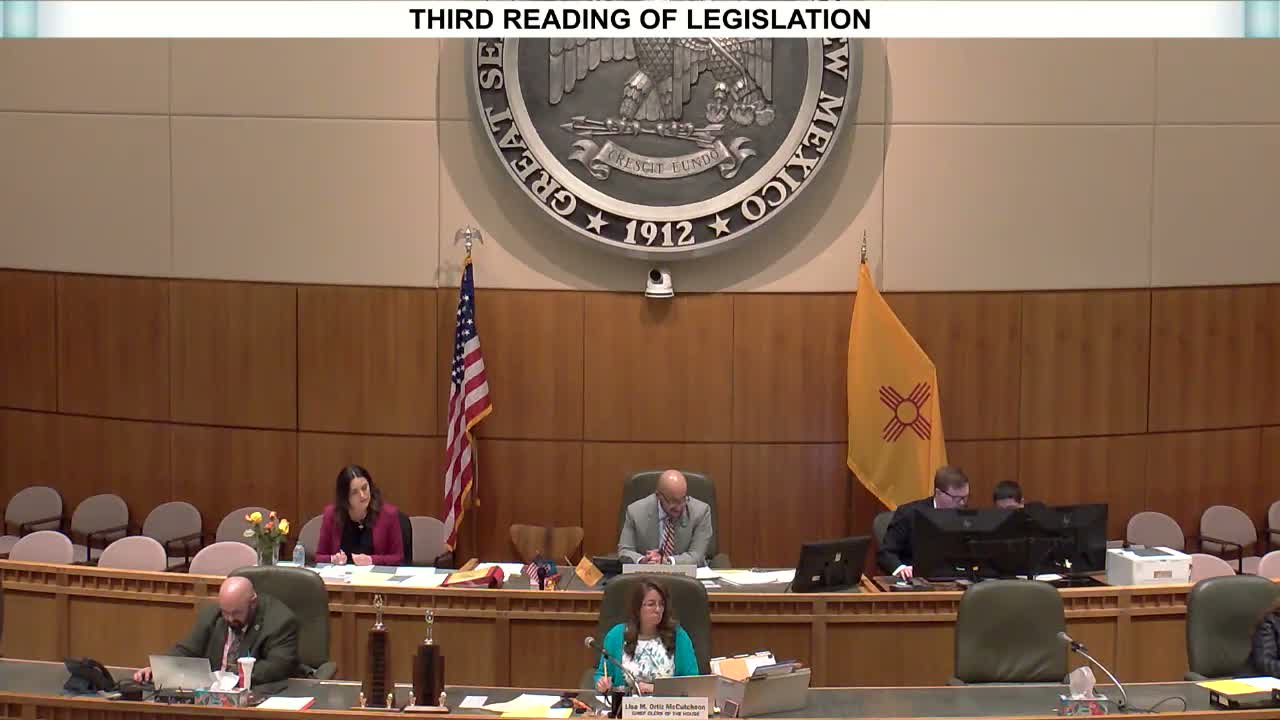
The House approved Senate Bill 3, as twice amended, a civil‑procedure bill that updates the legal definitions and processes used when a person may pose an imminent risk of harm to themselves or to others. Proponents said the changes bring the involuntary‑commitment framework into line with contemporary clinical practice and provide clearer guidance for first responders and behavioral‑health providers.
Floor debate spanned several hours. Members asked detailed questions about how evaluations gather data (hospital records, family interviews and other collateral sources), how HIPAA‑protected information might be handled in court‑directed evaluations, and how local infrastructure and short‑term holding facilities would be used. One floor amendment sought to clarify that law enforcement officers and certain first responders may triage a person at the scene and route them to hospital care rather than detention; another amendment addressing how people with developmental disabilities are treated in the process was offered and much debated before the sponsor withdrew it.
Disability advocates and several members expressed concern about the risk of civil commitments being used inappropriately for people with developmental or intellectual disabilities. Supporters said the bill includes notice and court‑review steps, and that Department of Health rules and built‑in evaluation processes would limit misuse. Members also pressed for clarity on definitions such as 'short‑term portal' (the bill uses the term to describe an observation or evaluation site); the sponsor said implementing rules would address many of the operational questions raised on the floor.
Senate Bill 3 passed on final passage by a recorded vote of 58 AYE, 10 NAY. Supporters described it as a carefully drafted civil statute to improve public safety and access to care; critics asked the sponsor and DOH for specific rule language and implementation plans to avoid unintended consequences for vulnerable populations.
Votes at a glance: Senate Bill 3 (as twice amended) — Final passage, 58 AYE, 10 NAY.
Floor debate spanned several hours. Members asked detailed questions about how evaluations gather data (hospital records, family interviews and other collateral sources), how HIPAA‑protected information might be handled in court‑directed evaluations, and how local infrastructure and short‑term holding facilities would be used. One floor amendment sought to clarify that law enforcement officers and certain first responders may triage a person at the scene and route them to hospital care rather than detention; another amendment addressing how people with developmental disabilities are treated in the process was offered and much debated before the sponsor withdrew it.
Disability advocates and several members expressed concern about the risk of civil commitments being used inappropriately for people with developmental or intellectual disabilities. Supporters said the bill includes notice and court‑review steps, and that Department of Health rules and built‑in evaluation processes would limit misuse. Members also pressed for clarity on definitions such as 'short‑term portal' (the bill uses the term to describe an observation or evaluation site); the sponsor said implementing rules would address many of the operational questions raised on the floor.
Senate Bill 3 passed on final passage by a recorded vote of 58 AYE, 10 NAY. Supporters described it as a carefully drafted civil statute to improve public safety and access to care; critics asked the sponsor and DOH for specific rule language and implementation plans to avoid unintended consequences for vulnerable populations.
Votes at a glance: Senate Bill 3 (as twice amended) — Final passage, 58 AYE, 10 NAY.
View the Full Meeting & All Its Details
This article offers just a summary. Unlock complete video, transcripts, and insights as a Founder Member.
✓
Watch full, unedited meeting videos
✓
Search every word spoken in unlimited transcripts
✓
AI summaries & real-time alerts (all government levels)
✓
Permanent access to expanding government content
30-day money-back guarantee
