Senate panel tables drone bill after extensive debate over definitions, exemptions and civil penalties
February 09, 2026 | Senate, Committees, Legislative, New Mexico
This article was created by AI summarizing key points discussed. AI makes mistakes, so for full details and context, please refer to the video of the full meeting. Please report any errors so we can fix them. Report an error »
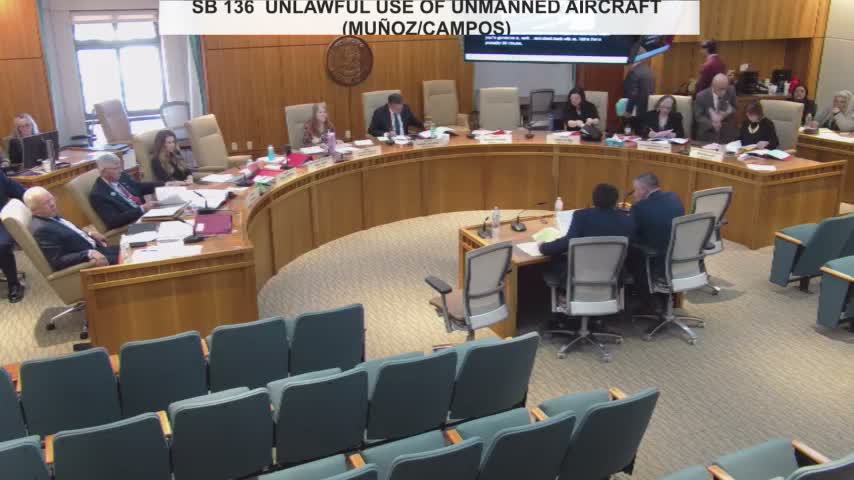
The Senate Judiciary Committee on Monday tabled Senate Bill 136 after extended questioning about the bill’s definitions and broad exemptions.
Sponsor Senator Munoz described the measure as narrowly tailored to protect critical infrastructure — including power, water and pipelines — and to close enforcement gaps that law enforcement says make drone-related investigations difficult. "Drones are increasingly capable of high resolution imaging and long distance surveillance and are increasingly accessible," he said.
Rob Hart of the governor’s organized crime commission and a New Mexico State Police representative testified that criminal organizations have weaponized and repurposed off-the-shelf drones for surveillance, logistics and even to drop contraband; they said the lack of a state criminal statute complicates investigations and prosecutions.
Committee members raised multiple drafting concerns: the bill does not define core terms such as "surveillance," "proximity" or what counts as "critical infrastructure" in all contexts; exemptions for commercial, academic and community-based users could be overly broad; and some members warned the measure could unintentionally criminalize benign or accidental conduct, impede journalistic activity or restrict citizens’ ability to record government officials.
Sponsor and supporters defended leaving certain matters to the courts or factfinder and said the bill uses existing statutory definitions where appropriate. After debate, a substitute motion to table the bill prevailed on a roll-call vote and the panel tabled SB136 for further work.
What happens next: sponsor and committee members said the measure needs narrower definitions and clearer exemptions; the tabling vote halts immediate progress and leaves time for reworking the draft.
Sponsor Senator Munoz described the measure as narrowly tailored to protect critical infrastructure — including power, water and pipelines — and to close enforcement gaps that law enforcement says make drone-related investigations difficult. "Drones are increasingly capable of high resolution imaging and long distance surveillance and are increasingly accessible," he said.
Rob Hart of the governor’s organized crime commission and a New Mexico State Police representative testified that criminal organizations have weaponized and repurposed off-the-shelf drones for surveillance, logistics and even to drop contraband; they said the lack of a state criminal statute complicates investigations and prosecutions.
Committee members raised multiple drafting concerns: the bill does not define core terms such as "surveillance," "proximity" or what counts as "critical infrastructure" in all contexts; exemptions for commercial, academic and community-based users could be overly broad; and some members warned the measure could unintentionally criminalize benign or accidental conduct, impede journalistic activity or restrict citizens’ ability to record government officials.
Sponsor and supporters defended leaving certain matters to the courts or factfinder and said the bill uses existing statutory definitions where appropriate. After debate, a substitute motion to table the bill prevailed on a roll-call vote and the panel tabled SB136 for further work.
What happens next: sponsor and committee members said the measure needs narrower definitions and clearer exemptions; the tabling vote halts immediate progress and leaves time for reworking the draft.
Don't Miss a Word: See the Full Meeting!
Go beyond summaries. Unlock every video, transcript, and key insight with a Founder Membership.
✓
Get instant access to full meeting videos
✓
Search and clip any phrase from complete transcripts
✓
Receive AI-powered summaries & custom alerts
✓
Enjoy lifetime, unrestricted access to government data
30-day money-back guarantee
