Officials warn Chesapeake Bay restoration faces funding, timeline challenges as settlement and trust fund shifts reshape strategy
February 10, 2026 | Education, Business and Administration Subcommittee, Budget and Taxation Committee, SENATE, SENATE, Committees, Legislative, Maryland
This article was created by AI summarizing key points discussed. AI makes mistakes, so for full details and context, please refer to the video of the full meeting. Please report any errors so we can fix them. Report an error »
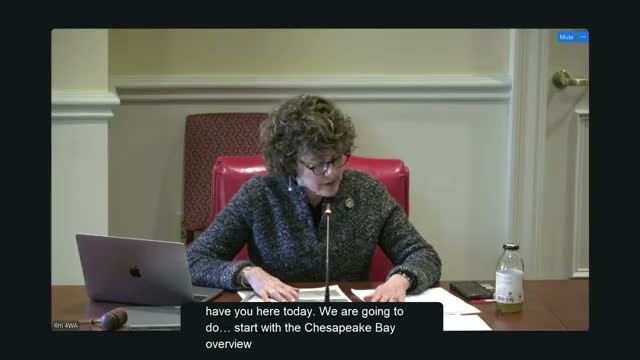
The Education, Business and Administration Subcommittee heard a Department of Legislative Services briefing Feb. 9 on Chesapeake Bay restoration funding and policy, with analyst Andrew Gray outlining shortfalls and state leaders describing steps to track progress under a revised Bay agreement.
Gray told the subcommittee the Chesapeake Bay restoration effort remains anchored in the total maximum daily load (TMDL) framework and watershed implementation plans, but Maryland and the partnership of Bay states are unlikely to meet the 2025 restoration goals. "It looks like the 2025 restoration goal will not be met by Maryland nor by the other states as a whole either," Gray said, citing continued high nitrogen loadings from upstream states.
Why it matters: committee members were presented with numbers showing shifts in available restoration funding and a narrower trust-fund balance, alongside a new regional agreement that pushes some outcomes to 2040 but introduces annual metrics intended to improve accountability.
Gray summarized fiscal changes between FY26 and FY27, saying overall Chesapeake Bay restoration funding shows a $113,200,000 change driven by a roughly $48.6 million increase tied to transfer-tax estimates and specific program adjustments, a $27.6 million rise in special funds for State Highway Administration TMDL compliance, a $23.6 million increase for the Maryland Department of the Environment (including a $27.2 million water-quality loan fund item), and about $8 million more in general obligation bond support for agricultural cost-share programs.
He warned the Chesapeake and Atlantic Coastal Bays 2010 Trust Fund has been used for operating expenses, reducing its balance from $47.4 million in 2025 to a projected $23.2 million in 2027, and noted a $12.7 million decrease in the Department of Natural Resources competitive grant program between those years. "Its expenses from the fund are above its revenues," Gray said, adding that DLS recommends committee narrative asking agencies for clearer reporting on how fund sources are used for whole-watershed purposes.
On policy, Gray described the revised watershed agreement ratified Dec. 2, 2025, which consolidates goals and extends the restoration target to 2040 while adding interim, annual metrics to track progress. He also highlighted the Bay Restoration Fund's long-running role in upgrading wastewater treatment plants: 66 of 67 major plants have been upgraded, and the administration proposes keeping the current fee ("around $60 per year for most households") to support an estimated $900 million of additional plant work to reach an ideal 2.85 mg/L nitrogen standard.
Conowingo Dam settlement: Gray and state officials described the Conowingo Dam relicensing and settlement as a material development. The revised agreement, announced Oct. 2, 2025, increased the previously reported $200 million settlement to $340 million. Gray said about $87.6 million is identified for water-quality resilience work and roughly $18.7 million remains committed to dredging; Maryland has contributed $25 million to implementation efforts. DLS asked the administration to clarify how settlement funds are being allocated, the other states' contributions, and the status of Federal Energy Regulatory Commission (FERC) review.
State officials'response: Secretary Kurtz of the Department of Natural Resources said Maryland has consolidated the Bay agreement into four goals and 21 outcomes with yearly metrics tied to interim 2033 benchmarks. "When we think about this new target date of 2040, that does not mean that we are pushing all the work out to 2040," Kurtz said, adding the annual metrics are intended to allow earlier detection of shortfalls. Kurtz and other agency leaders defended Maryland's funding architecture and programs (including LEAF and the Bay Restoration Fund) as providing a framework to pursue the 2040 target while acknowledging implementation tweaks may be needed.
On federal supports, Kurtz said the Bay program's top-line funding is relatively stable but cuts to operating budgets at agencies such as NOAA and USGS will reduce technical support and monitoring capacity, prompting expanded state and local monitoring partnerships.
What comes next: DLS recommended agencies provide committee narrative and reports clarifying historical and projected Chesapeake Bay spending, the administration's plan for reaching the 2040 outcomes, and updates on Conowingo RFP responses and FERC actions. Officials said some Conowingo-related cleanup and modeling work is already underway and that FERC action is expected next year.
The subcommittee did not take formal action at the hearing; DLS will follow up with committee-narrative recommendations and requested briefings.
Gray told the subcommittee the Chesapeake Bay restoration effort remains anchored in the total maximum daily load (TMDL) framework and watershed implementation plans, but Maryland and the partnership of Bay states are unlikely to meet the 2025 restoration goals. "It looks like the 2025 restoration goal will not be met by Maryland nor by the other states as a whole either," Gray said, citing continued high nitrogen loadings from upstream states.
Why it matters: committee members were presented with numbers showing shifts in available restoration funding and a narrower trust-fund balance, alongside a new regional agreement that pushes some outcomes to 2040 but introduces annual metrics intended to improve accountability.
Gray summarized fiscal changes between FY26 and FY27, saying overall Chesapeake Bay restoration funding shows a $113,200,000 change driven by a roughly $48.6 million increase tied to transfer-tax estimates and specific program adjustments, a $27.6 million rise in special funds for State Highway Administration TMDL compliance, a $23.6 million increase for the Maryland Department of the Environment (including a $27.2 million water-quality loan fund item), and about $8 million more in general obligation bond support for agricultural cost-share programs.
He warned the Chesapeake and Atlantic Coastal Bays 2010 Trust Fund has been used for operating expenses, reducing its balance from $47.4 million in 2025 to a projected $23.2 million in 2027, and noted a $12.7 million decrease in the Department of Natural Resources competitive grant program between those years. "Its expenses from the fund are above its revenues," Gray said, adding that DLS recommends committee narrative asking agencies for clearer reporting on how fund sources are used for whole-watershed purposes.
On policy, Gray described the revised watershed agreement ratified Dec. 2, 2025, which consolidates goals and extends the restoration target to 2040 while adding interim, annual metrics to track progress. He also highlighted the Bay Restoration Fund's long-running role in upgrading wastewater treatment plants: 66 of 67 major plants have been upgraded, and the administration proposes keeping the current fee ("around $60 per year for most households") to support an estimated $900 million of additional plant work to reach an ideal 2.85 mg/L nitrogen standard.
Conowingo Dam settlement: Gray and state officials described the Conowingo Dam relicensing and settlement as a material development. The revised agreement, announced Oct. 2, 2025, increased the previously reported $200 million settlement to $340 million. Gray said about $87.6 million is identified for water-quality resilience work and roughly $18.7 million remains committed to dredging; Maryland has contributed $25 million to implementation efforts. DLS asked the administration to clarify how settlement funds are being allocated, the other states' contributions, and the status of Federal Energy Regulatory Commission (FERC) review.
State officials'response: Secretary Kurtz of the Department of Natural Resources said Maryland has consolidated the Bay agreement into four goals and 21 outcomes with yearly metrics tied to interim 2033 benchmarks. "When we think about this new target date of 2040, that does not mean that we are pushing all the work out to 2040," Kurtz said, adding the annual metrics are intended to allow earlier detection of shortfalls. Kurtz and other agency leaders defended Maryland's funding architecture and programs (including LEAF and the Bay Restoration Fund) as providing a framework to pursue the 2040 target while acknowledging implementation tweaks may be needed.
On federal supports, Kurtz said the Bay program's top-line funding is relatively stable but cuts to operating budgets at agencies such as NOAA and USGS will reduce technical support and monitoring capacity, prompting expanded state and local monitoring partnerships.
What comes next: DLS recommended agencies provide committee narrative and reports clarifying historical and projected Chesapeake Bay spending, the administration's plan for reaching the 2040 outcomes, and updates on Conowingo RFP responses and FERC actions. Officials said some Conowingo-related cleanup and modeling work is already underway and that FERC action is expected next year.
The subcommittee did not take formal action at the hearing; DLS will follow up with committee-narrative recommendations and requested briefings.
Don't Miss a Word: See the Full Meeting!
Go beyond summaries. Unlock every video, transcript, and key insight with a Founder Membership.
✓
Get instant access to full meeting videos
✓
Search and clip any phrase from complete transcripts
✓
Receive AI-powered summaries & custom alerts
✓
Enjoy lifetime, unrestricted access to government data
30-day money-back guarantee
