Planning Department presents FY27 allowance; heritage and humanities groups urge restored grant funding
February 10, 2026 | Education, Business and Administration Subcommittee, Budget and Taxation Committee, SENATE, SENATE, Committees, Legislative, Maryland
This article was created by AI summarizing key points discussed. AI makes mistakes, so for full details and context, please refer to the video of the full meeting. Please report any errors so we can fix them. Report an error »
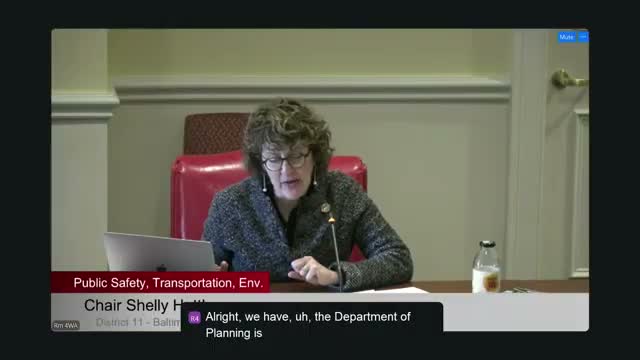
The subcommittee also heard the Department of Planning's FY27 allowance and received public testimony from heritage-area and humanities advocates.
Elizabeth Bridal, the DLS analyst covering the department, said the FY27 allowance for the Department of Planning decreases slightly to just under $49 million, with identified deficiencies of about $1.3 million for salary and fringe, and a proposed $250,000 non-capital grant program for African American heritage preservation established by chapter 622 of 2025. Bridal described buffer provisions that would reduce mandated funding for the small commercial historic revitalization tax credit from $2 million to $500,000 annually and recommended clearer contingent language on several fund swaps and contingent appropriations.
Rebecca Flores, Secretary of the Maryland Department of Planning, concurred with the DLS recommendations and described a prototype permitting-dashboard pilot developed with DoIT focused on place-based and infrastructure projects. Flores said the coordinated permitting-review council established by the governor's December 2024 executive order has produced a discovery process and a pilot dashboard that will inform a report of preliminary findings due to the governor by July 1.
Flores described the dashboard as a prototype tracking system to help agencies understand permitting processes for infrastructure projects, and said the prototype is already in use for pilot projects. She said the work focuses on regulatory, process and technology recommendations and aims to phase changes over time.
Public testimony: several witnesses urged continued or increased support for heritage-area grants and the Maryland Humanities grant program. Lucille Walker, executive director of the Southern Maryland National Heritage Area, thanked the governor for level funding and noted that program-open-space support for the Maryland Heritage Area Authority provides a dedicated restricted line that is not part of the general fund; she said $6 million statewide returns more than $5.1 million directly to local projects but that requests exceed available funds.
Elizabeth Anderson Comer, president of the Catoctin Furnace Historical Society, and Lindsey Baker, CEO of Maryland Humanities, described the impact of SHINE and general operating grants. Baker said the Maryland Humanities general operating support program funded $1 million in FY25 but was reduced to $250,000 in FY26, cutting the share of applicants served from nearly all qualified groups to roughly one in four; she urged restoring funding so small community organizations can continue operating and serving residents.
Next steps: DLS said it will follow up on contingent funding clarifications and the department will provide additional detail as requested. The hearing concluded after public testimony.
Elizabeth Bridal, the DLS analyst covering the department, said the FY27 allowance for the Department of Planning decreases slightly to just under $49 million, with identified deficiencies of about $1.3 million for salary and fringe, and a proposed $250,000 non-capital grant program for African American heritage preservation established by chapter 622 of 2025. Bridal described buffer provisions that would reduce mandated funding for the small commercial historic revitalization tax credit from $2 million to $500,000 annually and recommended clearer contingent language on several fund swaps and contingent appropriations.
Rebecca Flores, Secretary of the Maryland Department of Planning, concurred with the DLS recommendations and described a prototype permitting-dashboard pilot developed with DoIT focused on place-based and infrastructure projects. Flores said the coordinated permitting-review council established by the governor's December 2024 executive order has produced a discovery process and a pilot dashboard that will inform a report of preliminary findings due to the governor by July 1.
Flores described the dashboard as a prototype tracking system to help agencies understand permitting processes for infrastructure projects, and said the prototype is already in use for pilot projects. She said the work focuses on regulatory, process and technology recommendations and aims to phase changes over time.
Public testimony: several witnesses urged continued or increased support for heritage-area grants and the Maryland Humanities grant program. Lucille Walker, executive director of the Southern Maryland National Heritage Area, thanked the governor for level funding and noted that program-open-space support for the Maryland Heritage Area Authority provides a dedicated restricted line that is not part of the general fund; she said $6 million statewide returns more than $5.1 million directly to local projects but that requests exceed available funds.
Elizabeth Anderson Comer, president of the Catoctin Furnace Historical Society, and Lindsey Baker, CEO of Maryland Humanities, described the impact of SHINE and general operating grants. Baker said the Maryland Humanities general operating support program funded $1 million in FY25 but was reduced to $250,000 in FY26, cutting the share of applicants served from nearly all qualified groups to roughly one in four; she urged restoring funding so small community organizations can continue operating and serving residents.
Next steps: DLS said it will follow up on contingent funding clarifications and the department will provide additional detail as requested. The hearing concluded after public testimony.
Don't Miss a Word: See the Full Meeting!
Go beyond summaries. Unlock every video, transcript, and key insight with a Founder Membership.
✓
Get instant access to full meeting videos
✓
Search and clip any phrase from complete transcripts
✓
Receive AI-powered summaries & custom alerts
✓
Enjoy lifetime, unrestricted access to government data
30-day money-back guarantee
