CARB contingency measure will shrink SmogCheck exemption in triggered areas; BAR, DMV to implement for San Joaquin Valley by 2027
January 31, 2026 | Bureau of Automotive Repair, Other State Agencies, Executive, California
This article was created by AI summarizing key points discussed. AI makes mistakes, so for full details and context, please refer to the video of the full meeting. Please report any errors so we can fix them. Report an error »
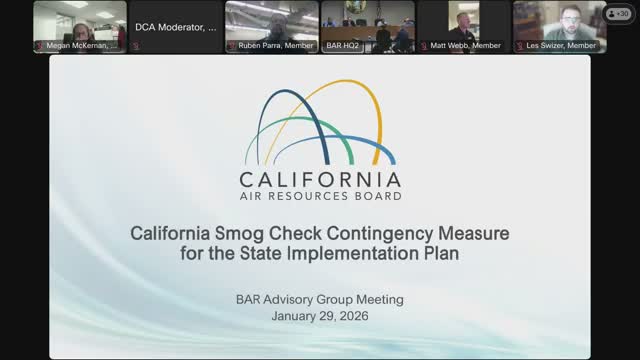
A California Air Resources Board official told the Bureau of Automotive Repair advisory group on Jan. 29 that a SmogCheck contingency measure approved into the State Implementation Plan will be triggered where U.S. EPA finds a failure to attain national air quality standards, and would reduce the new‑vehicle SmogCheck exemption by one model year in affected areas.
"Contingency measures have to be able to take effect without any further board action," said Ariel Fiddledine, chief of CARB’s Air Quality Planning branch. CARB staff said an EPA finding becomes effective one month after EPA publishes it; the measure must begin implementation within 30 days of that effective date and generate emission reductions within one to two years.
CARB staff explained the practical effect: the current 8‑model‑year exemption for some light‑duty vehicles would become 7 model years in a triggered area; a second trigger could move the exemption to 6 model years. The San Joaquin Valley received an EPA finding for failure to attain the 80 parts‑per‑billion ozone standard (EPA action effective Oct. 27, 2025), and CARB staff said they are coordinating with BAR and the Department of Motor Vehicles on programming and public outreach. CARB and BAR staff said the Valley changes are being targeted to take effect at the start of 2027.
CARB described the legal weight of the change: because the contingency measure is in the SIP, it is federally enforceable once EPA approves it, and the state could face consequences—including increased emissions offsets for some stationary sources or loss of federal highway funds—if it fails to implement required SIP measures.
Industry and advisory members raised operational and budget questions. "When this vehicle comes into the SmogCheck program, the $25 abatement fee goes away on that vehicle," said Dave Kusa of the Automotive Service Councils of California, referring to the $21 that typically flows to Carl Moyer incentive programs and $4 that funds BAR program implementation. CARB staff said they performed an analysis at the time of adoption (2023) comparing Moyer funding impacts to estimated emission reductions and concluded the net reductions justified the measure; they said they can update that analysis with more recent data and provide BAR with estimates of how many motorists and fees will be affected.
Advisory members asked for technical detail on expected failure rates. CARB staff said an earlier analysis used a roughly 4.5% SmogCheck failure rate for 8‑model‑year vehicles (about half of a 9% overall rate referenced in staff materials), and that BAR’s more granular failure‑mode data and DMV registration data feed CARB’s emissions model (MFAC) used to estimate reductions. CARB and BAR agreed to follow up to provide updated counts and budget‑impact estimates to BAR leadership.
Public commenters and industry representatives made additional points: several asked whether the change should be statewide rather than area‑by‑area (one commenter said localized geography like the Valley’s mountain basin influences pollution differently), some urged CARB to share more detailed failure‑mode data (permanent codes, battery replacements, gas‑cap faults), and collision‑repair representatives pressed for clear communication to consumers so shops are not blamed for regulatory changes.
CARB staff said they are preparing FAQs and outreach materials and will coordinate web updates with BAR and DMV so industry and motorists have notice well before programming and enforcement changes go into effect.
Next steps: CARB and BAR will exchange updated motorist counts and fiscal estimates for affected ZIP codes in the San Joaquin Valley and continue outreach; BAR and DMV will plan software and notification changes so affected motorists and stations receive clear guidance before the planned early‑2027 implementation.
Representative quotes in this report come from CARB’s Ariel Fiddledine and BAR’s Patrick Dorey and advisory members during the Jan. 29 BAR advisory meeting.
"Contingency measures have to be able to take effect without any further board action," said Ariel Fiddledine, chief of CARB’s Air Quality Planning branch. CARB staff said an EPA finding becomes effective one month after EPA publishes it; the measure must begin implementation within 30 days of that effective date and generate emission reductions within one to two years.
CARB staff explained the practical effect: the current 8‑model‑year exemption for some light‑duty vehicles would become 7 model years in a triggered area; a second trigger could move the exemption to 6 model years. The San Joaquin Valley received an EPA finding for failure to attain the 80 parts‑per‑billion ozone standard (EPA action effective Oct. 27, 2025), and CARB staff said they are coordinating with BAR and the Department of Motor Vehicles on programming and public outreach. CARB and BAR staff said the Valley changes are being targeted to take effect at the start of 2027.
CARB described the legal weight of the change: because the contingency measure is in the SIP, it is federally enforceable once EPA approves it, and the state could face consequences—including increased emissions offsets for some stationary sources or loss of federal highway funds—if it fails to implement required SIP measures.
Industry and advisory members raised operational and budget questions. "When this vehicle comes into the SmogCheck program, the $25 abatement fee goes away on that vehicle," said Dave Kusa of the Automotive Service Councils of California, referring to the $21 that typically flows to Carl Moyer incentive programs and $4 that funds BAR program implementation. CARB staff said they performed an analysis at the time of adoption (2023) comparing Moyer funding impacts to estimated emission reductions and concluded the net reductions justified the measure; they said they can update that analysis with more recent data and provide BAR with estimates of how many motorists and fees will be affected.
Advisory members asked for technical detail on expected failure rates. CARB staff said an earlier analysis used a roughly 4.5% SmogCheck failure rate for 8‑model‑year vehicles (about half of a 9% overall rate referenced in staff materials), and that BAR’s more granular failure‑mode data and DMV registration data feed CARB’s emissions model (MFAC) used to estimate reductions. CARB and BAR agreed to follow up to provide updated counts and budget‑impact estimates to BAR leadership.
Public commenters and industry representatives made additional points: several asked whether the change should be statewide rather than area‑by‑area (one commenter said localized geography like the Valley’s mountain basin influences pollution differently), some urged CARB to share more detailed failure‑mode data (permanent codes, battery replacements, gas‑cap faults), and collision‑repair representatives pressed for clear communication to consumers so shops are not blamed for regulatory changes.
CARB staff said they are preparing FAQs and outreach materials and will coordinate web updates with BAR and DMV so industry and motorists have notice well before programming and enforcement changes go into effect.
Next steps: CARB and BAR will exchange updated motorist counts and fiscal estimates for affected ZIP codes in the San Joaquin Valley and continue outreach; BAR and DMV will plan software and notification changes so affected motorists and stations receive clear guidance before the planned early‑2027 implementation.
Representative quotes in this report come from CARB’s Ariel Fiddledine and BAR’s Patrick Dorey and advisory members during the Jan. 29 BAR advisory meeting.
Don't Miss a Word: See the Full Meeting!
Go beyond summaries. Unlock every video, transcript, and key insight with a Founder Membership.
✓
Get instant access to full meeting videos
✓
Search and clip any phrase from complete transcripts
✓
Receive AI-powered summaries & custom alerts
✓
Enjoy lifetime, unrestricted access to government data
30-day money-back guarantee
