Baltimore County CRR commission hears fund overview, legal limits on use of proceeds
February 10, 2026 | Baltimore County, Maryland
This article was created by AI summarizing key points discussed. AI makes mistakes, so for full details and context, please refer to the video of the full meeting. Please report any errors so we can fix them. Report an error »
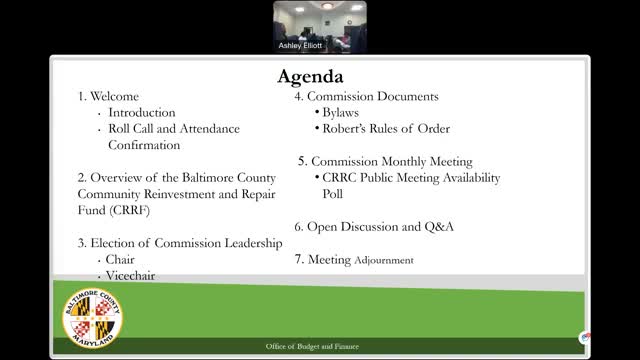
Ashley Elliott, a Baltimore County staff member working with the new commission, opened the panel and told members the Community Reinvestment and Repair (CRR) special revenue fund was created under state direction and established locally by a Baltimore County ordinance (Bill 37‑24).
"This fund is specifically designed to support low‑income and disproportionately impacted areas," Elliott said, and she emphasized that, by law, the money cannot be used for law enforcement or to supplant existing county programs.
Why it matters: county staff said the fund directs a portion of cannabis sales tax revenue into a special revenue account meant to support restorative justice‑oriented programs in roughly 15 ZIP codes with higher‑than‑average cannabis enforcement rates. Commissioners were told the fund is meant to support homelessness and shelter services, mental health and substance‑use supports, housing assistance, education and advocacy, workforce development and criminal justice reforms such as expungement.
Staff described the grant pipeline: applications will be reviewed by staff and an internal grants committee, pass through executive review and accounting checks, and then be formalized in grant agreements. Matthew S. Carpenter, deputy director of budget and finance, gave a high‑level fiscal picture: the county has received "over $10,000,000" into the fund to date and the CRF balance for FY25 was described in the meeting as "well over $13,000,000;" staff also offered an approximate recurring revenue figure for planning purposes.
Legal and procurement limits were highlighted. County staff warned commissioners that multi‑year grant arrangements and larger dollar commitments may require additional legal review and council involvement, and that county practice typically triggers additional counsel review for commitments that extend beyond two years or exceed $25,000.
Next steps: staff said they will present draft grant documents, training on the Open Meetings Act and CRF overview materials at upcoming meetings so commissioners can weigh policy questions about grant length, operating versus program grants, and whether to allow up‑front partial payments for smaller organizations.
The commission agreed to continue discussing the fund’s priorities and to use the provided map and community survey to focus outreach and program design.
"This fund is specifically designed to support low‑income and disproportionately impacted areas," Elliott said, and she emphasized that, by law, the money cannot be used for law enforcement or to supplant existing county programs.
Why it matters: county staff said the fund directs a portion of cannabis sales tax revenue into a special revenue account meant to support restorative justice‑oriented programs in roughly 15 ZIP codes with higher‑than‑average cannabis enforcement rates. Commissioners were told the fund is meant to support homelessness and shelter services, mental health and substance‑use supports, housing assistance, education and advocacy, workforce development and criminal justice reforms such as expungement.
Staff described the grant pipeline: applications will be reviewed by staff and an internal grants committee, pass through executive review and accounting checks, and then be formalized in grant agreements. Matthew S. Carpenter, deputy director of budget and finance, gave a high‑level fiscal picture: the county has received "over $10,000,000" into the fund to date and the CRF balance for FY25 was described in the meeting as "well over $13,000,000;" staff also offered an approximate recurring revenue figure for planning purposes.
Legal and procurement limits were highlighted. County staff warned commissioners that multi‑year grant arrangements and larger dollar commitments may require additional legal review and council involvement, and that county practice typically triggers additional counsel review for commitments that extend beyond two years or exceed $25,000.
Next steps: staff said they will present draft grant documents, training on the Open Meetings Act and CRF overview materials at upcoming meetings so commissioners can weigh policy questions about grant length, operating versus program grants, and whether to allow up‑front partial payments for smaller organizations.
The commission agreed to continue discussing the fund’s priorities and to use the provided map and community survey to focus outreach and program design.
View the Full Meeting & All Its Details
This article offers just a summary. Unlock complete video, transcripts, and insights as a Founder Member.
✓
Watch full, unedited meeting videos
✓
Search every word spoken in unlimited transcripts
✓
AI summaries & real-time alerts (all government levels)
✓
Permanent access to expanding government content
30-day money-back guarantee
