Senate Committee holds bill on CNMI emergency reserve fund, cites unclear 'special revenue' link
February 10, 2026 | Senate, Northern Mariana Legislative Sessions, Northern Mariana Islands
This article was created by AI summarizing key points discussed. AI makes mistakes, so for full details and context, please refer to the video of the full meeting. Please report any errors so we can fix them. Report an error »
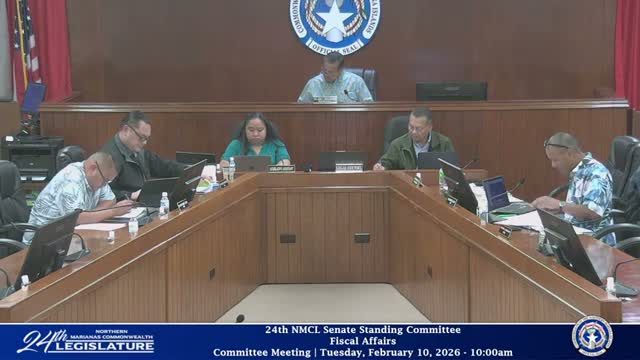
Chairman opened debate on House Bill 24-33, which would create a dedicated CNMI emergency reserve fund with mandatory annual deposits and defined disbursement procedures, and invited legal guidance and member comment.
Counsel Bermudez told the committee that portions of the bill mirror language already used in the FY2026 budget and that codifying the language would make it permanent. Counsel also warned the bill, as written, fails to show the legal 'nexus' required to treat the reserve as special revenue and therefore could be subject to the constitutionally mandated 25% education set-aside (PSS). "If the bill is fixed and it is clearly a special fund as defined in the bill, then it would not be subject to the 25% of PSS," counsel said, but added the current draft is missing that linkage.
Senators pressed the practical and policy implications. Senator Castro and others argued the fund is warranted by repeated disaster-related revenue shortfalls (typhoons, pandemic) and suggested FEMA reimbursements could be designated explicitly as the fund's source. Senator Cruz warned that a broad "rainy day" label could be tapped for minor needs and urged a clear definition of what constitutes an emergency. Several members favored holding the bill to draft precise definitions and to add reporting, investment, and reimbursement provisions so the fund can be replenished when FEMA or other reimbursements arrive.
The committee did not take a final vote on the bill. Instead, members agreed to hold the measure for further drafting and to prioritize amendments that (1) establish the legal nexus between source and permitted uses, (2) clarify eligibility and what qualifies as a valid emergency, (3) specify whether FEMA reimbursements (or other defined receipts) will be routed automatically to the reserve, and (4) include reporting and investment rules to protect and grow the fund.
The committee asked staff to prepare proposed amendments and to return the bill to a future session for markup.
Counsel Bermudez told the committee that portions of the bill mirror language already used in the FY2026 budget and that codifying the language would make it permanent. Counsel also warned the bill, as written, fails to show the legal 'nexus' required to treat the reserve as special revenue and therefore could be subject to the constitutionally mandated 25% education set-aside (PSS). "If the bill is fixed and it is clearly a special fund as defined in the bill, then it would not be subject to the 25% of PSS," counsel said, but added the current draft is missing that linkage.
Senators pressed the practical and policy implications. Senator Castro and others argued the fund is warranted by repeated disaster-related revenue shortfalls (typhoons, pandemic) and suggested FEMA reimbursements could be designated explicitly as the fund's source. Senator Cruz warned that a broad "rainy day" label could be tapped for minor needs and urged a clear definition of what constitutes an emergency. Several members favored holding the bill to draft precise definitions and to add reporting, investment, and reimbursement provisions so the fund can be replenished when FEMA or other reimbursements arrive.
The committee did not take a final vote on the bill. Instead, members agreed to hold the measure for further drafting and to prioritize amendments that (1) establish the legal nexus between source and permitted uses, (2) clarify eligibility and what qualifies as a valid emergency, (3) specify whether FEMA reimbursements (or other defined receipts) will be routed automatically to the reserve, and (4) include reporting and investment rules to protect and grow the fund.
The committee asked staff to prepare proposed amendments and to return the bill to a future session for markup.
Don't Miss a Word: See the Full Meeting!
Go beyond summaries. Unlock every video, transcript, and key insight with a Founder Membership.
✓
Get instant access to full meeting videos
✓
Search and clip any phrase from complete transcripts
✓
Receive AI-powered summaries & custom alerts
✓
Enjoy lifetime, unrestricted access to government data
30-day money-back guarantee
