Senate committee reviews HB 24-30 SD1 to move cannabis oversight to Commerce; officials stress funds must not be commingled
February 10, 2026 | Senate, Northern Mariana Legislative Sessions, Northern Mariana Islands
This article was created by AI summarizing key points discussed. AI makes mistakes, so for full details and context, please refer to the video of the full meeting. Please report any errors so we can fix them. Report an error »
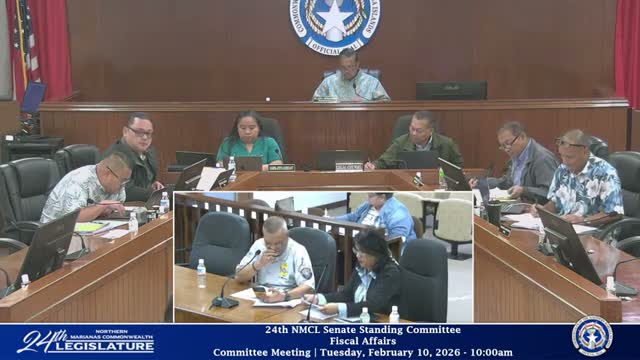
The Senate committee on HB 24-30 SD1 on Jan. 18 heard agency officials describe plans to move cannabis regulatory functions into the Department of Commerce and to fund the regulatory role without using general fund dollars.
Secretary Mafnes told the committee that while the Senate voted to disapprove a governor's executive order, the House did not act within the constitutional review period and “as a result, the order became effective on 01/18/2026, and commerce is implementing the law as it currently stands.” She described House Bill 24-30 SD1 as a conservative appropriations bill intended to protect school funding and ensure continuity of oversight during a transition.
The department's director of the Alcohol Beverage & Tobacco Commission, David R. Maritita, told lawmakers the agency has been in touch with federal partners about potential conflicts between federal grants and the transfer of cannabis functions. Maritita said ABTC recently received an award of about $1,300,000 tied to work for the U.S. Food and Drug Administration and that Commerce was advised by FDA counterparts that, provided the department does not commingle cannabis revenue with federal program funds, the FDA contract should not be jeopardized. "As long as we don't commingle the funds," Maritita said, "then the operations will be not affected."
Lawmakers pressed agency officials on the short-term and recurring costs of absorbing cannabis staff. Maritita said the department completed a fiscal impact analysis for three staff it planned to absorb and estimated roughly $92,000 for the fiscal year to cover those positions. He said, pending formal appropriation, the department has used a revolving account to set funds aside temporarily and intends to reimburse that account from cannabis funds if the appropriations in HB 24-30 are enacted.
Committee members asked for detailed, month-by-month cost estimates and the remaining funding needed through Sept. 30 so the bill could be amended before a scheduled floor session in Tinian. Officials provided interim fund figures: an uncertified addition of $69,349 and a cited balance of $441,792.50 in one cannabis-related account, and $1,138,880.33 in another account, figures the agency said came from OMB this morning and are uncertified.
On license counts, Maritita said there are six active dispensaries on-island and, to his knowledge, four licensed producers; he said licenses are valid for one year and renewable annually. The agency also described plans to cross-train ABTC staff with cannabis personnel and to fold cannabis outreach and school-education into existing alcohol and tobacco programs to preserve continuity while operating under tight financial constraints.
Lawmakers raised legal and operational questions about inter-island transport and enforcement. Officials described interstate-commerce limits as a potential hurdle and said federal reclassification of marijuana would shift that legal context but is not imminent. Given current resource limits, the department said it will rely on cross-trained personnel on other islands before deploying new enforcement teams.
The committee set a short timetable for follow-up: agency staff were asked to deliver a written cost breakdown before the Friday floor session in Tinian so members could consider amendments to set aside funds for wages and operations. The hearing recessed for a short break and planned to reconvene at 01:30.
The committee did not take a formal vote on HB 24-30 SD1 during the recorded discussion; members instead sought additional fiscal detail and proposed amendments ahead of the upcoming floor session.
Secretary Mafnes told the committee that while the Senate voted to disapprove a governor's executive order, the House did not act within the constitutional review period and “as a result, the order became effective on 01/18/2026, and commerce is implementing the law as it currently stands.” She described House Bill 24-30 SD1 as a conservative appropriations bill intended to protect school funding and ensure continuity of oversight during a transition.
The department's director of the Alcohol Beverage & Tobacco Commission, David R. Maritita, told lawmakers the agency has been in touch with federal partners about potential conflicts between federal grants and the transfer of cannabis functions. Maritita said ABTC recently received an award of about $1,300,000 tied to work for the U.S. Food and Drug Administration and that Commerce was advised by FDA counterparts that, provided the department does not commingle cannabis revenue with federal program funds, the FDA contract should not be jeopardized. "As long as we don't commingle the funds," Maritita said, "then the operations will be not affected."
Lawmakers pressed agency officials on the short-term and recurring costs of absorbing cannabis staff. Maritita said the department completed a fiscal impact analysis for three staff it planned to absorb and estimated roughly $92,000 for the fiscal year to cover those positions. He said, pending formal appropriation, the department has used a revolving account to set funds aside temporarily and intends to reimburse that account from cannabis funds if the appropriations in HB 24-30 are enacted.
Committee members asked for detailed, month-by-month cost estimates and the remaining funding needed through Sept. 30 so the bill could be amended before a scheduled floor session in Tinian. Officials provided interim fund figures: an uncertified addition of $69,349 and a cited balance of $441,792.50 in one cannabis-related account, and $1,138,880.33 in another account, figures the agency said came from OMB this morning and are uncertified.
On license counts, Maritita said there are six active dispensaries on-island and, to his knowledge, four licensed producers; he said licenses are valid for one year and renewable annually. The agency also described plans to cross-train ABTC staff with cannabis personnel and to fold cannabis outreach and school-education into existing alcohol and tobacco programs to preserve continuity while operating under tight financial constraints.
Lawmakers raised legal and operational questions about inter-island transport and enforcement. Officials described interstate-commerce limits as a potential hurdle and said federal reclassification of marijuana would shift that legal context but is not imminent. Given current resource limits, the department said it will rely on cross-trained personnel on other islands before deploying new enforcement teams.
The committee set a short timetable for follow-up: agency staff were asked to deliver a written cost breakdown before the Friday floor session in Tinian so members could consider amendments to set aside funds for wages and operations. The hearing recessed for a short break and planned to reconvene at 01:30.
The committee did not take a formal vote on HB 24-30 SD1 during the recorded discussion; members instead sought additional fiscal detail and proposed amendments ahead of the upcoming floor session.
Don't Miss a Word: See the Full Meeting!
Go beyond summaries. Unlock every video, transcript, and key insight with a Founder Membership.
✓
Get instant access to full meeting videos
✓
Search and clip any phrase from complete transcripts
✓
Receive AI-powered summaries & custom alerts
✓
Enjoy lifetime, unrestricted access to government data
30-day money-back guarantee
