Portsmouth staff brief council on unsolicited PPEA plan for new city hall, garage; public hearing set for March 10
February 10, 2026 | Portsmouth, Norfolk County, Virginia
This article was created by AI summarizing key points discussed. AI makes mistakes, so for full details and context, please refer to the video of the full meeting. Please report any errors so we can fix them. Report an error »
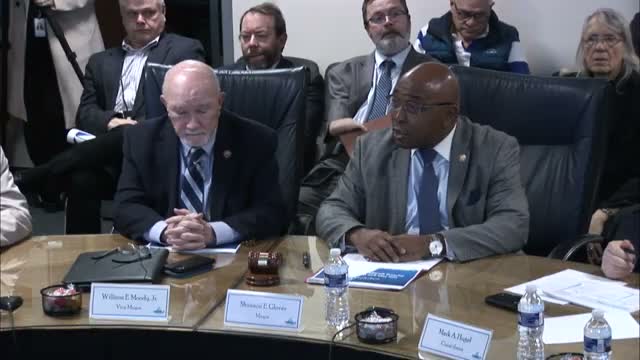
City Manager Steven Carter told the Portsmouth City Council on Feb. 9 that the city has received an unsolicited proposal under the Public-Private Education and Infrastructure Act (PPEA) for a rebuilt city hall, a replacement parking garage and a public plaza near the Children’s Museum in downtown Portsmouth.
Carter said the submission came from a team identified as RHMCN (naming Ripley Hedwalt as lead developer, MEB as general contractor and Clark Nexon as architect/engineer) and stressed the council was not soliciting or endorsing that team. "PPEA stands for the Public Private Education and Infrastructure Act," Carter said, adding the statute provides checkpoints and exit points so the city retains control over whether to proceed.
Why it matters: the proposal aims to keep city government in the downtown area and, officials said, could help "unlock" waterfront redevelopment and support local businesses. Carter described the current city hall as undersized with deferred maintenance, accessibility and security shortcomings that make renovation less attractive to some council members.
What staff proposed: Carter described the next steps as an evaluation and due-diligence period under an interim agreement. During that phase, developers would produce a roughly 35% design and preliminary engineering so staff can validate costs and financing. "The interim agreement is the homework phase," Carter said, and he emphasized the interim agreement itself is not final and that the council would have multiple decision points to stop the process.
Estimated price and financing: Carter presented an order-of-magnitude construction estimate of about $86,000,000 and said the total including the financing vehicle could be closer to $93,000,000. He stressed those are conceptual ranges and not guaranteed numbers: "Everything that we're looking at is a range but not a commitment." The estimate as presented does not include furniture, fixtures and equipment or other move-in costs, which Carter said would be shown during due diligence.
Public process and schedule: Staff asked the council to schedule a public hearing on March 10. Carter explained Virginia law requires at least a 30-day waiting period after that hearing before the city can enter an interim agreement. He said staff expects the homework period and associated reviews could mean 90–120 days of work before returning to council with validated numbers and financing options.
Council questions and staff responses: Council members pressed staff on how the PPEA process began, whether prior programming studies (2019 and updated in 2025) informed the proposal, whether the 45-day advertisement window limited competition, and what ownership or lease structures would look like during an initial 30-year period under some financing models. Carter and interim city attorney Derek Challenger said the PPEA can begin with an unsolicited submission, that some team members had prior work for the city and therefore were aware of city programming, and that ownership and financing structures vary by the option chosen and will be vetted in due diligence.
Advisers and decision authority: Carter said the city will use contracted engineers and financial advisers in addition to in-house staff; he repeatedly underscored that ultimate decision-making authority remains with the council and noted rating agencies may treat some long-term lease arrangements as debt for credit analysis.
Next steps: The council agreed to schedule the March 10 public hearing to allow public comment and to preserve statutory waiting periods before any interim agreement. Carter also invited the development team to identify themselves at the meeting; representatives introduced themselves to the council during the presentation.
The meeting closed with council members moving to a closed session later in the agenda to consult legal counsel on pending litigation (see "Votes at a glance" below).
Carter said the submission came from a team identified as RHMCN (naming Ripley Hedwalt as lead developer, MEB as general contractor and Clark Nexon as architect/engineer) and stressed the council was not soliciting or endorsing that team. "PPEA stands for the Public Private Education and Infrastructure Act," Carter said, adding the statute provides checkpoints and exit points so the city retains control over whether to proceed.
Why it matters: the proposal aims to keep city government in the downtown area and, officials said, could help "unlock" waterfront redevelopment and support local businesses. Carter described the current city hall as undersized with deferred maintenance, accessibility and security shortcomings that make renovation less attractive to some council members.
What staff proposed: Carter described the next steps as an evaluation and due-diligence period under an interim agreement. During that phase, developers would produce a roughly 35% design and preliminary engineering so staff can validate costs and financing. "The interim agreement is the homework phase," Carter said, and he emphasized the interim agreement itself is not final and that the council would have multiple decision points to stop the process.
Estimated price and financing: Carter presented an order-of-magnitude construction estimate of about $86,000,000 and said the total including the financing vehicle could be closer to $93,000,000. He stressed those are conceptual ranges and not guaranteed numbers: "Everything that we're looking at is a range but not a commitment." The estimate as presented does not include furniture, fixtures and equipment or other move-in costs, which Carter said would be shown during due diligence.
Public process and schedule: Staff asked the council to schedule a public hearing on March 10. Carter explained Virginia law requires at least a 30-day waiting period after that hearing before the city can enter an interim agreement. He said staff expects the homework period and associated reviews could mean 90–120 days of work before returning to council with validated numbers and financing options.
Council questions and staff responses: Council members pressed staff on how the PPEA process began, whether prior programming studies (2019 and updated in 2025) informed the proposal, whether the 45-day advertisement window limited competition, and what ownership or lease structures would look like during an initial 30-year period under some financing models. Carter and interim city attorney Derek Challenger said the PPEA can begin with an unsolicited submission, that some team members had prior work for the city and therefore were aware of city programming, and that ownership and financing structures vary by the option chosen and will be vetted in due diligence.
Advisers and decision authority: Carter said the city will use contracted engineers and financial advisers in addition to in-house staff; he repeatedly underscored that ultimate decision-making authority remains with the council and noted rating agencies may treat some long-term lease arrangements as debt for credit analysis.
Next steps: The council agreed to schedule the March 10 public hearing to allow public comment and to preserve statutory waiting periods before any interim agreement. Carter also invited the development team to identify themselves at the meeting; representatives introduced themselves to the council during the presentation.
The meeting closed with council members moving to a closed session later in the agenda to consult legal counsel on pending litigation (see "Votes at a glance" below).
Don't Miss a Word: See the Full Meeting!
Go beyond summaries. Unlock every video, transcript, and key insight with a Founder Membership.
✓
Get instant access to full meeting videos
✓
Search and clip any phrase from complete transcripts
✓
Receive AI-powered summaries & custom alerts
✓
Enjoy lifetime, unrestricted access to government data
30-day money-back guarantee
