Committee backs bill letting state police get retirement credit for temporary disability without member cost
February 09, 2026 | 2026 Legislature TN, Tennessee
This article was created by AI summarizing key points discussed. AI makes mistakes, so for full details and context, please refer to the video of the full meeting. Please report any errors so we can fix them. Report an error »
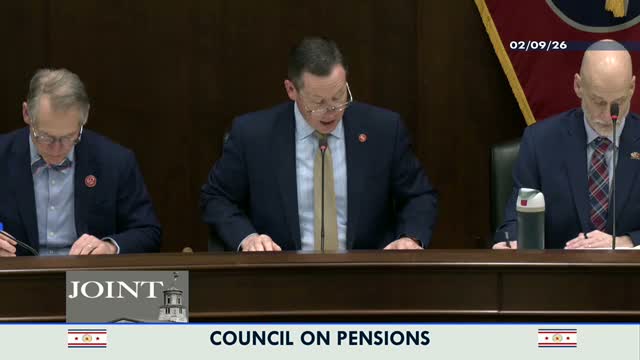
Senator Reeves said the measure, HB 1906 / SB 2017, would allow state police officers to receive retirement credit for periods of temporary disability at no cost to the member and allow political subdivisions to adopt a similar provision for local police. "This legislation allows state police officers to receive retirement credits for periods of disability at no cost to the member," he said.
The department explained the change would let qualifying state police officers — defined in current law to include Department of Safety commission members and Tennessee Bureau of Investigation agents — receive the credit without paying the hybrid plan's usual 5% employee contribution plus interest. "Under current statute, those in the hybrid plan would be required to pay 5% of employee contributions plus interest to establish that. This would allow state police officers ... to claim that credit without cost to the member," the department representative said.
Members questioned the bill’s scope. Several asked whether officers with similar roles — including TWRA officers and state park badge officers — would be included. The department and sponsor said park rangers are not covered by mandatory retirement and thus were not included; TWRA officers were discussed as potentially similar but were not automatically covered by the bill as drafted. Chairman Watson cautioned, "be careful about selective inclusion because ultimately selective inclusion becomes general inclusion," urging members to consider cost implications before widening eligibility.
Committee members also asked for a definition of "temporary" disability; the department said temporary disability may be established for periods not to exceed one year per occurrence. Sponsors characterized the focus as targeted to officers subject to mandatory retirement, saying the treasurer’s office brought the bill and that the department and sponsor would consider amendments later if members wanted broader inclusion.
A motion to give HB 1906 / SB 2017 a positive recommendation passed on a roll call vote, recorded as 12 ayes, 0 noes; the committee recommended the bill to its standing committee.
The council moved on to the next agenda item; no formal cost estimate was entered into the record during the hearing, and the sponsor said additional changes could be considered on the floor or in later committee stops.
The department explained the change would let qualifying state police officers — defined in current law to include Department of Safety commission members and Tennessee Bureau of Investigation agents — receive the credit without paying the hybrid plan's usual 5% employee contribution plus interest. "Under current statute, those in the hybrid plan would be required to pay 5% of employee contributions plus interest to establish that. This would allow state police officers ... to claim that credit without cost to the member," the department representative said.
Members questioned the bill’s scope. Several asked whether officers with similar roles — including TWRA officers and state park badge officers — would be included. The department and sponsor said park rangers are not covered by mandatory retirement and thus were not included; TWRA officers were discussed as potentially similar but were not automatically covered by the bill as drafted. Chairman Watson cautioned, "be careful about selective inclusion because ultimately selective inclusion becomes general inclusion," urging members to consider cost implications before widening eligibility.
Committee members also asked for a definition of "temporary" disability; the department said temporary disability may be established for periods not to exceed one year per occurrence. Sponsors characterized the focus as targeted to officers subject to mandatory retirement, saying the treasurer’s office brought the bill and that the department and sponsor would consider amendments later if members wanted broader inclusion.
A motion to give HB 1906 / SB 2017 a positive recommendation passed on a roll call vote, recorded as 12 ayes, 0 noes; the committee recommended the bill to its standing committee.
The council moved on to the next agenda item; no formal cost estimate was entered into the record during the hearing, and the sponsor said additional changes could be considered on the floor or in later committee stops.
View the Full Meeting & All Its Details
This article offers just a summary. Unlock complete video, transcripts, and insights as a Founder Member.
✓
Watch full, unedited meeting videos
✓
Search every word spoken in unlimited transcripts
✓
AI summaries & real-time alerts (all government levels)
✓
Permanent access to expanding government content
30-day money-back guarantee
