Tennessee Senate approves pilot to place free menstrual hygiene vending machines in select schools
February 09, 2026 | 2026 Legislature TN, Tennessee
This article was created by AI summarizing key points discussed. AI makes mistakes, so for full details and context, please refer to the video of the full meeting. Please report any errors so we can fix them. Report an error »
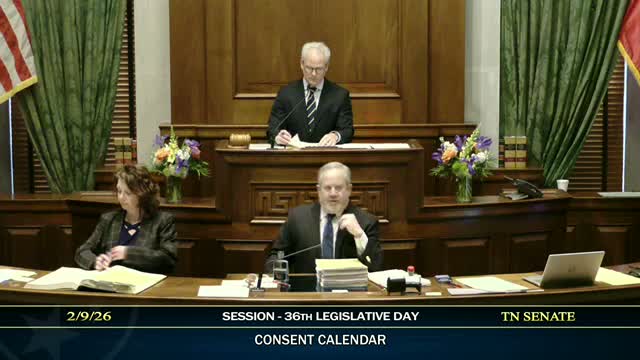
The Tennessee Senate on the floor on Feb. 11 passed Senate Bill 5 87 on third and final consideration, directing the Department of Health to establish a pilot program providing menstrual hygiene products at no cost to students through vending machines in eligible schools.
Leader Ackberry, the motion’s sponsor, described the legislation as a targeted pilot that will allow the Department of Health to select one school in each grand division under the adopted amendment and to prioritize schools with the highest percentages of economically disadvantaged students. "This legislation requires the department of health to establish and administer a pilot program to have hygiene vending machines in eligible schools to dispense feminine hiding hygiene products to students at no cost," Leader Ackberry said on the Senate floor.
The Education Committee amendment adopted on the floor changed the minimum number of schools selected for participation to one school per grand division and makes the bill effective for the 2627 school year. During floor debate the sponsor framed the bill as a measure to prevent students from missing class when they lack access to these products and said the Department is authorized to work with local health departments, nonprofits, churches and other organizations to supply vending machines and accept donations.
The Senate took a roll-call vote after debate and voice queries; the clerk recorded the tally as Ayes 27, Nays 3 and the presiding officer declared the bill passed on third and final consideration.
The legislation authorizes the Department of Health, in partnership with the governor’s office of faith-based and community initiatives and partner organizations, to administer the pilot and explore statewide expansion if successful. Implementation details (including vendor selection, machine locations within schools, restocking plans, privacy protocols and specific eligibility criteria for schools) are to be developed by the department under the bill’s direction.
Next steps: the bill, having passed the Senate, will proceed per legislative process toward enrollment and, if enacted, to implementation by the Department of Health under the timelines established by the amendment.
Leader Ackberry, the motion’s sponsor, described the legislation as a targeted pilot that will allow the Department of Health to select one school in each grand division under the adopted amendment and to prioritize schools with the highest percentages of economically disadvantaged students. "This legislation requires the department of health to establish and administer a pilot program to have hygiene vending machines in eligible schools to dispense feminine hiding hygiene products to students at no cost," Leader Ackberry said on the Senate floor.
The Education Committee amendment adopted on the floor changed the minimum number of schools selected for participation to one school per grand division and makes the bill effective for the 2627 school year. During floor debate the sponsor framed the bill as a measure to prevent students from missing class when they lack access to these products and said the Department is authorized to work with local health departments, nonprofits, churches and other organizations to supply vending machines and accept donations.
The Senate took a roll-call vote after debate and voice queries; the clerk recorded the tally as Ayes 27, Nays 3 and the presiding officer declared the bill passed on third and final consideration.
The legislation authorizes the Department of Health, in partnership with the governor’s office of faith-based and community initiatives and partner organizations, to administer the pilot and explore statewide expansion if successful. Implementation details (including vendor selection, machine locations within schools, restocking plans, privacy protocols and specific eligibility criteria for schools) are to be developed by the department under the bill’s direction.
Next steps: the bill, having passed the Senate, will proceed per legislative process toward enrollment and, if enacted, to implementation by the Department of Health under the timelines established by the amendment.
View the Full Meeting & All Its Details
This article offers just a summary. Unlock complete video, transcripts, and insights as a Founder Member.
✓
Watch full, unedited meeting videos
✓
Search every word spoken in unlimited transcripts
✓
AI summaries & real-time alerts (all government levels)
✓
Permanent access to expanding government content
30-day money-back guarantee
