Lincoln County adopts transportation funding policy, authorizes reimbursement agreements
February 09, 2026 | Lincoln County, North Carolina
This article was created by AI summarizing key points discussed. AI makes mistakes, so for full details and context, please refer to the video of the full meeting. Please report any errors so we can fix them. Report an error »
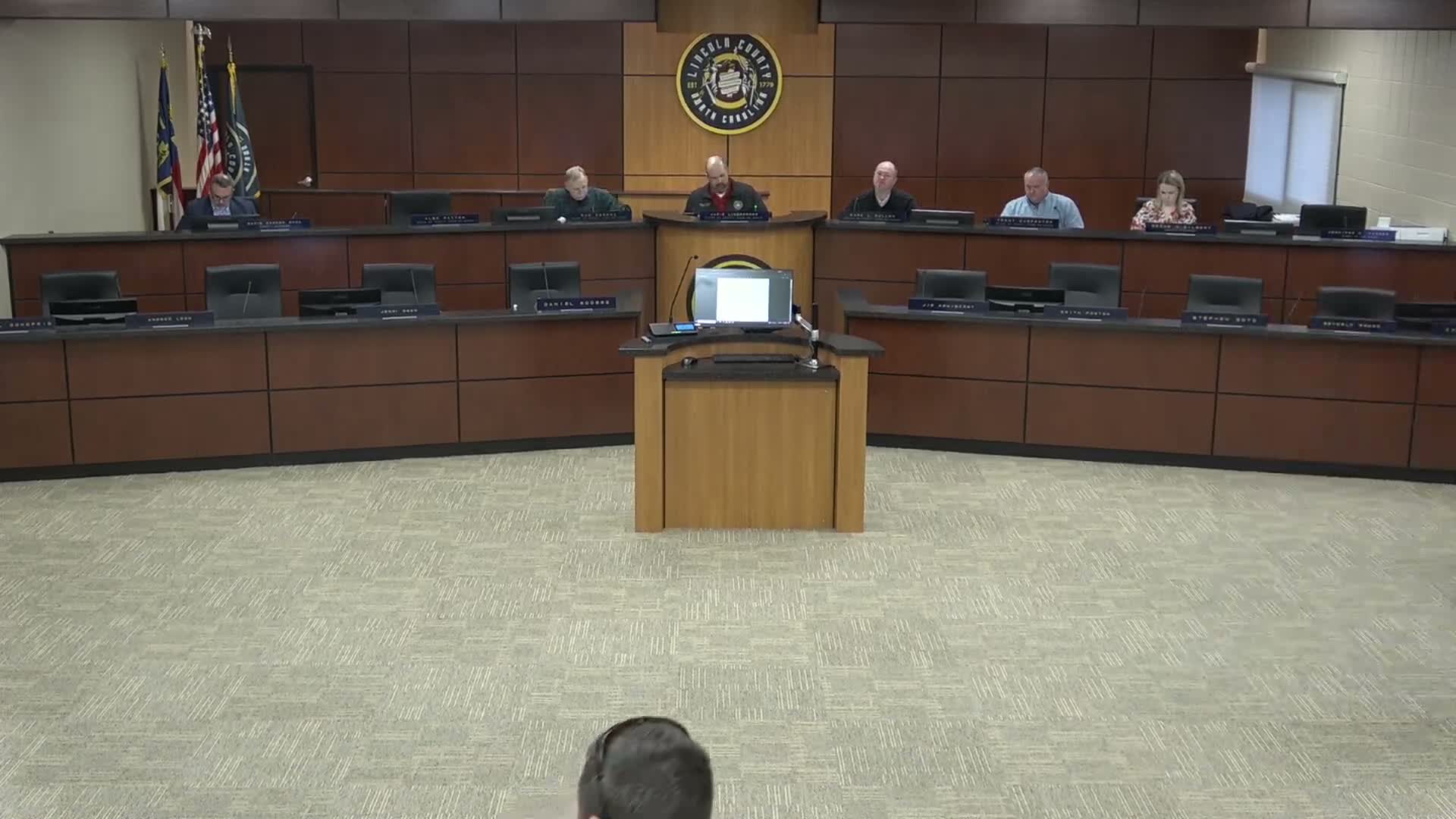
Lincoln County commissioners voted to adopt a revised county transportation funding policy and a companion reimbursement-agreement ordinance at their February 2026 meeting. The changes set the county's maximum participation at 40% of a project's overall cost and clarify how funding sources and scoring criteria are counted.
County staff member Andrew told the board the policy removes a subjective "community support" metric, merges "population centers" with "public places," doubles the weight for economic-development scoring where appropriate, and requests aligning crash-related metrics with the Department of Transportation categories. "We modified it to the maximum scoring, or maximum county participation being 40% of the overall cost for this transportation funding policy," Andrew said, summarizing the principal changes.
Andrew described the underlying fund that pays for these projects as an excise-tax-driven account created in 2017'18 with a baseline of $859,192; funds collected above that baseline roll into the transportation fund. "At the end of FY '25 [the fund] had a balance of around $3,000,000," he said, and the fund had spent about $1,200,000 to date on a mobility study and several roadway and school-access projects.
As part of the revisions, staff asked the board to lower the administrative minimum eligibility threshold to 22.5 points out of a new 45-point maximum (50% of the revised maximum) so that projects that do not meet the threshold would be screened out administratively. Andrew said that change would prevent bringing lower-impact requests to the board for individual consideration.
The companion reimbursement-agreement ordinance establishes the county's authority to enter into agreements that reimburse developers for completed work rather than advancing seed funds, and it requires adherence to the county's public-bidding procedures. "We will simply be reimbursing for work done upon project completion," Andrew said. He added that if developers "misstep" and do not follow procurement rules, the ordinance provides that reimbursement would not be due.
Commissioners asked clarifying questions about the zoning relationship, public input and the scoring table. One commissioner emphasized that removing the staff's community-support score does not eliminate public hearings or public participation in zoning matters. Another commissioner described the change as moving the process from ad hoc negotiation to a more quantitative system that ranks projects by impact.
Commissioner Mullen moved to approve the transportation funding policy; the motion passed by voice vote. Commissioner Carpenter moved to adopt the reimbursement-agreement ordinance; the board approved the ordinance on first read.
The approved policy and ordinance create a formal mechanism for prioritizing and reimbursing transportation projects using excess excise-tax revenue. Staff indicated they will return with any minor metric alignments needed to match DOT standards and the administrative process for screening projects that fall below the minimum score.
County staff member Andrew told the board the policy removes a subjective "community support" metric, merges "population centers" with "public places," doubles the weight for economic-development scoring where appropriate, and requests aligning crash-related metrics with the Department of Transportation categories. "We modified it to the maximum scoring, or maximum county participation being 40% of the overall cost for this transportation funding policy," Andrew said, summarizing the principal changes.
Andrew described the underlying fund that pays for these projects as an excise-tax-driven account created in 2017'18 with a baseline of $859,192; funds collected above that baseline roll into the transportation fund. "At the end of FY '25 [the fund] had a balance of around $3,000,000," he said, and the fund had spent about $1,200,000 to date on a mobility study and several roadway and school-access projects.
As part of the revisions, staff asked the board to lower the administrative minimum eligibility threshold to 22.5 points out of a new 45-point maximum (50% of the revised maximum) so that projects that do not meet the threshold would be screened out administratively. Andrew said that change would prevent bringing lower-impact requests to the board for individual consideration.
The companion reimbursement-agreement ordinance establishes the county's authority to enter into agreements that reimburse developers for completed work rather than advancing seed funds, and it requires adherence to the county's public-bidding procedures. "We will simply be reimbursing for work done upon project completion," Andrew said. He added that if developers "misstep" and do not follow procurement rules, the ordinance provides that reimbursement would not be due.
Commissioners asked clarifying questions about the zoning relationship, public input and the scoring table. One commissioner emphasized that removing the staff's community-support score does not eliminate public hearings or public participation in zoning matters. Another commissioner described the change as moving the process from ad hoc negotiation to a more quantitative system that ranks projects by impact.
Commissioner Mullen moved to approve the transportation funding policy; the motion passed by voice vote. Commissioner Carpenter moved to adopt the reimbursement-agreement ordinance; the board approved the ordinance on first read.
The approved policy and ordinance create a formal mechanism for prioritizing and reimbursing transportation projects using excess excise-tax revenue. Staff indicated they will return with any minor metric alignments needed to match DOT standards and the administrative process for screening projects that fall below the minimum score.
View the Full Meeting & All Its Details
This article offers just a summary. Unlock complete video, transcripts, and insights as a Founder Member.
✓
Watch full, unedited meeting videos
✓
Search every word spoken in unlimited transcripts
✓
AI summaries & real-time alerts (all government levels)
✓
Permanent access to expanding government content
30-day money-back guarantee
