Staff recommends keeping Kennesaw's "family" definition; fire and code staff warn changes would reclassify homes
December 08, 2025 | Kennesaw, Cobb County, Georgia
This article was created by AI summarizing key points discussed. AI makes mistakes, so for full details and context, please refer to the video of the full meeting. Please report any errors so we can fix them. Report an error »
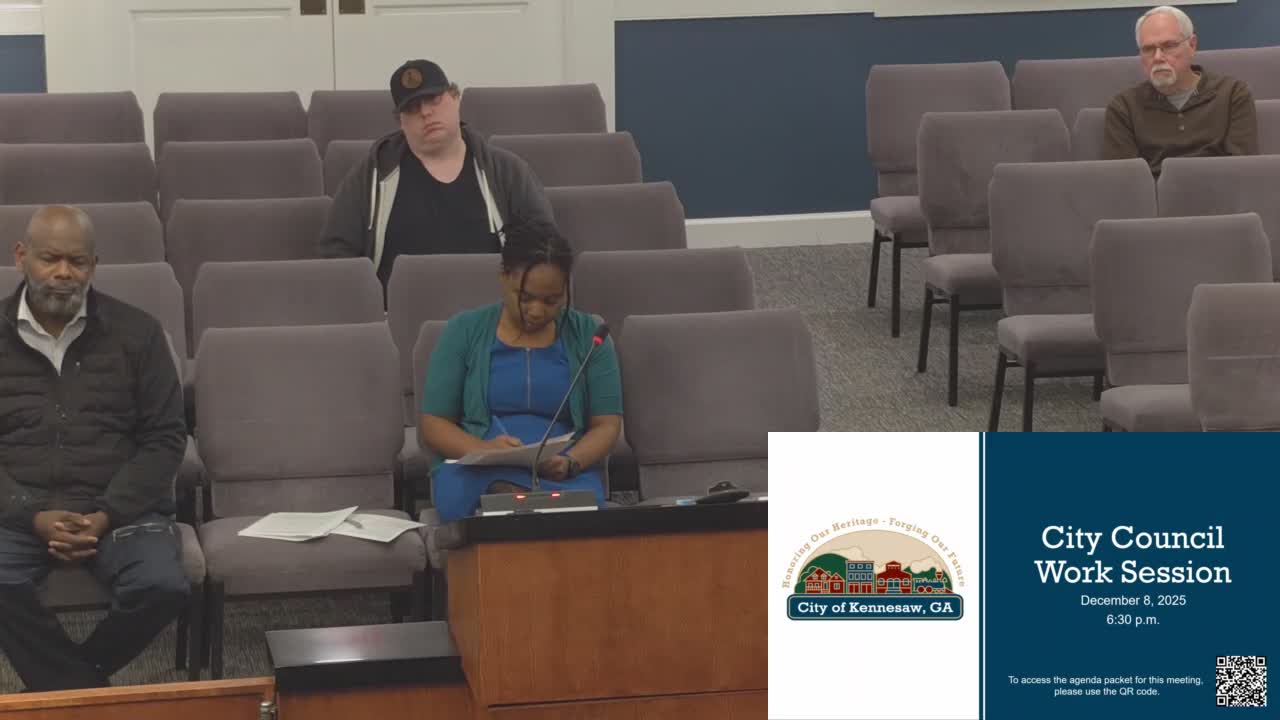
City staff presented a discussion-only item on updating the definition of "family" in the Unified Development Code and the maximum number of unrelated occupants allowed in a single-family dwelling. Staff (Speaker 6) explained the current zoning definition allows related persons or not more than three unrelated persons occupying a dwelling as a single housekeeping unit; exceeding three unrelated occupants would change the unit's classification to lodging under the International Building Code (IBC) and trigger fire and construction reviews.
Scott Banks of the building department (Speaker 14) and code-enforcement staff described practical consequences if the city increased the unrelated-occupant limit: properties would require fire review, potential construction modifications (egress, stair width, guardrails), and code-enforcement cases would likely increase because parking and nuisance complaints tend to rise when unrelated-occupant loads increase. Banks said enforcement cases related to three-or-more unrelated occupants typically arise from complaints and that the city currently has "up to 12 to 14 cases" a year that generate follow-up; most cases result in notices to come into compliance rather than frequent court actions.
Council members asked whether caregivers or unmarried couples would be counted as unrelated; staff said immediate family units (spouses, children, grandparents) are treated as a single household for zoning, but unmarried couples without legal ties are counted as unrelated under the current ordinance. Staff recommended retaining the definition as written to avoid reclassifying single-family homes as lodging and to reduce the administrative and enforcement burden of increased cases.
What happens next: staff will not change the occupancy definition at this time and will provide clarifying language to reduce confusion, per staff recommendation.
Scott Banks of the building department (Speaker 14) and code-enforcement staff described practical consequences if the city increased the unrelated-occupant limit: properties would require fire review, potential construction modifications (egress, stair width, guardrails), and code-enforcement cases would likely increase because parking and nuisance complaints tend to rise when unrelated-occupant loads increase. Banks said enforcement cases related to three-or-more unrelated occupants typically arise from complaints and that the city currently has "up to 12 to 14 cases" a year that generate follow-up; most cases result in notices to come into compliance rather than frequent court actions.
Council members asked whether caregivers or unmarried couples would be counted as unrelated; staff said immediate family units (spouses, children, grandparents) are treated as a single household for zoning, but unmarried couples without legal ties are counted as unrelated under the current ordinance. Staff recommended retaining the definition as written to avoid reclassifying single-family homes as lodging and to reduce the administrative and enforcement burden of increased cases.
What happens next: staff will not change the occupancy definition at this time and will provide clarifying language to reduce confusion, per staff recommendation.
View the Full Meeting & All Its Details
This article offers just a summary. Unlock complete video, transcripts, and insights as a Founder Member.
✓
Watch full, unedited meeting videos
✓
Search every word spoken in unlimited transcripts
✓
AI summaries & real-time alerts (all government levels)
✓
Permanent access to expanding government content
30-day money-back guarantee
