West Chester planning commission weighs street safety, tree canopy and attainable housing in comp‑plan review
February 10, 2026 | West Chester, Chester County, Pennsylvania
This article was created by AI summarizing key points discussed. AI makes mistakes, so for full details and context, please refer to the video of the full meeting. Please report any errors so we can fix them. Report an error »
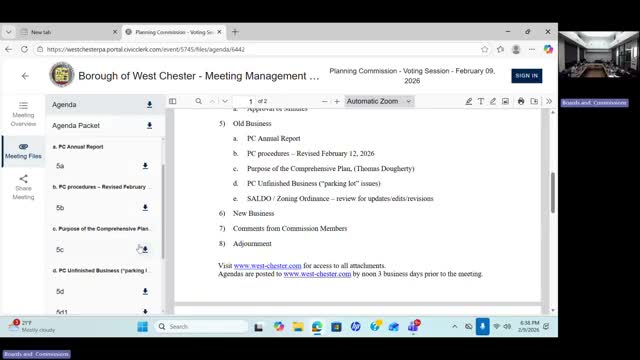
Commissioners at the West Chester Borough Planning Commission meeting on Feb. 9 focused the bulk of their discussion on elements of a new comprehensive plan — particularly street safety, tree canopy incentives, parking requirements and where attainable housing fits into the borough fabric.
A lengthy presentation from a commission member (Speaker 5) used PennDOT/SEPTA curb‑extension examples to argue that recurring crashes on High Street and similar corridors are indicative of design shortcomings, not solely enforcement failures. "Taking back a road is not financially neutral. It's a values decision, not a budget decision," the presenter said, urging the commission to consider the trade‑offs before pursuing local control of state-owned streets.
The presentation also stressed tree canopy and impervious-surface policy as levers for borough resilience. The presenter cited the comp plan’s recommendation that West Chester inventory and protect heritage trees and noted that a one-time stormwater-fee rebate was unlikely to underwrite the scale of street‑tree planting the commission seeks. He suggested incentivizing tree infrastructure by relaxing some impervious-coverage limits in exchange for borough-backed planting infrastructure.
Parking and zoning framed much of the debate. The presenter noted older zoning patterns and parking ratios — for example, a cited parking standard of one space per 250 square feet for certain restaurants vs. one per 500 in the town center — and argued those requirements shape development toward larger, parking‑heavy projects rather than smaller, more attainable housing types. He pointed to precedents for cottage courts and courtyard townhouses as models for attainable units that better match the borough’s desired character.
Commissioner Alan (Speaker 4) proposed a prioritization exercise to convert the commission’s long list of issues into an actionable "parking lot" of items scored 1–10 by commissioners; he asked members to return scored lists and suggested attaching sponsors to high‑priority items so work can be shepherded between meetings. Several commissioners asked that specific topics — maximum building coverage, height overlays and clear sight‑distance requirements — be added to that prioritization list for follow‑up.
Why it matters: Changes to parking, lot coverage and height rules directly influence what types of housing and commercial development are feasible in town-center and neighborhood zoning districts. Commissioners framed the comp‑plan work as a multi-year effort that should be implementable and responsive to borough history and fiscal realities.
Next steps recorded in the meeting: commissioners will review the prioritization chart, add missing items, score them, and return the results to Alan (Speaker 4) so staff can compile the commission’s collective priorities for the next meeting.
A lengthy presentation from a commission member (Speaker 5) used PennDOT/SEPTA curb‑extension examples to argue that recurring crashes on High Street and similar corridors are indicative of design shortcomings, not solely enforcement failures. "Taking back a road is not financially neutral. It's a values decision, not a budget decision," the presenter said, urging the commission to consider the trade‑offs before pursuing local control of state-owned streets.
The presentation also stressed tree canopy and impervious-surface policy as levers for borough resilience. The presenter cited the comp plan’s recommendation that West Chester inventory and protect heritage trees and noted that a one-time stormwater-fee rebate was unlikely to underwrite the scale of street‑tree planting the commission seeks. He suggested incentivizing tree infrastructure by relaxing some impervious-coverage limits in exchange for borough-backed planting infrastructure.
Parking and zoning framed much of the debate. The presenter noted older zoning patterns and parking ratios — for example, a cited parking standard of one space per 250 square feet for certain restaurants vs. one per 500 in the town center — and argued those requirements shape development toward larger, parking‑heavy projects rather than smaller, more attainable housing types. He pointed to precedents for cottage courts and courtyard townhouses as models for attainable units that better match the borough’s desired character.
Commissioner Alan (Speaker 4) proposed a prioritization exercise to convert the commission’s long list of issues into an actionable "parking lot" of items scored 1–10 by commissioners; he asked members to return scored lists and suggested attaching sponsors to high‑priority items so work can be shepherded between meetings. Several commissioners asked that specific topics — maximum building coverage, height overlays and clear sight‑distance requirements — be added to that prioritization list for follow‑up.
Why it matters: Changes to parking, lot coverage and height rules directly influence what types of housing and commercial development are feasible in town-center and neighborhood zoning districts. Commissioners framed the comp‑plan work as a multi-year effort that should be implementable and responsive to borough history and fiscal realities.
Next steps recorded in the meeting: commissioners will review the prioritization chart, add missing items, score them, and return the results to Alan (Speaker 4) so staff can compile the commission’s collective priorities for the next meeting.
View the Full Meeting & All Its Details
This article offers just a summary. Unlock complete video, transcripts, and insights as a Founder Member.
✓
Watch full, unedited meeting videos
✓
Search every word spoken in unlimited transcripts
✓
AI summaries & real-time alerts (all government levels)
✓
Permanent access to expanding government content
30-day money-back guarantee
