Subcommittee advances broad PFAS biosolids substitute with tiered limits and work group
February 09, 2026 | 2026 Legislature VA, Virginia
This article was created by AI summarizing key points discussed. AI makes mistakes, so for full details and context, please refer to the video of the full meeting. Please report any errors so we can fix them. Report an error »
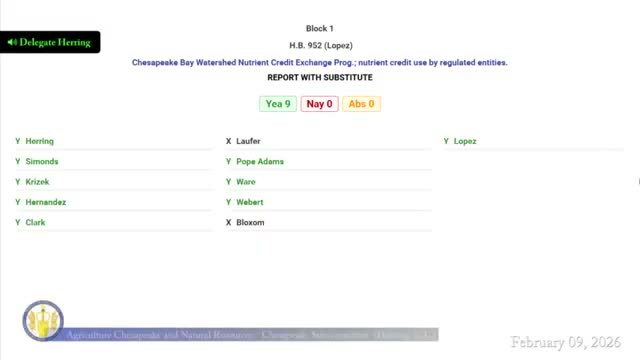
The subcommittee reported a comprehensive substitute to HB 14 43 that establishes a statewide monitoring and response framework for PFAS in biosolids and requires DEQ to modify relevant permits. The substitute calls for monthly PFOS sampling during the 2027 calendar year and quarterly sampling thereafter (with DEQ approval), disclosure of all 40 contaminants collected by the EPA method to landowners, and a tiered approach including a prohibition on land application if concentrations reach 50 micrograms per kilogram on a rolling 12-month basis.
Sponsor Delegate Lopez explained the substitute as a product of extensive stakeholder meetings intended to strike a balance among protecting rural communities, preserving beneficial reuse, and avoiding immediate disruption to wastewater operations. "This substitute amendment is a product of multiple meetings with stakeholders on this issue," the sponsor said, adding that the bill aims to identify elevated biosolids and create a path forward for management.
Conservation and riverkeeper groups praised the monthly testing, disclosure and use of EPA method 1633; farmers urged lower thresholds and annual review by the working group to avoid disadvantaging in-state producers. Municipal and wastewater associations described the substitute as stringent but workable and raised concerns about testing costs, data management and the lack of landfill/incineration capacity if land application were restricted.
The substitute establishes a multi‑party work group charged with deciding how to handle restricted biosolids (landfill, incineration, storage), how to present user-friendly test summaries to landowners, and whether to refine numeric thresholds as data accrues. The subcommittee reported the substitute and the bill will continue through the legislative process; the recorded vote tally was not fully specified in the transcript.
Sponsor Delegate Lopez explained the substitute as a product of extensive stakeholder meetings intended to strike a balance among protecting rural communities, preserving beneficial reuse, and avoiding immediate disruption to wastewater operations. "This substitute amendment is a product of multiple meetings with stakeholders on this issue," the sponsor said, adding that the bill aims to identify elevated biosolids and create a path forward for management.
Conservation and riverkeeper groups praised the monthly testing, disclosure and use of EPA method 1633; farmers urged lower thresholds and annual review by the working group to avoid disadvantaging in-state producers. Municipal and wastewater associations described the substitute as stringent but workable and raised concerns about testing costs, data management and the lack of landfill/incineration capacity if land application were restricted.
The substitute establishes a multi‑party work group charged with deciding how to handle restricted biosolids (landfill, incineration, storage), how to present user-friendly test summaries to landowners, and whether to refine numeric thresholds as data accrues. The subcommittee reported the substitute and the bill will continue through the legislative process; the recorded vote tally was not fully specified in the transcript.
View the Full Meeting & All Its Details
This article offers just a summary. Unlock complete video, transcripts, and insights as a Founder Member.
✓
Watch full, unedited meeting videos
✓
Search every word spoken in unlimited transcripts
✓
AI summaries & real-time alerts (all government levels)
✓
Permanent access to expanding government content
30-day money-back guarantee
