Legislative auditors report improved reporting but note software and late‑filing issues among Nevada licensing boards
February 07, 2026 | 2026 Legislature NV, Nevada
This article was created by AI summarizing key points discussed. AI makes mistakes, so for full details and context, please refer to the video of the full meeting. Please report any errors so we can fix them. Report an error »
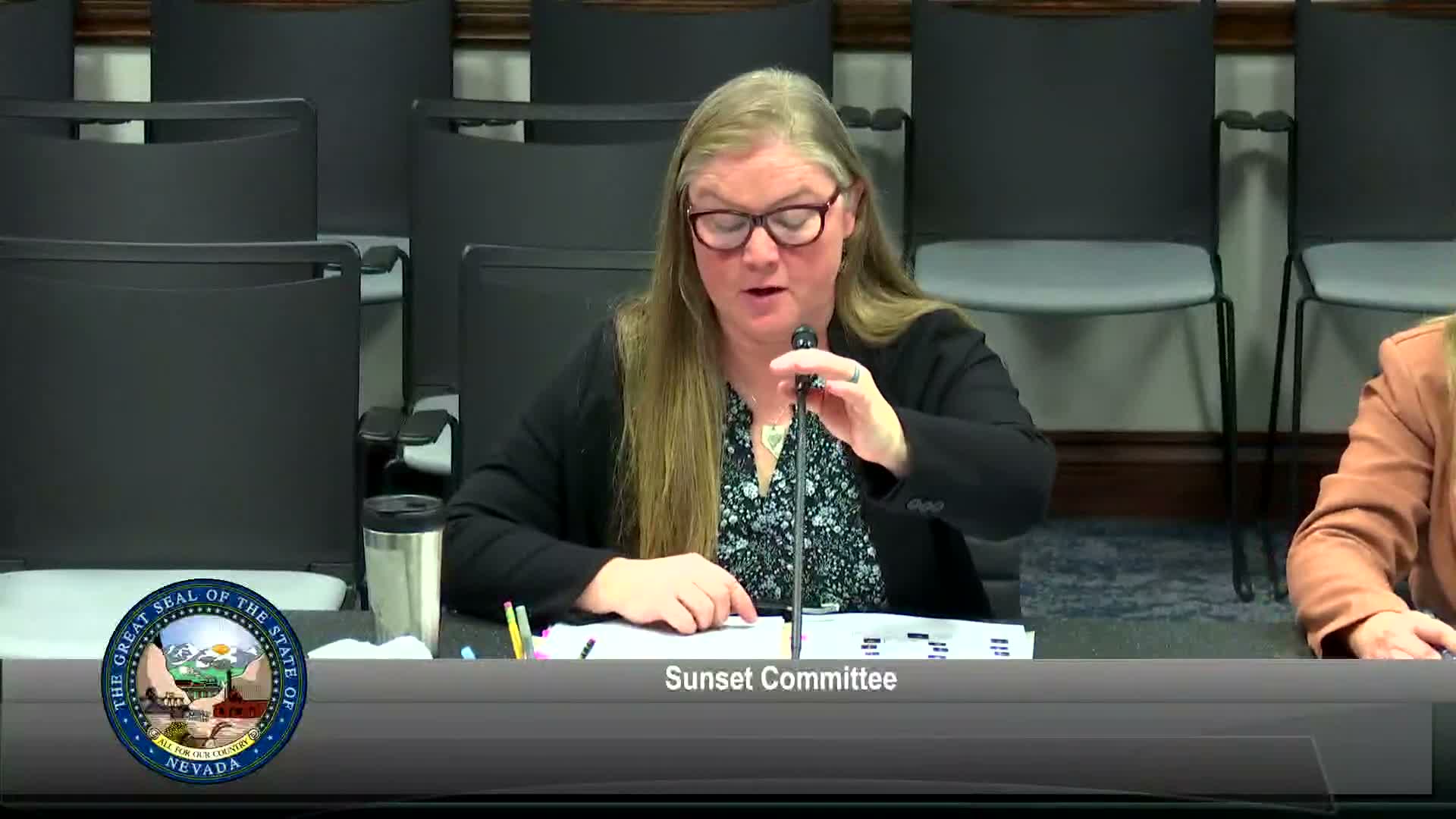
Legislative audit staff told the Nevada Legislature’s Sunset Committee on the committee’s biannual status report that statewide oversight of professional and occupational licensing boards has improved, though several recurring issues remain.
Laura Harwood, deputy legislative auditor, and Tammy Goetz, LCB audit manager, said the audit division’s January 30, 2026 letter to the committee summarizes reviews of 35 occupational licensing boards. Harwood said most boards filed required reports on time for fiscal year 2025 and that the division received fewer questions this year than in prior years.
"Compared to prior years, our fiscal year 2025 financial statement review found improvements in board reporting," Harwood said.
The presentation identified three common problem areas. First, the Board of Applied Behavior Analysis had delayed its FY2025 audited financial statement because its contract with a certified public accountant expired; the board’s contract was approved in January 2026 and Harwood said the audit was in progress and expected to be complete in February 2026. Second, several small boards reported accounting software limitations that produced small fund‑balance discrepancies and hindered reconciliation (the Certified Court Reporters board reported a prior‑year fund balance discrepancy of about $100 described as an unknown software adjustment). Third, some boards reported increased external audit costs; Harwood cited one small board that said its audit cost about $16,000 and another that reported costs had tripled.
Harwood noted the audit division tracks boards with negative fund balances to monitor insolvency risk and inquires about unusually large reserves. She also said the division reviews disciplinary‑action summaries required by statute and that boards had submitted the quarterly disciplinary summaries for the last four reporting periods.
Committee members pressed staff on whether the software problems stemmed from a common vendor or from state consolidation efforts. Harwood said the problem boards maintain independent software rather than using a centralized state system. On questions about unresolved external‑auditor findings (for example, delinquent PERS contributions), Harwood said the audit division will track those matters and report back in the division’s July letter if findings remain outstanding.
Chair Backus thanked audit staff for the clear report and said the committee will expect follow‑up on outstanding items in the next report.
Provenance: presentation and Q&A in the committee’s biannual status report (LCB letter dated 01/30/2026).
Laura Harwood, deputy legislative auditor, and Tammy Goetz, LCB audit manager, said the audit division’s January 30, 2026 letter to the committee summarizes reviews of 35 occupational licensing boards. Harwood said most boards filed required reports on time for fiscal year 2025 and that the division received fewer questions this year than in prior years.
"Compared to prior years, our fiscal year 2025 financial statement review found improvements in board reporting," Harwood said.
The presentation identified three common problem areas. First, the Board of Applied Behavior Analysis had delayed its FY2025 audited financial statement because its contract with a certified public accountant expired; the board’s contract was approved in January 2026 and Harwood said the audit was in progress and expected to be complete in February 2026. Second, several small boards reported accounting software limitations that produced small fund‑balance discrepancies and hindered reconciliation (the Certified Court Reporters board reported a prior‑year fund balance discrepancy of about $100 described as an unknown software adjustment). Third, some boards reported increased external audit costs; Harwood cited one small board that said its audit cost about $16,000 and another that reported costs had tripled.
Harwood noted the audit division tracks boards with negative fund balances to monitor insolvency risk and inquires about unusually large reserves. She also said the division reviews disciplinary‑action summaries required by statute and that boards had submitted the quarterly disciplinary summaries for the last four reporting periods.
Committee members pressed staff on whether the software problems stemmed from a common vendor or from state consolidation efforts. Harwood said the problem boards maintain independent software rather than using a centralized state system. On questions about unresolved external‑auditor findings (for example, delinquent PERS contributions), Harwood said the audit division will track those matters and report back in the division’s July letter if findings remain outstanding.
Chair Backus thanked audit staff for the clear report and said the committee will expect follow‑up on outstanding items in the next report.
Provenance: presentation and Q&A in the committee’s biannual status report (LCB letter dated 01/30/2026).
Don't Miss a Word: See the Full Meeting!
Go beyond summaries. Unlock every video, transcript, and key insight with a Founder Membership.
✓
Get instant access to full meeting videos
✓
Search and clip any phrase from complete transcripts
✓
Receive AI-powered summaries & custom alerts
✓
Enjoy lifetime, unrestricted access to government data
30-day money-back guarantee
