EMRB urges staggered board terms to preserve institutional knowledge as public‑sector bargaining expands
February 07, 2026 | 2026 Legislature NV, Nevada
This article was created by AI summarizing key points discussed. AI makes mistakes, so for full details and context, please refer to the video of the full meeting. Please report any errors so we can fix them. Report an error »
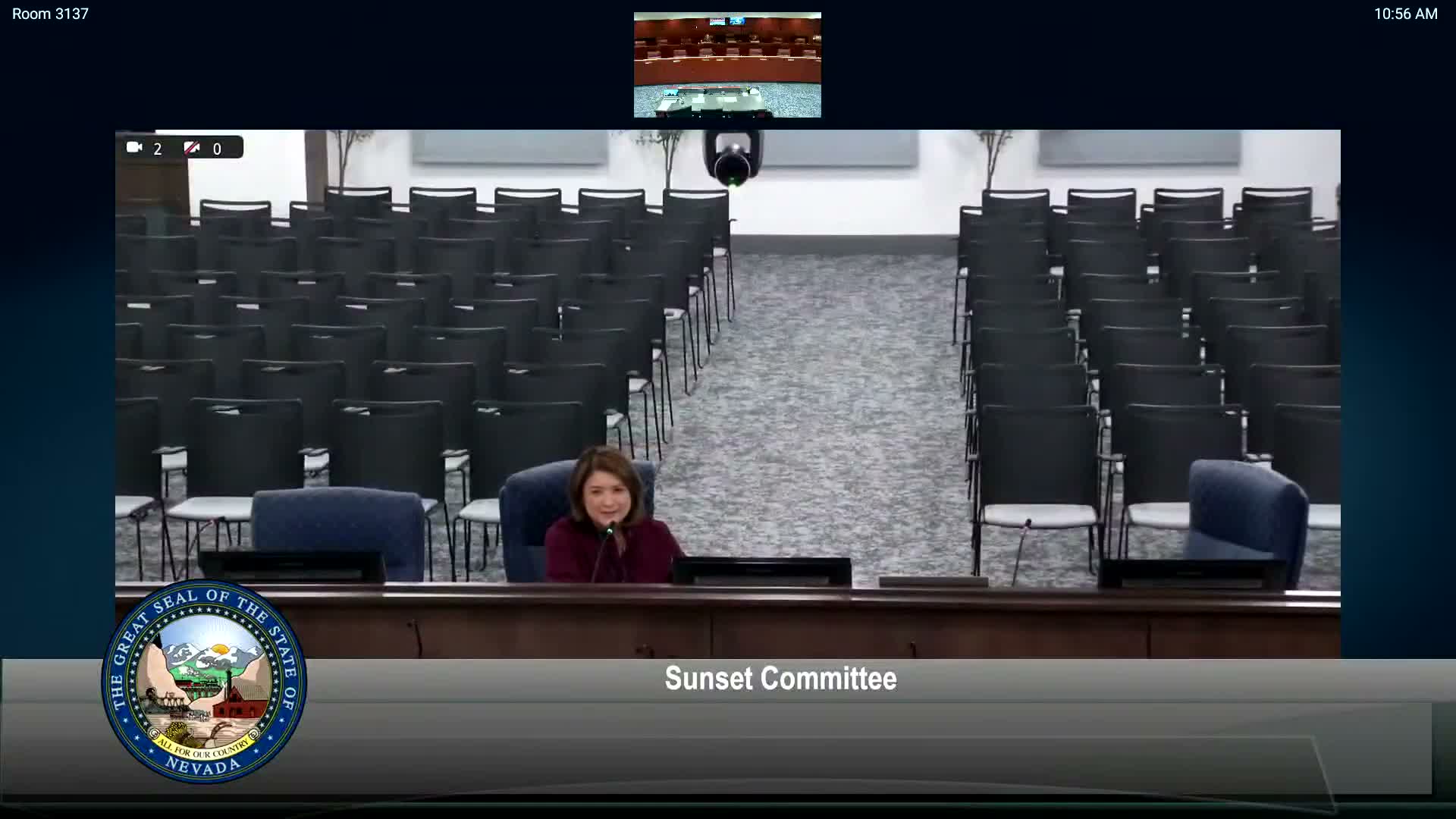
The Government Employee Management Relations Board (EMRB) asked the Sunset Committee to approve a statutory fix to stagger board member terms so Nevada does not lose institutional knowledge when multiple terms expire in the same year.
Commissioner Mary Sue Romualdez Abilar told the committee the EMRB administers public‑sector labor relations in Nevada under the Local Government Employee Management Relations Act (commonly known as the Dodge Act). She said the agency’s jurisdiction has grown to cover more than 100,000 public employees statewide, including approximately 12,000 state executive department employees and about 93,000 local government employees. The EMRB operates with very small staff—Abilar described two full‑time staff plus the commissioner supporting five board members—and is self‑funded through capped annual assessments rather than the general fund.
The board’s single statutory recommendation presented to the committee was a one‑time adjustment to stagger terms because four of five current members’ terms expire in 2029. Abilar said the 2016 expansion from three to five members enabled efficient hearing panels (three‑member panels), improved case flow and eliminated backlog.
During committee questioning, members pressed the EMRB on appointment practices and member qualifications (Abilar said there are no statutory qualifications beyond conflict‑of‑interest restrictions but that applicants with labor backgrounds are preferred), the six‑month filing limitation for unfair‑practice complaints and how the board tolls that deadline in practice, and how bargaining units are determined for local governments (Abilar: local governments generally determine local bargaining units by community of interest; the board resolves disputes when parties cannot agree; the board determines state bargaining units). On precedent, Abilar said the board relies on prior EMRB orders and National Labor Relations Board decisions where EMRB precedent is lacking.
Several members suggested the committee consider guardrails on appointments, term staggering, and diversity goals for the board.
Provenance: EMRB commissioner presentation and committee Q&A.
Commissioner Mary Sue Romualdez Abilar told the committee the EMRB administers public‑sector labor relations in Nevada under the Local Government Employee Management Relations Act (commonly known as the Dodge Act). She said the agency’s jurisdiction has grown to cover more than 100,000 public employees statewide, including approximately 12,000 state executive department employees and about 93,000 local government employees. The EMRB operates with very small staff—Abilar described two full‑time staff plus the commissioner supporting five board members—and is self‑funded through capped annual assessments rather than the general fund.
The board’s single statutory recommendation presented to the committee was a one‑time adjustment to stagger terms because four of five current members’ terms expire in 2029. Abilar said the 2016 expansion from three to five members enabled efficient hearing panels (three‑member panels), improved case flow and eliminated backlog.
During committee questioning, members pressed the EMRB on appointment practices and member qualifications (Abilar said there are no statutory qualifications beyond conflict‑of‑interest restrictions but that applicants with labor backgrounds are preferred), the six‑month filing limitation for unfair‑practice complaints and how the board tolls that deadline in practice, and how bargaining units are determined for local governments (Abilar: local governments generally determine local bargaining units by community of interest; the board resolves disputes when parties cannot agree; the board determines state bargaining units). On precedent, Abilar said the board relies on prior EMRB orders and National Labor Relations Board decisions where EMRB precedent is lacking.
Several members suggested the committee consider guardrails on appointments, term staggering, and diversity goals for the board.
Provenance: EMRB commissioner presentation and committee Q&A.
Don't Miss a Word: See the Full Meeting!
Go beyond summaries. Unlock every video, transcript, and key insight with a Founder Membership.
✓
Get instant access to full meeting videos
✓
Search and clip any phrase from complete transcripts
✓
Receive AI-powered summaries & custom alerts
✓
Enjoy lifetime, unrestricted access to government data
30-day money-back guarantee
