Finance committee recommends $200,000 to study county indirect costs and grant rates
February 10, 2026 | Barnstable County, Massachusetts
This article was created by AI summarizing key points discussed. AI makes mistakes, so for full details and context, please refer to the video of the full meeting. Please report any errors so we can fix them. Report an error »
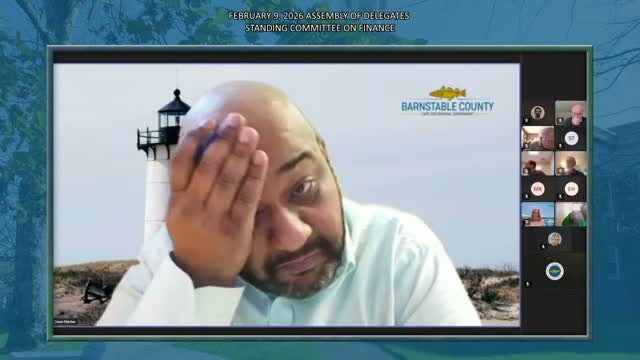
The Barnstable County Assembly of Delegates standing committee on finance voted to recommend a $200,000 supplemental appropriation to fund studies of federal indirect cost rates and internal cost allocations that would inform how the county charges for grant administration and core services.
Finance Director Carol Coppola told the committee the appropriation would be funded from the county’s unreserved fund balance and pay for an RFP-driven study: an external federal indirect-cost rate effort and an internal allocation study for county departments including IT and laboratory services. "We would prepare the schedule of federal awards (SEFA) internally and CLA’s involved with their portion," Coppola said of the grant-reporting process.
Members raised several questions about scope and consequences. Delegate Killian asked whether the county had undertaken such a study before; Coppola said not at the county level and pointed to the Cape Cod Commission as an entity that maintains an authorized federal indirect cost rate. Delegates discussed the federal "de minimis" (noted in the discussion as having moved from 10% to 15%), the typical size of indirect rates (Coppola referenced rates around 40% in some contexts), and whether a higher indirect rate would reduce program dollars available in individual grants.
Delegates also questioned why the supplement was proposed in FY26 rather than deferred to the FY27 budget process. Coppola said the goal was to complete the study in FY26 so any new rates could be implemented in FY27. Assistant County Administrator Mary Harrick and others noted that earlier work on enterprise funds (for example, the dredge) would inform internal allocations; Coppola said the external component would exclude dredge-specific external pricing because that work requires specialized market analysis already underway by Anchor QEA, but the internal allocation study would identify charges appropriate to enterprise funds such as the dredge.
Clerk Fletcher and others noted an RFP had been posted and five proposals were received, though the county had not yet finished scoring technical and cost proposals. Coppola said she estimated the study cost range at roughly $175,000–$200,000 based on inquiries with qualified firms.
On a roll-call vote the committee recommended the proposed ordinance to the full assembly, 4–1; Chair Omen recorded the lone dissent, expressing concern about using a supplemental appropriation when commissioners had recently said they preferred to avoid supplemental budgets.
Ending note: Committee members asked the clerk to ensure ordinance language provides appropriate specificity about the RFP/purpose and to return the item to the full assembly with the committee’s recommendation.
Finance Director Carol Coppola told the committee the appropriation would be funded from the county’s unreserved fund balance and pay for an RFP-driven study: an external federal indirect-cost rate effort and an internal allocation study for county departments including IT and laboratory services. "We would prepare the schedule of federal awards (SEFA) internally and CLA’s involved with their portion," Coppola said of the grant-reporting process.
Members raised several questions about scope and consequences. Delegate Killian asked whether the county had undertaken such a study before; Coppola said not at the county level and pointed to the Cape Cod Commission as an entity that maintains an authorized federal indirect cost rate. Delegates discussed the federal "de minimis" (noted in the discussion as having moved from 10% to 15%), the typical size of indirect rates (Coppola referenced rates around 40% in some contexts), and whether a higher indirect rate would reduce program dollars available in individual grants.
Delegates also questioned why the supplement was proposed in FY26 rather than deferred to the FY27 budget process. Coppola said the goal was to complete the study in FY26 so any new rates could be implemented in FY27. Assistant County Administrator Mary Harrick and others noted that earlier work on enterprise funds (for example, the dredge) would inform internal allocations; Coppola said the external component would exclude dredge-specific external pricing because that work requires specialized market analysis already underway by Anchor QEA, but the internal allocation study would identify charges appropriate to enterprise funds such as the dredge.
Clerk Fletcher and others noted an RFP had been posted and five proposals were received, though the county had not yet finished scoring technical and cost proposals. Coppola said she estimated the study cost range at roughly $175,000–$200,000 based on inquiries with qualified firms.
On a roll-call vote the committee recommended the proposed ordinance to the full assembly, 4–1; Chair Omen recorded the lone dissent, expressing concern about using a supplemental appropriation when commissioners had recently said they preferred to avoid supplemental budgets.
Ending note: Committee members asked the clerk to ensure ordinance language provides appropriate specificity about the RFP/purpose and to return the item to the full assembly with the committee’s recommendation.
Don't Miss a Word: See the Full Meeting!
Go beyond summaries. Unlock every video, transcript, and key insight with a Founder Membership.
✓
Get instant access to full meeting videos
✓
Search and clip any phrase from complete transcripts
✓
Receive AI-powered summaries & custom alerts
✓
Enjoy lifetime, unrestricted access to government data
30-day money-back guarantee
