Defendant argues videos on phone were seized beyond warrant scope in appeal to high court
February 09, 2026 | Judicial - Supreme Court, Judicial, Massachusetts
This article was created by AI summarizing key points discussed. AI makes mistakes, so for full details and context, please refer to the video of the full meeting. Please report any errors so we can fix them. Report an error »
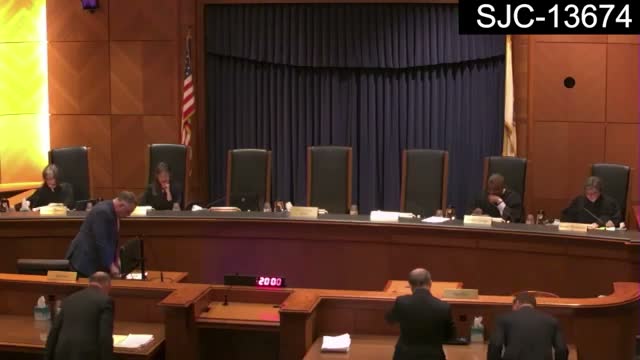
Attorney Seldon told the Supreme Judicial Court that Jerome Q. Mead’s conviction for first-degree murder rests in part on three videos recovered from Mead’s cell phone that, defense counsel argued, were outside the scope of a warrant issued for unrelated firearms offenses. "They don't get a do over," Seldon said, arguing the Commonwealth chose not to present affidavit or witness evidence to prove the discovery was lawful.
The issue centers on whether the files could be used under the plain-view doctrine or whether the later review of an extraction required a separate warrant. Seldon outlined the timeline: a homicide on Sept. 16; an unrelated firearms arrest on Sept. 24 during which police seized Mead’s phone; an extraction performed and delivered on CD; and, according to defense counsel, a copy of that CD later handed to a homicide detective. "He made a copy of that CD from Witherspoon on September 29, and he gave that copy to [the] homicide detective," Seldon said, pressing the court that the Commonwealth never established how or when the videos were located.
Commonwealth counsel Kenneth Steinfeld countered that the record does not show a separate search for homicide evidence and argued the defendant bears the initial burden to show an unconstitutional search occurred. "There was never a search for evidence of the homicide in this case," Steinfeld said, urging the court to respect the suppression record and the representations relied upon below.
Justices probed whether plain-view principles can be applied to digital extractions and whether an evidentiary hearing should be ordered now. A justice asked, "So if the suppression order should have been granted, what do we do with the sufficiency question? Is that something that should be resolved now or left for a retrial?" Defense counsel responded that the court can and should consider relief under rule 33e to avoid a potential miscarriage of justice if the videos were improperly admitted.
Both sides cited precedents: defense counsel invoked Balicki and Yousef as authorities treating later review of extracted digital media as a separate search for which a new warrant may be required; Steinfeld emphasized limits of the suppression record and argued that the representations accepted by the trial judge were sufficient absent a request for an evidentiary hearing. The justices also questioned whether remanding for an evidentiary hearing would give the Commonwealth an unfair second chance to shore up its case.
Argument concluded with no ruling from the bench. The court indicated it would consider the parties’ positions and issue a decision at a later date.
The issue centers on whether the files could be used under the plain-view doctrine or whether the later review of an extraction required a separate warrant. Seldon outlined the timeline: a homicide on Sept. 16; an unrelated firearms arrest on Sept. 24 during which police seized Mead’s phone; an extraction performed and delivered on CD; and, according to defense counsel, a copy of that CD later handed to a homicide detective. "He made a copy of that CD from Witherspoon on September 29, and he gave that copy to [the] homicide detective," Seldon said, pressing the court that the Commonwealth never established how or when the videos were located.
Commonwealth counsel Kenneth Steinfeld countered that the record does not show a separate search for homicide evidence and argued the defendant bears the initial burden to show an unconstitutional search occurred. "There was never a search for evidence of the homicide in this case," Steinfeld said, urging the court to respect the suppression record and the representations relied upon below.
Justices probed whether plain-view principles can be applied to digital extractions and whether an evidentiary hearing should be ordered now. A justice asked, "So if the suppression order should have been granted, what do we do with the sufficiency question? Is that something that should be resolved now or left for a retrial?" Defense counsel responded that the court can and should consider relief under rule 33e to avoid a potential miscarriage of justice if the videos were improperly admitted.
Both sides cited precedents: defense counsel invoked Balicki and Yousef as authorities treating later review of extracted digital media as a separate search for which a new warrant may be required; Steinfeld emphasized limits of the suppression record and argued that the representations accepted by the trial judge were sufficient absent a request for an evidentiary hearing. The justices also questioned whether remanding for an evidentiary hearing would give the Commonwealth an unfair second chance to shore up its case.
Argument concluded with no ruling from the bench. The court indicated it would consider the parties’ positions and issue a decision at a later date.
View the Full Meeting & All Its Details
This article offers just a summary. Unlock complete video, transcripts, and insights as a Founder Member.
✓
Watch full, unedited meeting videos
✓
Search every word spoken in unlimited transcripts
✓
AI summaries & real-time alerts (all government levels)
✓
Permanent access to expanding government content
30-day money-back guarantee
