Okaloosa officials warn of enrollment drop under state model; district may face multi‑million-dollar adjustments
February 10, 2026 | Okaloosa, School Districts, Florida
This article was created by AI summarizing key points discussed. AI makes mistakes, so for full details and context, please refer to the video of the full meeting. Please report any errors so we can fix them. Report an error »
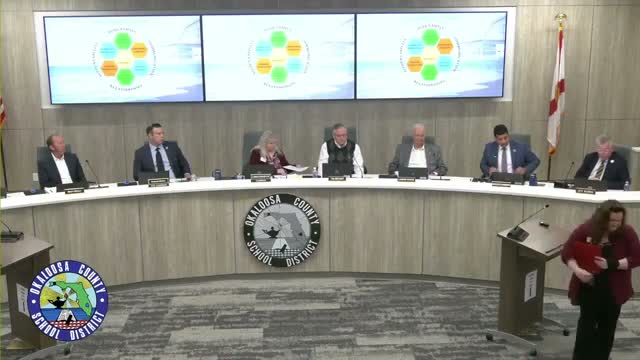
District staff on Wednesday gave a detailed briefing on full-time-equivalent (FTE) counts, state funding formulas and a state model that projects substantial enrollment declines for the 2627 school year.
The district’s FTE presenter cited Florida statute and the two annual FTE surveys (October and February), emphasizing that the February survey is the district’s current operational count. "FTE stands for full time equivalent," the presenter said while describing the statutory counting windows and how attendance and instructional minutes feed the formula.
Why it matters: state funding to Florida school districts is calculated using the FEFP (Florida Education Finance Program) model; decreases in FTE translate into lower state allocations. District staff said program cost factors and the base student allocation have not risen enough to offset the district’s declining seat time. Presenters pointed to several structural drivers: more students taking virtual courses, increased dual-enrollment and middle-school acceleration that reduces seat time counted by the home high school.
Key figures and projection: presenters said the district previously saw a drop of roughly 600 students in the current year; a state model (model 4) used for 2627 projects an additional decline that could total about 1,293 FTE in the modeled scenario. Officials warned that a combined multi‑year shortfall would require program and staffing adjustments; one senior administrator said recent budget adjustments have exceeded $22 million across the last few years and projected next-year reductions could be "in north of $10,000,000."
Responses and options: board members asked where missing students had gone; staff pointed to the Family Empowerment Scholarship (tax-credit funded PEP), natural attrition, and students opting out of full-day schedules. Staff also discussed the state's processing timeline (February submission processed in April) and said they will brief the board when final state numbers are available.
Procedural note: staff stressed there are limited short-term remedies that do not change operations—options include local scheduling changes, evaluating period structures (7‑period vs. 6‑period days), and targeting recruitment at the elementary level. The superintendent said the district has been planning and will come to the board with options during the budget process.
Ending: officials said they will continue monitoring February counts, coordinate with finance and present budget scenarios to the board as state calculations finalize in April.
The district’s FTE presenter cited Florida statute and the two annual FTE surveys (October and February), emphasizing that the February survey is the district’s current operational count. "FTE stands for full time equivalent," the presenter said while describing the statutory counting windows and how attendance and instructional minutes feed the formula.
Why it matters: state funding to Florida school districts is calculated using the FEFP (Florida Education Finance Program) model; decreases in FTE translate into lower state allocations. District staff said program cost factors and the base student allocation have not risen enough to offset the district’s declining seat time. Presenters pointed to several structural drivers: more students taking virtual courses, increased dual-enrollment and middle-school acceleration that reduces seat time counted by the home high school.
Key figures and projection: presenters said the district previously saw a drop of roughly 600 students in the current year; a state model (model 4) used for 2627 projects an additional decline that could total about 1,293 FTE in the modeled scenario. Officials warned that a combined multi‑year shortfall would require program and staffing adjustments; one senior administrator said recent budget adjustments have exceeded $22 million across the last few years and projected next-year reductions could be "in north of $10,000,000."
Responses and options: board members asked where missing students had gone; staff pointed to the Family Empowerment Scholarship (tax-credit funded PEP), natural attrition, and students opting out of full-day schedules. Staff also discussed the state's processing timeline (February submission processed in April) and said they will brief the board when final state numbers are available.
Procedural note: staff stressed there are limited short-term remedies that do not change operations—options include local scheduling changes, evaluating period structures (7‑period vs. 6‑period days), and targeting recruitment at the elementary level. The superintendent said the district has been planning and will come to the board with options during the budget process.
Ending: officials said they will continue monitoring February counts, coordinate with finance and present budget scenarios to the board as state calculations finalize in April.
Don't Miss a Word: See the Full Meeting!
Go beyond summaries. Unlock every video, transcript, and key insight with a Founder Membership.
✓
Get instant access to full meeting videos
✓
Search and clip any phrase from complete transcripts
✓
Receive AI-powered summaries & custom alerts
✓
Enjoy lifetime, unrestricted access to government data
30-day money-back guarantee
