Palo Alto leaders, families press for immediate steps after youth death at Caltrain crossing
February 10, 2026 | Palo Alto, Santa Clara County, California
This article was created by AI summarizing key points discussed. AI makes mistakes, so for full details and context, please refer to the video of the full meeting. Please report any errors so we can fix them. Report an error »
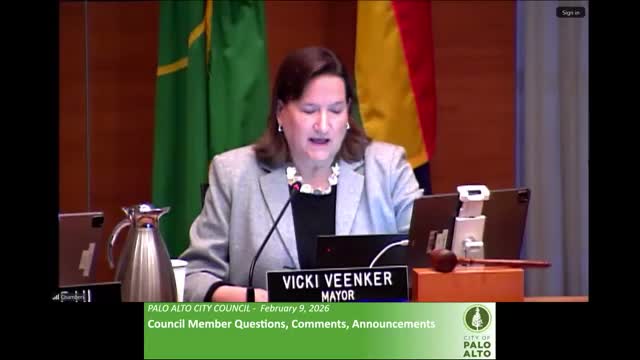
Mayor Veenker opened the Feb. 9 meeting by acknowledging the city’s grief after last week’s death of a Palo Alto youth on the Caltrain tracks and announcing an ad hoc rail safety and youth mental-health committee to pursue urgent steps. “We are all heartbroken,” the mayor said, urging residents to use the city’s mental-health resources (www.paloalto.gov/bewell; 988).
The ad hoc committee, chaired by Council Member Lythcott Haines with Council Member Burt and Vice Mayor Stone serving, reported it has already met with city staff and Caltrain. Lythcott Haines told the council Caltrain has installed intrusion-detection technology at Churchill Crossing adjacent to Palo Alto High School and plans installations at other crossings; the committee is evaluating additional measures including paid security, other access restrictions and, as an option, closure of Churchill Crossing. She added the committee will need to coordinate any closure with Caltrain and the California Public Utilities Commission because of regulatory authority.
Public commenters pressed for rapid action. Students, parents and community members described multiple recent suicides at local rail crossings and urged immediate steps to reduce access to lethal means. One parent—reading comments from a family directly affected—urged the council to “close Churchill” and add patrols; track-watch volunteers and therapists described the crossings as an ongoing trauma trigger for students and families. Several speakers linked prevention to a mix of short-term safety steps and longer-term investments in mental-health services and youth programming.
Council members emphasized the complexity of choices and the need to act quickly but with partners. City leaders said staff and the ad hoc committee will continue to gather feasibility information and return recommendations to the full council soon; Lythcott Haines said the ad hoc hoped to present initial options "possibly by the end of the month." The mayor, council and staff repeatedly linked the local effort to Caltrain, the school district and state regulators and asked residents to use grief resources in the meantime.
The council did not take formal action on closures or deployments at the meeting; the ad hoc committee will continue engagement with partners and report back with recommendations and implementation details.
The ad hoc committee, chaired by Council Member Lythcott Haines with Council Member Burt and Vice Mayor Stone serving, reported it has already met with city staff and Caltrain. Lythcott Haines told the council Caltrain has installed intrusion-detection technology at Churchill Crossing adjacent to Palo Alto High School and plans installations at other crossings; the committee is evaluating additional measures including paid security, other access restrictions and, as an option, closure of Churchill Crossing. She added the committee will need to coordinate any closure with Caltrain and the California Public Utilities Commission because of regulatory authority.
Public commenters pressed for rapid action. Students, parents and community members described multiple recent suicides at local rail crossings and urged immediate steps to reduce access to lethal means. One parent—reading comments from a family directly affected—urged the council to “close Churchill” and add patrols; track-watch volunteers and therapists described the crossings as an ongoing trauma trigger for students and families. Several speakers linked prevention to a mix of short-term safety steps and longer-term investments in mental-health services and youth programming.
Council members emphasized the complexity of choices and the need to act quickly but with partners. City leaders said staff and the ad hoc committee will continue to gather feasibility information and return recommendations to the full council soon; Lythcott Haines said the ad hoc hoped to present initial options "possibly by the end of the month." The mayor, council and staff repeatedly linked the local effort to Caltrain, the school district and state regulators and asked residents to use grief resources in the meantime.
The council did not take formal action on closures or deployments at the meeting; the ad hoc committee will continue engagement with partners and report back with recommendations and implementation details.
Don't Miss a Word: See the Full Meeting!
Go beyond summaries. Unlock every video, transcript, and key insight with a Founder Membership.
✓
Get instant access to full meeting videos
✓
Search and clip any phrase from complete transcripts
✓
Receive AI-powered summaries & custom alerts
✓
Enjoy lifetime, unrestricted access to government data
30-day money-back guarantee
