Livingston County farm leader highlights digesters, warns solar and overtime changes threaten dairy economics
February 09, 2026 | Livingston County, New York
This article was created by AI summarizing key points discussed. AI makes mistakes, so for full details and context, please refer to the video of the full meeting. Please report any errors so we can fix them. Report an error »
An unnamed presenter representing Noblehurst Farms and the Livingston County Farm Bureau outlined the county
s agricultural profile and renewable-energy operations and urged policy attention to mounting pressures on dairy producers.
The presenter described Noblehurst Farms as a seventh-generation operation that milks about 2,000 cows and operates an on‑farm methane digester and a subsidiary called Natural Upcycling in Piffard that collects food waste for energy production. "We feed our digester ... about 15,000 tons of food waste per month," he said, adding the unit can generate enough electricity to power roughly 500 homes.
He offered a snapshot of county agriculture: about 612 farms and roughly 196,000 acres of farmland (average farm size ~321 acres), with an estimated 1,000 on‑farm production jobs. "What these farms produce an economic impact in Livingston County?" he asked, answering that farms sell nearly $300 million in products annually, with livestock and dairy accounting for about $200 million of that total.
Presenter framed dairy as central to the local economy and labor market. He said Livingston County has about 27,500 milk cows and ranks among the state
s higher-producing counties for grains and dairy-related commodities. He also cautioned that farming operates on narrow margins: "Most important thing to remember, farmers are price takers," he said, and cited commodity price declines — class 3 milk at roughly $15–$16 per hundredweight now versus about $24 a year earlier, corn at about $4 per bushel versus $8 in 2022 — as evidence of a volatile marketplace that strains profitability.
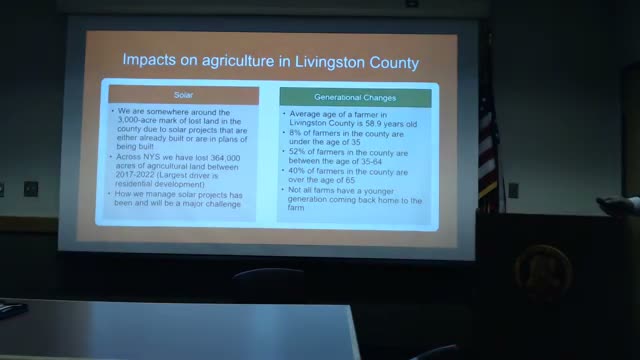
Two local pressures drew repeated attention. First, solar projects are converting farmland: the presenter estimated at least 3,000 acres in Livingston County have been or are slated for solar development and said that number may be higher once projects in the queue are accounted for. Second, demographic change is reducing the pool of young farmers — the presenter put the county
s average farmer age near 58–59, with only about 8% under 35 — which creates incentives for some owners to lease or sell land for nonagricultural uses.
During a wide-ranging question-and-answer session, attendees asked about land-protection options such as the Genesee Valley Conservancy and purchase-of-development-rights programs; the presenter recommended working with the conservancy and noted it has protected significant acreage. Dan Kai, Livingston County planner for the USDA Natural Resource Conservation Service, explained wetland and agricultural land easement partnerships and funding mechanisms.
The presenter also stressed the interaction between renewable-energy siting and grid capacity, saying his farm had been unable to expand digester export capacity because local substations lacked spare interconnection capacity, with solar projects already consuming queued capacity. "If you want to upgrade the substation, you can pay the $2,000,000 and you can do that," he said.
He closed by urging public engagement and farm visits to bridge urban-rural understanding, noting school field trips, FFA and farm tours as existing entry points.
The Environmental Management Council hosted the session and left time for audience follow-up and possible future meetings.
s agricultural profile and renewable-energy operations and urged policy attention to mounting pressures on dairy producers.
The presenter described Noblehurst Farms as a seventh-generation operation that milks about 2,000 cows and operates an on‑farm methane digester and a subsidiary called Natural Upcycling in Piffard that collects food waste for energy production. "We feed our digester ... about 15,000 tons of food waste per month," he said, adding the unit can generate enough electricity to power roughly 500 homes.
He offered a snapshot of county agriculture: about 612 farms and roughly 196,000 acres of farmland (average farm size ~321 acres), with an estimated 1,000 on‑farm production jobs. "What these farms produce an economic impact in Livingston County?" he asked, answering that farms sell nearly $300 million in products annually, with livestock and dairy accounting for about $200 million of that total.
Presenter framed dairy as central to the local economy and labor market. He said Livingston County has about 27,500 milk cows and ranks among the state
s higher-producing counties for grains and dairy-related commodities. He also cautioned that farming operates on narrow margins: "Most important thing to remember, farmers are price takers," he said, and cited commodity price declines — class 3 milk at roughly $15–$16 per hundredweight now versus about $24 a year earlier, corn at about $4 per bushel versus $8 in 2022 — as evidence of a volatile marketplace that strains profitability.
Two local pressures drew repeated attention. First, solar projects are converting farmland: the presenter estimated at least 3,000 acres in Livingston County have been or are slated for solar development and said that number may be higher once projects in the queue are accounted for. Second, demographic change is reducing the pool of young farmers — the presenter put the county
s average farmer age near 58–59, with only about 8% under 35 — which creates incentives for some owners to lease or sell land for nonagricultural uses.
During a wide-ranging question-and-answer session, attendees asked about land-protection options such as the Genesee Valley Conservancy and purchase-of-development-rights programs; the presenter recommended working with the conservancy and noted it has protected significant acreage. Dan Kai, Livingston County planner for the USDA Natural Resource Conservation Service, explained wetland and agricultural land easement partnerships and funding mechanisms.
The presenter also stressed the interaction between renewable-energy siting and grid capacity, saying his farm had been unable to expand digester export capacity because local substations lacked spare interconnection capacity, with solar projects already consuming queued capacity. "If you want to upgrade the substation, you can pay the $2,000,000 and you can do that," he said.
He closed by urging public engagement and farm visits to bridge urban-rural understanding, noting school field trips, FFA and farm tours as existing entry points.
The Environmental Management Council hosted the session and left time for audience follow-up and possible future meetings.
View the Full Meeting & All Its Details
This article offers just a summary. Unlock complete video, transcripts, and insights as a Founder Member.
✓
Watch full, unedited meeting videos
✓
Search every word spoken in unlimited transcripts
✓
AI summaries & real-time alerts (all government levels)
✓
Permanent access to expanding government content
30-day money-back guarantee
