Board denies proposed women’s recovery residence at 822 Green Street after neighbors raise parking, safety concerns
February 10, 2026 | Madison City, Jefferson County, Indiana
This article was created by AI summarizing key points discussed. AI makes mistakes, so for full details and context, please refer to the video of the full meeting. Please report any errors so we can fix them. Report an error »
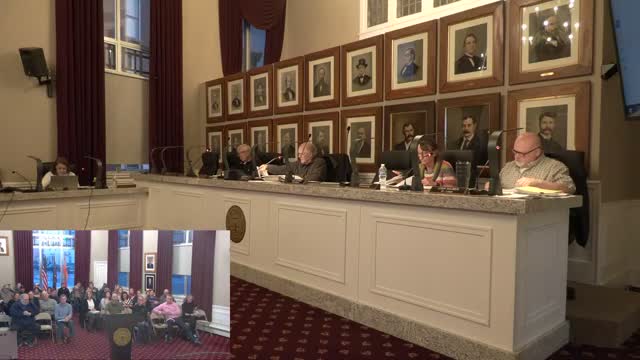
MADISON — The Madison Board of Zoning Appeals voted on Feb. 9 to deny a conditional‑use application for a proposed women’s recovery residence at 822 Green Street, rejecting the application by a 3‑1 vote after more than two hours of testimony from the applicant, residents and recovery advocates.
Sherilyn Miller, appearing for Recovery Foundation of Southern Indiana, described the house as a structured recovery residence for women with a maximum capacity of 10 residents in five bedrooms and a program model that requires employment, participation in recovery meetings and life‑skills classes. Miller said the program would seek state oversight, including certification through the Department of Mental Health as a level‑3 recovery residence and enrollment as a Recovery Works provider. "Stable housing is one of the strongest predictors of long‑term recovery," Miller said, arguing the house would reduce strain on local health and public‑safety resources.
Neighbors and other residents voiced opposition focused on parking, traffic and the site’s proximity to a sports complex used by children. Jacob McCollum, a resident who identified himself as a field‑grade officer in the Indiana Army National Guard, said relying on the sports complex parking to serve a residential property was "an unfair use" and that the property lacked required on‑site parking. "If you take a look at the property ... you can't park in the yard according to the current ordinances," McCollum said.
Several speakers raised questions about program oversight, credentials and outcomes. Connie McCollum, who said she has worked in correctional reentry programs, cited a statistic and asked what safeguards would follow program failures: "68 percent, according to SAMHSA ... 68 percent of people that enter into recovery in transitional housing fail within the first several months. So what happens when these people fail?" Tammy Hagemeyer, an RN who has specialized in addiction treatment, warned the board that it approves the structure but has limited authority to enforce program standards after approval.
Supporters of the proposed house spoke as well. Maggie Parks, who said she completed a recovery program in Madison and now works, urged approval and recounted personal benefits from recovery housing. John Fort Wendell and others described successful outcomes from local recovery residences and suggested site‑specific solutions to mitigate parking concerns.
Board members considered the nine state criteria that govern conditional uses and discussed the forthcoming unified development ordinance (UDO), which will reclassify "recovery residence" and change where such uses are permissible. Staff and one board member noted that applicants file under the current ordinance, and that the new UDO could make a similar application ineligible in residential districts. During deliberations the chair offered the board options including time‑limited approval with conditions to address parking and program concerns.
After debate the board took a motion to deny the application. The board recorded the outcome as a denial by a 3‑1 vote. The chair told the applicant she could seek another location and noted the community appears to support recovery programming in principle but not at the proposed site.
The applicant, Sherilyn Miller, said the purchase and operation would be contingent on receiving the conditional use and that the organization would continue searching for an appropriate site. The board record shows the application was denied; the applicant was advised to explore alternate locations and to consider site and parking solutions if reapplying.
What happens next: The application was denied and there is no board direction to refile at the same address. Miller said the organization will continue seeking sites that meet the program’s needs and zoning requirements.
Sherilyn Miller, appearing for Recovery Foundation of Southern Indiana, described the house as a structured recovery residence for women with a maximum capacity of 10 residents in five bedrooms and a program model that requires employment, participation in recovery meetings and life‑skills classes. Miller said the program would seek state oversight, including certification through the Department of Mental Health as a level‑3 recovery residence and enrollment as a Recovery Works provider. "Stable housing is one of the strongest predictors of long‑term recovery," Miller said, arguing the house would reduce strain on local health and public‑safety resources.
Neighbors and other residents voiced opposition focused on parking, traffic and the site’s proximity to a sports complex used by children. Jacob McCollum, a resident who identified himself as a field‑grade officer in the Indiana Army National Guard, said relying on the sports complex parking to serve a residential property was "an unfair use" and that the property lacked required on‑site parking. "If you take a look at the property ... you can't park in the yard according to the current ordinances," McCollum said.
Several speakers raised questions about program oversight, credentials and outcomes. Connie McCollum, who said she has worked in correctional reentry programs, cited a statistic and asked what safeguards would follow program failures: "68 percent, according to SAMHSA ... 68 percent of people that enter into recovery in transitional housing fail within the first several months. So what happens when these people fail?" Tammy Hagemeyer, an RN who has specialized in addiction treatment, warned the board that it approves the structure but has limited authority to enforce program standards after approval.
Supporters of the proposed house spoke as well. Maggie Parks, who said she completed a recovery program in Madison and now works, urged approval and recounted personal benefits from recovery housing. John Fort Wendell and others described successful outcomes from local recovery residences and suggested site‑specific solutions to mitigate parking concerns.
Board members considered the nine state criteria that govern conditional uses and discussed the forthcoming unified development ordinance (UDO), which will reclassify "recovery residence" and change where such uses are permissible. Staff and one board member noted that applicants file under the current ordinance, and that the new UDO could make a similar application ineligible in residential districts. During deliberations the chair offered the board options including time‑limited approval with conditions to address parking and program concerns.
After debate the board took a motion to deny the application. The board recorded the outcome as a denial by a 3‑1 vote. The chair told the applicant she could seek another location and noted the community appears to support recovery programming in principle but not at the proposed site.
The applicant, Sherilyn Miller, said the purchase and operation would be contingent on receiving the conditional use and that the organization would continue searching for an appropriate site. The board record shows the application was denied; the applicant was advised to explore alternate locations and to consider site and parking solutions if reapplying.
What happens next: The application was denied and there is no board direction to refile at the same address. Miller said the organization will continue seeking sites that meet the program’s needs and zoning requirements.
Don't Miss a Word: See the Full Meeting!
Go beyond summaries. Unlock every video, transcript, and key insight with a Founder Membership.
✓
Get instant access to full meeting videos
✓
Search and clip any phrase from complete transcripts
✓
Receive AI-powered summaries & custom alerts
✓
Enjoy lifetime, unrestricted access to government data
30-day money-back guarantee
