Rutgers researcher presents ‘Resolve It’ in silico tool to help forensic DNA labs optimize detection and validation
February 09, 2026 | Office of Justice Programs, Department of Justice (DOJ), Executive, Federal
This article was created by AI summarizing key points discussed. AI makes mistakes, so for full details and context, please refer to the video of the full meeting. Please report any errors so we can fix them. Report an error »
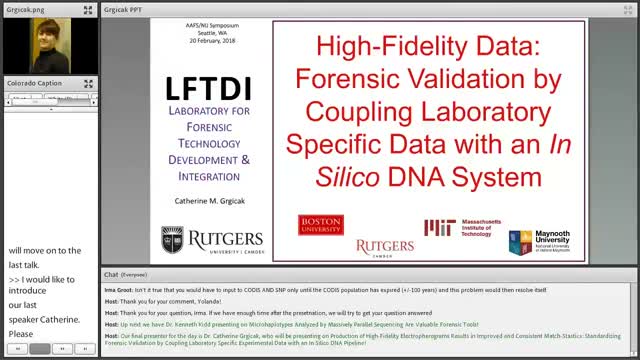
Dr. Catherine Grgachek, Henry Rutgers Chair in Chemistry at Rutgers University, described a software suite called Resolve It that her team developed to help forensic DNA laboratories optimize analytical settings and validate entire analytic pipelines.
Grgachek told attendees at the NIJ Forensic Science Center of Excellence presentation that many laboratories lose true signal because analytical thresholds and other parameters are not optimized as a single system. “The limit of detection for a DNA molecule is 1,” she said, arguing that an in silico approach can show when lowering thresholds preserves true peaks without producing unacceptable false detections.
The tool is intended to model the full laboratory pipeline: from PCR and sample preparation through instrument sensitivity, peak detection (using software such as GeneMapper or Osiris) and probabilistic interpretation. Labs provide a dilution-series CSV from their own instruments; Resolve It parameterizes equipment sensitivity, forces an initial copy number (for some tests to one) and runs simulated PCR and noise models to estimate false-positive and false-negative detection rates across scenarios. Grgachek said simulations can show when a lab should, for example, run 30 cycles instead of 29 or choose different injection settings.
Resolve It is modular: Grgachek described separate tabs for interpretation, an artifact-filtering module she called CleanIt, and a module for in silico PCR amplification and fluorescence conversion. She emphasized the software is designed so a lab can retain its preferred interpretation package and only use Resolve It for parameter optimization.
Grgachek presented examples showing how different lab settings yield different signal-to-noise resolutions and analytical-threshold recommendations. In one demonstration she showed an analytical threshold set at 15 RFU for one setting and noted that for another machine and kit the optimal threshold could be 45 RFU. “We still get good resolution, but now our optimal analytical threshold is 45 RFU rather than 15,” she said, adding that improving data quality should narrow variability in likelihood ratios across kits and instruments.
She also described how the team validated simulation-guided choices experimentally: after using Resolve It to identify optimized conditions, the group ran empirical dilution-series experiments and confirmed that match statistics and likelihood ratios improved under the simulated settings. On the scope of simulation testing, she said the team tested likelihood-ratio behavior against one million randomly simulated contributors to evaluate the probability that a random person would yield a likelihood ratio greater than 1.
Grgachek said the software is meant to lower the burden of validation as technology changes and to support emerging platforms. She noted the work received NIJ funding and that associated mixture datasets and project resources are freely available on the project website for laboratories to test their own conditions.
During audience questions, Grgachek reiterated that Resolve It is used to optimize laboratory parameters and that those optimizations are subsequently confirmed with experimental data; she said the group did not, however, run in silico mixtures and then process those same mixtures through the interpretation software as one combined automated check.
The session closed with thanks to Grgachek and the other presenters.
Grgachek told attendees at the NIJ Forensic Science Center of Excellence presentation that many laboratories lose true signal because analytical thresholds and other parameters are not optimized as a single system. “The limit of detection for a DNA molecule is 1,” she said, arguing that an in silico approach can show when lowering thresholds preserves true peaks without producing unacceptable false detections.
The tool is intended to model the full laboratory pipeline: from PCR and sample preparation through instrument sensitivity, peak detection (using software such as GeneMapper or Osiris) and probabilistic interpretation. Labs provide a dilution-series CSV from their own instruments; Resolve It parameterizes equipment sensitivity, forces an initial copy number (for some tests to one) and runs simulated PCR and noise models to estimate false-positive and false-negative detection rates across scenarios. Grgachek said simulations can show when a lab should, for example, run 30 cycles instead of 29 or choose different injection settings.
Resolve It is modular: Grgachek described separate tabs for interpretation, an artifact-filtering module she called CleanIt, and a module for in silico PCR amplification and fluorescence conversion. She emphasized the software is designed so a lab can retain its preferred interpretation package and only use Resolve It for parameter optimization.
Grgachek presented examples showing how different lab settings yield different signal-to-noise resolutions and analytical-threshold recommendations. In one demonstration she showed an analytical threshold set at 15 RFU for one setting and noted that for another machine and kit the optimal threshold could be 45 RFU. “We still get good resolution, but now our optimal analytical threshold is 45 RFU rather than 15,” she said, adding that improving data quality should narrow variability in likelihood ratios across kits and instruments.
She also described how the team validated simulation-guided choices experimentally: after using Resolve It to identify optimized conditions, the group ran empirical dilution-series experiments and confirmed that match statistics and likelihood ratios improved under the simulated settings. On the scope of simulation testing, she said the team tested likelihood-ratio behavior against one million randomly simulated contributors to evaluate the probability that a random person would yield a likelihood ratio greater than 1.
Grgachek said the software is meant to lower the burden of validation as technology changes and to support emerging platforms. She noted the work received NIJ funding and that associated mixture datasets and project resources are freely available on the project website for laboratories to test their own conditions.
During audience questions, Grgachek reiterated that Resolve It is used to optimize laboratory parameters and that those optimizations are subsequently confirmed with experimental data; she said the group did not, however, run in silico mixtures and then process those same mixtures through the interpretation software as one combined automated check.
The session closed with thanks to Grgachek and the other presenters.
View the Full Meeting & All Its Details
This article offers just a summary. Unlock complete video, transcripts, and insights as a Founder Member.
✓
Watch full, unedited meeting videos
✓
Search every word spoken in unlimited transcripts
✓
AI summaries & real-time alerts (all government levels)
✓
Permanent access to expanding government content
30-day money-back guarantee
