Study: Portable mass spectrometers could cut drug-lab backlogs and lower per-sample costs, but legal questions remain
February 09, 2026 | Office of Justice Programs, Department of Justice (DOJ), Executive, Federal
This article was created by AI summarizing key points discussed. AI makes mistakes, so for full details and context, please refer to the video of the full meeting. Please report any errors so we can fix them. Report an error »
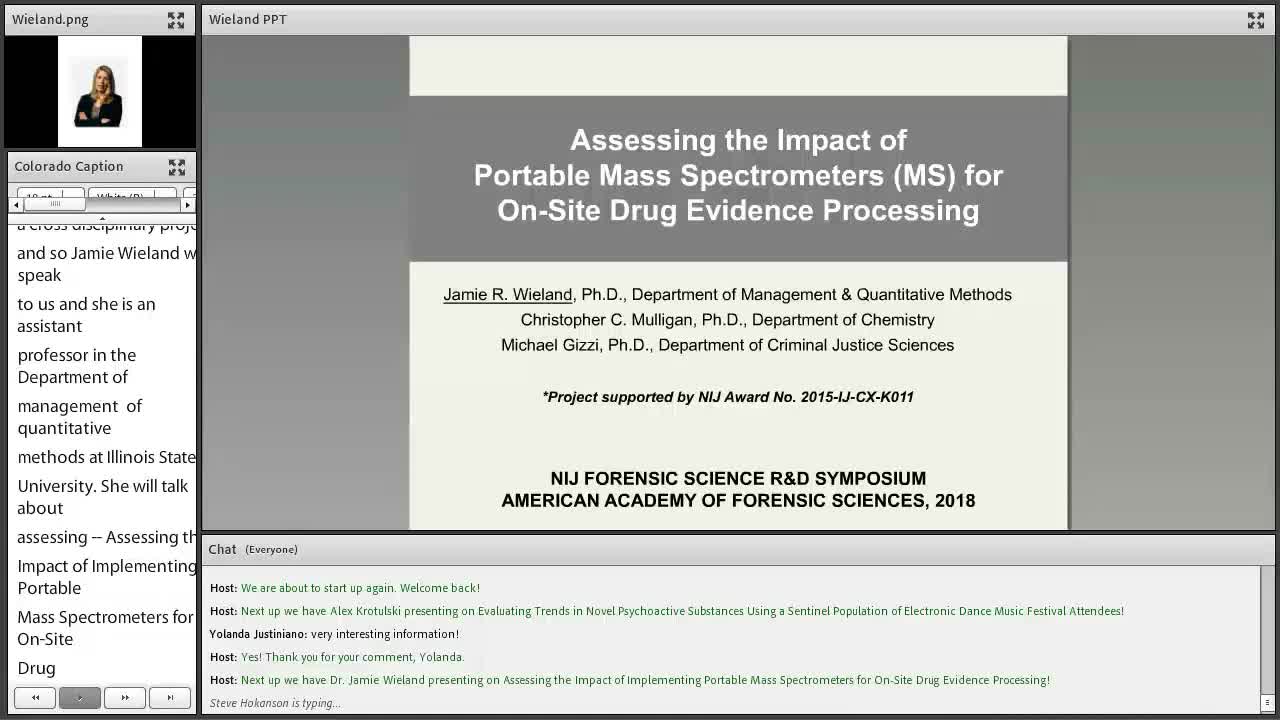
Jamie Whelan, an assistant professor in the Department of Management and Quantitative Methods at Illinois State University, told an academic seminar that portable mass spectrometers may allow police and crime-scene technicians to screen drug evidence on-site, reducing the number of samples labs must process.
Whelan said the interdisciplinary project (chemistry and criminal justice colleagues) looks at scientific, legal and economic impacts. "We're combining rapid screening techniques with on-site analysis of drug evidence," she said, adding that cross-training field practitioners could let agencies "determine the most pertinent samples to send off-site for analyses, in lab confirmation as needed."
The presentation reported laboratory-comparable accuracy in controlled tests. Whelan compared the study's results to 2017 DEA lab data and said the research produced a detection rate of "99.28 percent" versus "99.91 percent" in lab results, with a false-positive rate of "0.16 percent" compared with "0.88 percent" for lab testing; she said false positives in the study were attributed to user error. The team tested powders (including cocaine and bath salts), tablets, paraphernalia and injectables, including morphine and fentanyl, and used a 15-minute training session for trial users.
Whelan described the specific hardware used in the evaluation — the FLIR AIMS 1.2 — and the ionization approach (paper-spray ionization) that enables rapid screening of unprepared samples. She said the instrument is portable (just under 100 pounds), ruggedized for field use and supports multiple power options, including generator operation.
On costs, Whelan described a Monte Carlo simulation with 55 inputs and 100,000 replications to estimate the total cost per sample across collection, on-site analysis, transport and in-lab work. She reported a current-process mean operational cost of about "$166.98" per sample (standard deviation $12.51) and said scenario-based per-sample reductions ranged from roughly 27% to 64% depending on assumptions about who performs analyses and how instruments are deployed.
When Whelan added instrumentation acquisition and upkeep to the model, she reported breakeven examples such as about "702 samples per year" (roughly two samples per day) for one scenario and about "300 per year" (about one per day) in another, meaning per-sample costs fall with greater instrument utilization. Using a hypothetical large urban area with roughly 10,000 potentially processable evidence samples per year (about 30 per day), she estimated annual savings per system of roughly $400,000 to over $1,000,000, depending on the usage scenario and the number of systems deployed; she cautioned that savings would be distributed across state and local budgets.
Whelan also flagged legal and procedural concerns. She raised Fourth Amendment issues in an example: "if [an officer] were to screen your license for drug residue ... would they have probable cause then to search your vehicle?" She said that on-site analyses performed by officers (as opposed to third-party labs) create a risk of increased user bias similar to the difference between lab analysis and a breath test conducted by an officer. On contamination, she said protocols and software safeguards would be needed so operators must run blanks and be prevented from proceeding if contamination is detected.
Whelan acknowledged funding and support from the National Institute of Justice and sample support from the Bloomington, Illinois Police Department, said further work is underway to combine portable mass spectrometry with other field instruments (for example, Raman), and offered contact information for follow-up questions. During an online question-and-answer period, she reiterated that in a "presumptive" model on-site results would still be sent for confirmatory lab testing, whereas the "confirmatory" model assumes both analyses occur on-site under stricter protocols; she noted that court-admissibility and detailed procedural standards remain to be addressed.
The presentation left open next steps: further instrument-combination testing, development of contamination-prevention protocols and legal analysis of how on-site screening would interact with probable-cause standards and prosecutorial evidence rules.
Whelan said the interdisciplinary project (chemistry and criminal justice colleagues) looks at scientific, legal and economic impacts. "We're combining rapid screening techniques with on-site analysis of drug evidence," she said, adding that cross-training field practitioners could let agencies "determine the most pertinent samples to send off-site for analyses, in lab confirmation as needed."
The presentation reported laboratory-comparable accuracy in controlled tests. Whelan compared the study's results to 2017 DEA lab data and said the research produced a detection rate of "99.28 percent" versus "99.91 percent" in lab results, with a false-positive rate of "0.16 percent" compared with "0.88 percent" for lab testing; she said false positives in the study were attributed to user error. The team tested powders (including cocaine and bath salts), tablets, paraphernalia and injectables, including morphine and fentanyl, and used a 15-minute training session for trial users.
Whelan described the specific hardware used in the evaluation — the FLIR AIMS 1.2 — and the ionization approach (paper-spray ionization) that enables rapid screening of unprepared samples. She said the instrument is portable (just under 100 pounds), ruggedized for field use and supports multiple power options, including generator operation.
On costs, Whelan described a Monte Carlo simulation with 55 inputs and 100,000 replications to estimate the total cost per sample across collection, on-site analysis, transport and in-lab work. She reported a current-process mean operational cost of about "$166.98" per sample (standard deviation $12.51) and said scenario-based per-sample reductions ranged from roughly 27% to 64% depending on assumptions about who performs analyses and how instruments are deployed.
When Whelan added instrumentation acquisition and upkeep to the model, she reported breakeven examples such as about "702 samples per year" (roughly two samples per day) for one scenario and about "300 per year" (about one per day) in another, meaning per-sample costs fall with greater instrument utilization. Using a hypothetical large urban area with roughly 10,000 potentially processable evidence samples per year (about 30 per day), she estimated annual savings per system of roughly $400,000 to over $1,000,000, depending on the usage scenario and the number of systems deployed; she cautioned that savings would be distributed across state and local budgets.
Whelan also flagged legal and procedural concerns. She raised Fourth Amendment issues in an example: "if [an officer] were to screen your license for drug residue ... would they have probable cause then to search your vehicle?" She said that on-site analyses performed by officers (as opposed to third-party labs) create a risk of increased user bias similar to the difference between lab analysis and a breath test conducted by an officer. On contamination, she said protocols and software safeguards would be needed so operators must run blanks and be prevented from proceeding if contamination is detected.
Whelan acknowledged funding and support from the National Institute of Justice and sample support from the Bloomington, Illinois Police Department, said further work is underway to combine portable mass spectrometry with other field instruments (for example, Raman), and offered contact information for follow-up questions. During an online question-and-answer period, she reiterated that in a "presumptive" model on-site results would still be sent for confirmatory lab testing, whereas the "confirmatory" model assumes both analyses occur on-site under stricter protocols; she noted that court-admissibility and detailed procedural standards remain to be addressed.
The presentation left open next steps: further instrument-combination testing, development of contamination-prevention protocols and legal analysis of how on-site screening would interact with probable-cause standards and prosecutorial evidence rules.
View the Full Meeting & All Its Details
This article offers just a summary. Unlock complete video, transcripts, and insights as a Founder Member.
✓
Watch full, unedited meeting videos
✓
Search every word spoken in unlimited transcripts
✓
AI summaries & real-time alerts (all government levels)
✓
Permanent access to expanding government content
30-day money-back guarantee
