Senate committee hears S.291 to require disclosure of official travel funded by outside sources
February 07, 2026 | Government Operations, SENATE, Committees, Legislative , Vermont
This article was created by AI summarizing key points discussed. AI makes mistakes, so for full details and context, please refer to the video of the full meeting. Please report any errors so we can fix them. Report an error »
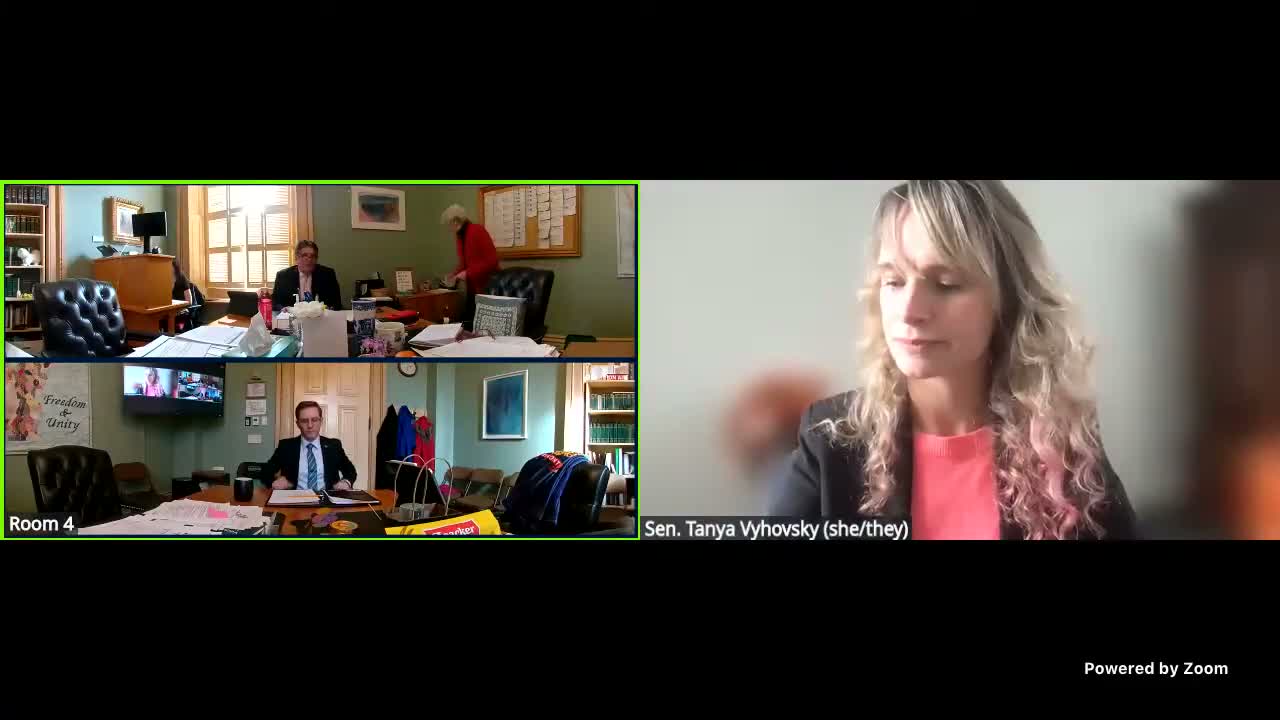
Senator Tanya Fivovsky told the Senate Committee on Government Operations on Feb. 6 that she sponsored S.291 to require disclosure of certain official travel paid for by outside sources, saying, “This is not a prohibition on that travel.”
Legislative counsel Tim Devon told the committee the bill would add a travel-disclosure requirement to the ethics provisions in Title 3, and would require members of the General Assembly and certain executive officers to file disclosures with the State Ethics Commission or another designated office. Devon said the covered executive officers would include the governor, lieutenant governor, treasurer, secretary and the attorney general as described in the bill text.
Under the proposal, a filer must report the purpose of the travel, whether the trip was taken in an official capacity, the itinerary (dates and stopovers) and, “with reasonable particularity,” any expense payments or reimbursements for transportation, food, tickets, lodging and other in‑kind items. The form must also identify which elements of travel costs were paid by the state, by the official, or by another source such as associations, lobbyists, political committees, parties or individuals.
Devon said the bill includes an exception: no disclosure would be required if travel is fully paid by the individual or by another state or the U.S. federal government. He also told the committee the draft does not appear to require claimants to submit substantiating documentation by default; it requires the descriptive elements on the form but not proof unless otherwise specified.
The committee also discussed mixed-purpose trips and timing. Senator White described traveling to the United Kingdom for a wedding where she was later invited to Parliament and asked whether only the portion paid by others would be reported; Devon said the bill contemplates identifying which elements of the trip were paid by others and that legislative counsel can help define thresholds for mixed-purpose travel. Devon said the bill would require filing within 30 calendar days after any cost is incurred, which could capture pre-purchased tickets and may require supplemental reporting as additional costs are incurred.
Devon said the bill would require a supplemental disclosure if a person or entity that paid for travel becomes involved in a matter concerning the filer within six months of the cost being incurred.
Several members raised administrative questions. One committee member suggested using the legislative office (citing Scott Moore) as a filing point until the State Ethics Commission has capacity; another warned the measure could impose new burdens on about 180 legislators plus executive officers. A senator urged transparency for trips funded by foreign governments, citing past delegations paid by Israel and Taiwan.
The committee did not take a vote on S.291 during the session. Members said legislative counsel would refine language on mixed-purpose travel, documentation and administrative procedures before the committee considers next steps.
Legislative counsel Tim Devon told the committee the bill would add a travel-disclosure requirement to the ethics provisions in Title 3, and would require members of the General Assembly and certain executive officers to file disclosures with the State Ethics Commission or another designated office. Devon said the covered executive officers would include the governor, lieutenant governor, treasurer, secretary and the attorney general as described in the bill text.
Under the proposal, a filer must report the purpose of the travel, whether the trip was taken in an official capacity, the itinerary (dates and stopovers) and, “with reasonable particularity,” any expense payments or reimbursements for transportation, food, tickets, lodging and other in‑kind items. The form must also identify which elements of travel costs were paid by the state, by the official, or by another source such as associations, lobbyists, political committees, parties or individuals.
Devon said the bill includes an exception: no disclosure would be required if travel is fully paid by the individual or by another state or the U.S. federal government. He also told the committee the draft does not appear to require claimants to submit substantiating documentation by default; it requires the descriptive elements on the form but not proof unless otherwise specified.
The committee also discussed mixed-purpose trips and timing. Senator White described traveling to the United Kingdom for a wedding where she was later invited to Parliament and asked whether only the portion paid by others would be reported; Devon said the bill contemplates identifying which elements of the trip were paid by others and that legislative counsel can help define thresholds for mixed-purpose travel. Devon said the bill would require filing within 30 calendar days after any cost is incurred, which could capture pre-purchased tickets and may require supplemental reporting as additional costs are incurred.
Devon said the bill would require a supplemental disclosure if a person or entity that paid for travel becomes involved in a matter concerning the filer within six months of the cost being incurred.
Several members raised administrative questions. One committee member suggested using the legislative office (citing Scott Moore) as a filing point until the State Ethics Commission has capacity; another warned the measure could impose new burdens on about 180 legislators plus executive officers. A senator urged transparency for trips funded by foreign governments, citing past delegations paid by Israel and Taiwan.
The committee did not take a vote on S.291 during the session. Members said legislative counsel would refine language on mixed-purpose travel, documentation and administrative procedures before the committee considers next steps.
Don't Miss a Word: See the Full Meeting!
Go beyond summaries. Unlock every video, transcript, and key insight with a Founder Membership.
✓
Get instant access to full meeting videos
✓
Search and clip any phrase from complete transcripts
✓
Receive AI-powered summaries & custom alerts
✓
Enjoy lifetime, unrestricted access to government data
30-day money-back guarantee
