NDOT proposes three speed-cushion installations on Watson Wood; neighbors to vote by ballot
November 22, 2025 | Department of Transportation (NDOT) Meetings, Nashville, Davidson County, Tennessee
This article was created by AI summarizing key points discussed. AI makes mistakes, so for full details and context, please refer to the video of the full meeting. Please report any errors so we can fix them. Report an error »
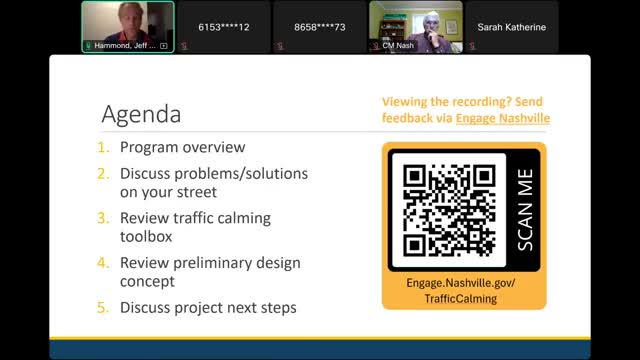
NDOT staff presented a preliminary plan to install three sets of speed cushions on Watson Wood, a residential street running between Edmonson Pike and Highcrest, and outlined the design, ballot and construction timeline. "These projects are very much resident driven and data driven," Councilman Nash said as he joined the meeting.
The project team said Watson Wood scored near the top of NDOT’s backlog and that the proposal responds to measured speeding and neighborhood requests. Presenter Jeff Hammond described site data showing an 85th-percentile speed of about 35 miles per hour, roughly 500 vehicles per day, and an approximately 22-foot roadway width — conditions that make the street a typical candidate for cushions. "If we can space them around 400 to 600 feet, that will give us a good slow progression of speed along the length of the project," Hammond said.
NDOT’s preliminary design calls for two sets of cushions between Edmonson Pike and Westcrest and a third set near Highcrest along the roughly 1,500-foot project segment. The agency explained its standard cushions are about 3 inches tall and 6 feet wide, with a default cushion length of 10.5 feet; shorter 7-foot units and longer units are used in specific contexts. NDOT staff emphasized constraints: cushions are typically avoided on slopes greater than about 5–8 percent and are not placed within roughly 15 feet of driveways to reduce conflicts.
The presenter described alternatives in NDOT’s toolbox — including speed tables (used sparingly because of emergency-response impacts), radar feedback signs for sites where cushions are infeasible, pavement-edge markings to visually narrow wide streets, and rarely used measures such as chicanes or traffic circles. NDOT maintains before-and-after monitoring and said cushions commonly reduce speeds by roughly 9–11 mph on many projects, while noting results vary by site.
Next steps: NDOT will conduct detailed field measurements, finalize design plans and post them online for review. The agency may hold a second neighborhood meeting or proceed directly to a six-week ballot. Ballots will be mailed to property owners whose parcels abut the project limits; horizontal-property configurations will receive ballots for each housing unit, owners with multiple parcels receive a single ballot and renters do not receive ballots. "Two thirds of the people who have voted in favor of the project will move it forward," Hammond said. If the ballot passes and contractor scheduling works as expected, NDOT estimated installation could occur in about a year.
Councilman Nash encouraged neighbors to check with one another when ballots are issued and to contact NDOT with questions. NDOT provided contact options (trafficcalming@Nashville.gov, the project QR link and trafficcalming.nashville.gov) and said design plans will be posted online before ballots are distributed.
The project team said Watson Wood scored near the top of NDOT’s backlog and that the proposal responds to measured speeding and neighborhood requests. Presenter Jeff Hammond described site data showing an 85th-percentile speed of about 35 miles per hour, roughly 500 vehicles per day, and an approximately 22-foot roadway width — conditions that make the street a typical candidate for cushions. "If we can space them around 400 to 600 feet, that will give us a good slow progression of speed along the length of the project," Hammond said.
NDOT’s preliminary design calls for two sets of cushions between Edmonson Pike and Westcrest and a third set near Highcrest along the roughly 1,500-foot project segment. The agency explained its standard cushions are about 3 inches tall and 6 feet wide, with a default cushion length of 10.5 feet; shorter 7-foot units and longer units are used in specific contexts. NDOT staff emphasized constraints: cushions are typically avoided on slopes greater than about 5–8 percent and are not placed within roughly 15 feet of driveways to reduce conflicts.
The presenter described alternatives in NDOT’s toolbox — including speed tables (used sparingly because of emergency-response impacts), radar feedback signs for sites where cushions are infeasible, pavement-edge markings to visually narrow wide streets, and rarely used measures such as chicanes or traffic circles. NDOT maintains before-and-after monitoring and said cushions commonly reduce speeds by roughly 9–11 mph on many projects, while noting results vary by site.
Next steps: NDOT will conduct detailed field measurements, finalize design plans and post them online for review. The agency may hold a second neighborhood meeting or proceed directly to a six-week ballot. Ballots will be mailed to property owners whose parcels abut the project limits; horizontal-property configurations will receive ballots for each housing unit, owners with multiple parcels receive a single ballot and renters do not receive ballots. "Two thirds of the people who have voted in favor of the project will move it forward," Hammond said. If the ballot passes and contractor scheduling works as expected, NDOT estimated installation could occur in about a year.
Councilman Nash encouraged neighbors to check with one another when ballots are issued and to contact NDOT with questions. NDOT provided contact options (trafficcalming@Nashville.gov, the project QR link and trafficcalming.nashville.gov) and said design plans will be posted online before ballots are distributed.
View the Full Meeting & All Its Details
This article offers just a summary. Unlock complete video, transcripts, and insights as a Founder Member.
✓
Watch full, unedited meeting videos
✓
Search every word spoken in unlimited transcripts
✓
AI summaries & real-time alerts (all government levels)
✓
Permanent access to expanding government content
30-day money-back guarantee
