Multnomah County warns of $87 million SHS funding gap as Metro warns tax remains volatile
February 09, 2026 | Multnomah County, Oregon
This article was created by AI summarizing key points discussed. AI makes mistakes, so for full details and context, please refer to the video of the full meeting. Please report any errors so we can fix them. Report an error »
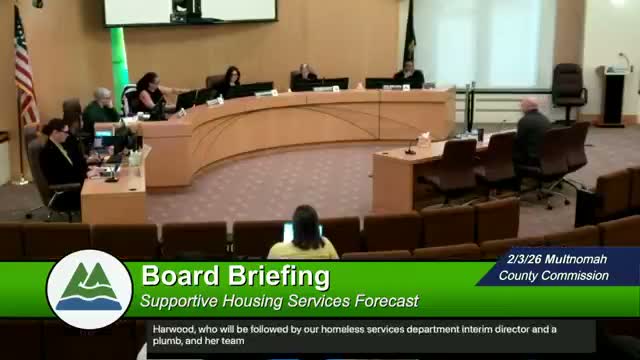
Multnomah County officials told the Board of Commissioners on Tuesday that the county faces a substantial funding shortfall for supportive housing services (SHS) in fiscal year 2027.
Anna Plumb, interim director of the Homeless Services Department, said the county spent most one‑time carryover funding accumulated during the pandemic and 2024 program ramp‑ups, leaving primarily ongoing resources that she said are not sufficient to sustain the existing system into FY27. "The short story is we're going to have a revenue gap," Plumb said.
The department's finance director, Antoinette, presented a discrete funding projection: staff are estimating an $87,000,000 difference between the FY26 revised budget ($334,000,000) and projected FY27 funding of about $247,000,000. Antoinette cautioned the number could change as the budget process progresses and said final figures will be published in the county's requested budget on Feb. 13.
Metro also briefed the board immediately before the HSD update. Josh Harwood, who leads Metro's revenue and analytics work, said the new housing services tax remains concentrated and therefore volatile: "In October, we got $40,000,000 in unexpected revenue for past year receipts," he said, adding that similar one‑time positive or negative swings are possible and that local reliance on a small set of high‑liability filers makes the revenue stream less resilient.
What the department plans and what the budget will include
Plumb said HSD programmed a large one‑time receipt in 2024 (about $50,000,000) to respond to an immediate crisis and that past underspending in the program's early years produced significant carryover that is now largely spent. Because of those dynamics and the state rebalance that reduced expected state funds, the department has been planning adjustments since mid‑2025 and has developed a problem statement and proposed solution to redesign the system to house as many people as possible within smaller ongoing resources.
Plumb described three priorites the department will use to frame FY27 decisions, in prioritized order: keep people housed (protect existing placements), prioritize housing placement (increase placements into permanent housing), and maximize shelter effectiveness (ensure shelter functions as a pathway to housing). She said staff are using program‑level evaluations, a recently released shelter report, facility condition reviews, cost‑of‑service tools and extensive provider engagement to inform tradeoffs.
Linking KPIs and budget choices
Commissioners repeatedly pressed staff to show how KPIs, funded levels and outcomes will be tied together. Jillian (a staff presenter) explained that the previous KPI set expired in December and that the new KPIs will be linked to the budget process: "If you fund housing placements for example at this level, this is how many placements will get at the end of the year," she said. Several commissioners asked for a clear comparison showing what the previously adopted community sheltering strategy achieved, why placement goals were not met, and how the revised approach differs.
City of Portland funding and reserves
Plumb said county staff are in active conversations with the City of Portland and understand the city intends to keep the money flowing into the homelessness response system but plans to use its contribution to support alternative shelter sites. Commissioners raised concerns that a roughly $25,000,000 shift in city funding toward city‑run shelter strategies will constrain the county's ability to maintain shelter units that have historically supported placement pathways.
Antoinette said the county's reserve policy target is 10% of forecast, while Metro recommends 15%; she noted the county tapped reserves last year and has committed to rebuilding them over a three‑year period where possible.
What happens next
Staff emphasized that specific budget allocations were not being proposed in this briefing and that the requested budget — with more detail on proposed responses to the revenue gap, spending scenarios and expected people‑served outcomes — will be published on Feb. 13. Chair Vega Peterson said joint sessions with City of Portland leadership on roles and responsibilities are being scheduled to inform decisions.
Commissioners asked for follow‑up materials, including: (1) analysis of why the community sheltering strategy did not achieve its placement goals, (2) explicit KPI targets tied to funded scenarios, (3) district or geographic breakdowns where possible, and (4) clarifications about the City of Portland funding commitments. The board will consider those materials as part of the FY27 budget process.
Anna Plumb, interim director of the Homeless Services Department, said the county spent most one‑time carryover funding accumulated during the pandemic and 2024 program ramp‑ups, leaving primarily ongoing resources that she said are not sufficient to sustain the existing system into FY27. "The short story is we're going to have a revenue gap," Plumb said.
The department's finance director, Antoinette, presented a discrete funding projection: staff are estimating an $87,000,000 difference between the FY26 revised budget ($334,000,000) and projected FY27 funding of about $247,000,000. Antoinette cautioned the number could change as the budget process progresses and said final figures will be published in the county's requested budget on Feb. 13.
Metro also briefed the board immediately before the HSD update. Josh Harwood, who leads Metro's revenue and analytics work, said the new housing services tax remains concentrated and therefore volatile: "In October, we got $40,000,000 in unexpected revenue for past year receipts," he said, adding that similar one‑time positive or negative swings are possible and that local reliance on a small set of high‑liability filers makes the revenue stream less resilient.
What the department plans and what the budget will include
Plumb said HSD programmed a large one‑time receipt in 2024 (about $50,000,000) to respond to an immediate crisis and that past underspending in the program's early years produced significant carryover that is now largely spent. Because of those dynamics and the state rebalance that reduced expected state funds, the department has been planning adjustments since mid‑2025 and has developed a problem statement and proposed solution to redesign the system to house as many people as possible within smaller ongoing resources.
Plumb described three priorites the department will use to frame FY27 decisions, in prioritized order: keep people housed (protect existing placements), prioritize housing placement (increase placements into permanent housing), and maximize shelter effectiveness (ensure shelter functions as a pathway to housing). She said staff are using program‑level evaluations, a recently released shelter report, facility condition reviews, cost‑of‑service tools and extensive provider engagement to inform tradeoffs.
Linking KPIs and budget choices
Commissioners repeatedly pressed staff to show how KPIs, funded levels and outcomes will be tied together. Jillian (a staff presenter) explained that the previous KPI set expired in December and that the new KPIs will be linked to the budget process: "If you fund housing placements for example at this level, this is how many placements will get at the end of the year," she said. Several commissioners asked for a clear comparison showing what the previously adopted community sheltering strategy achieved, why placement goals were not met, and how the revised approach differs.
City of Portland funding and reserves
Plumb said county staff are in active conversations with the City of Portland and understand the city intends to keep the money flowing into the homelessness response system but plans to use its contribution to support alternative shelter sites. Commissioners raised concerns that a roughly $25,000,000 shift in city funding toward city‑run shelter strategies will constrain the county's ability to maintain shelter units that have historically supported placement pathways.
Antoinette said the county's reserve policy target is 10% of forecast, while Metro recommends 15%; she noted the county tapped reserves last year and has committed to rebuilding them over a three‑year period where possible.
What happens next
Staff emphasized that specific budget allocations were not being proposed in this briefing and that the requested budget — with more detail on proposed responses to the revenue gap, spending scenarios and expected people‑served outcomes — will be published on Feb. 13. Chair Vega Peterson said joint sessions with City of Portland leadership on roles and responsibilities are being scheduled to inform decisions.
Commissioners asked for follow‑up materials, including: (1) analysis of why the community sheltering strategy did not achieve its placement goals, (2) explicit KPI targets tied to funded scenarios, (3) district or geographic breakdowns where possible, and (4) clarifications about the City of Portland funding commitments. The board will consider those materials as part of the FY27 budget process.
Don't Miss a Word: See the Full Meeting!
Go beyond summaries. Unlock every video, transcript, and key insight with a Founder Membership.
✓
Get instant access to full meeting videos
✓
Search and clip any phrase from complete transcripts
✓
Receive AI-powered summaries & custom alerts
✓
Enjoy lifetime, unrestricted access to government data
30-day money-back guarantee
