Davenport outlines $65.7M Year‑1 CIP; council presses staff to increase neighborhood‑street funding
February 07, 2026 | Davenport City, Scott County, Iowa
This article was created by AI summarizing key points discussed. AI makes mistakes, so for full details and context, please refer to the video of the full meeting. Please report any errors so we can fix them. Report an error »
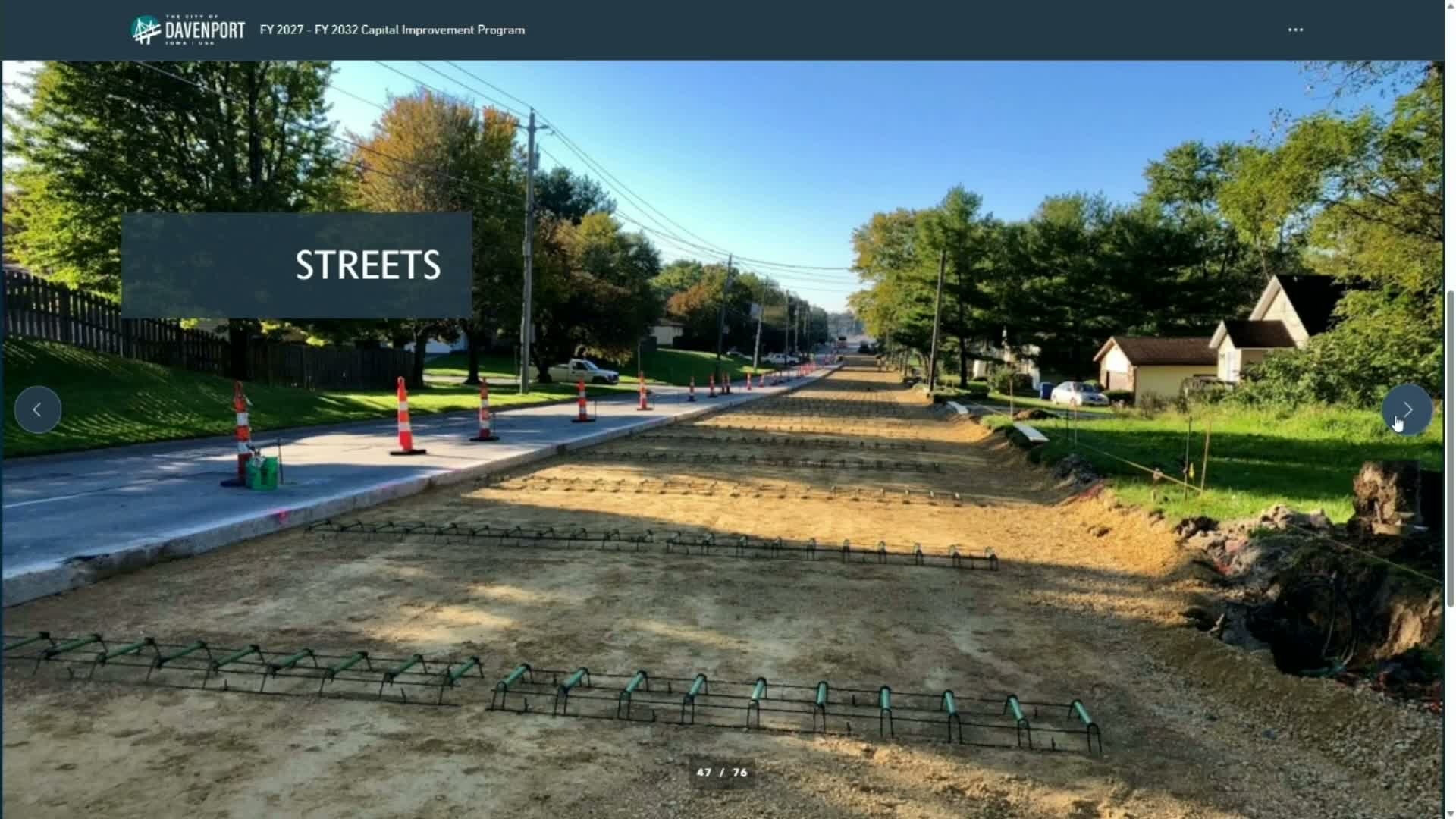
Davenport staff presented a six‑year capital improvement program during the city’s Feb. 7 budget workshop that places streets and sewer work at the top of capital priorities. Year 1 (fiscal 2027) is roughly $65.7 million, a rise driven by recent federal and state grant awards that will require local matches.
Clay, the city’s CIP lead, said streets and sanitary sewer projects together represent roughly two‑thirds of the FY27 program: “That dark blue is your street network… and that orange is your water pollution control plant,” he said while walking through the funding chart.
Staff described the street-selection framework: condition-based Payment Condition Index (PCI) scores, average daily traffic counts, drainage and subsurface needs, leverage from grants and the ability to avoid repeated utility cuts. Staff also provided unit cost guidance (preventive treatments are tens of dollars per square yard; full reconstruction ranges roughly $130–$150 per square yard) to explain variability in project scope and cost.
A lengthy council discussion followed about whether to raise neighborhood‑street funding. One council member proposed an aspirational target (for example, an additional ~$1 million per ward annually) to make visible progress; staff cautioned that while a $1 million increase buys approximately a mile of roadwork, materially improving the entire system would require sustained tens-of-millions of annual funding and also changes to delivery capacity.
Staff also flagged NEPA review delays for federally funded bridges and major projects, noting that the Iowa DOT’s current review backlog is pushing project timelines beyond previously expected construction seasons.
No vote or formal action was taken; staff said they would return with models and scenarios showing the effect of sustained neighborhood‑street increases versus one‑time additions, and with more detailed mapping by ward upon request.
Clay, the city’s CIP lead, said streets and sanitary sewer projects together represent roughly two‑thirds of the FY27 program: “That dark blue is your street network… and that orange is your water pollution control plant,” he said while walking through the funding chart.
Staff described the street-selection framework: condition-based Payment Condition Index (PCI) scores, average daily traffic counts, drainage and subsurface needs, leverage from grants and the ability to avoid repeated utility cuts. Staff also provided unit cost guidance (preventive treatments are tens of dollars per square yard; full reconstruction ranges roughly $130–$150 per square yard) to explain variability in project scope and cost.
A lengthy council discussion followed about whether to raise neighborhood‑street funding. One council member proposed an aspirational target (for example, an additional ~$1 million per ward annually) to make visible progress; staff cautioned that while a $1 million increase buys approximately a mile of roadwork, materially improving the entire system would require sustained tens-of-millions of annual funding and also changes to delivery capacity.
Staff also flagged NEPA review delays for federally funded bridges and major projects, noting that the Iowa DOT’s current review backlog is pushing project timelines beyond previously expected construction seasons.
No vote or formal action was taken; staff said they would return with models and scenarios showing the effect of sustained neighborhood‑street increases versus one‑time additions, and with more detailed mapping by ward upon request.
Don't Miss a Word: See the Full Meeting!
Go beyond summaries. Unlock every video, transcript, and key insight with a Founder Membership.
✓
Get instant access to full meeting videos
✓
Search and clip any phrase from complete transcripts
✓
Receive AI-powered summaries & custom alerts
✓
Enjoy lifetime, unrestricted access to government data
30-day money-back guarantee
