Davenport prioritizes sewer rehabilitation, private‑side I/I pilot and flood mitigation projects
February 07, 2026 | Davenport City, Scott County, Iowa
This article was created by AI summarizing key points discussed. AI makes mistakes, so for full details and context, please refer to the video of the full meeting. Please report any errors so we can fix them. Report an error »
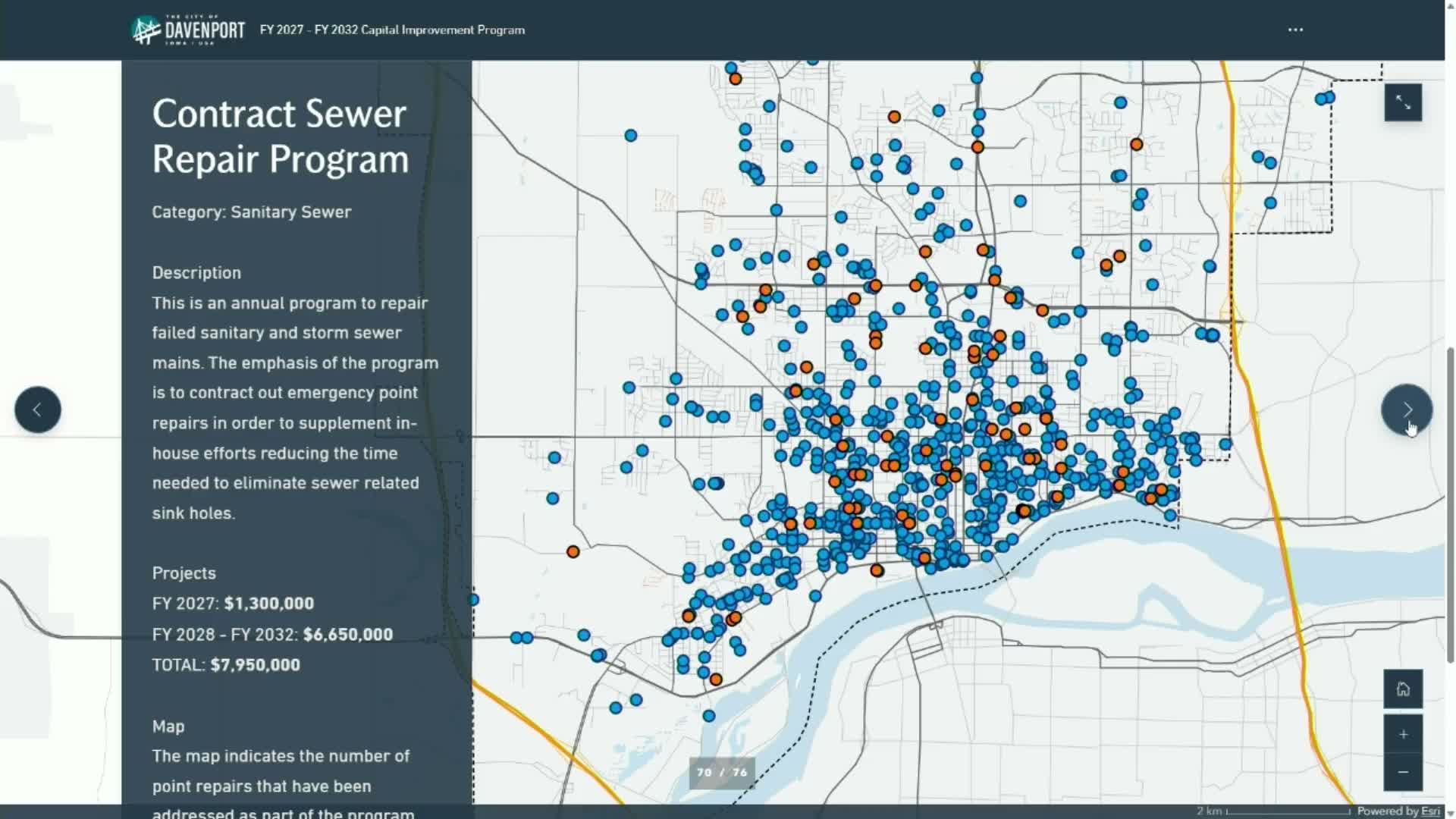
Davenport staff presented several sewer‑focused items during the Feb. 7 budget workshop, describing major lining programs, a private‑side I/I pilot, and water‑pollution‑plant investments that together aim to increase capacity and reduce sanitary sewer overflows.
Staff highlighted planned Investment in a large trunk‑line CIPP lining program (staff indicated a planned lining package in the next month for about $6.5 million) as well as continued annual contract repair programs and a popular sewer‑lateral repair program that historically caps city assistance (the current program has a $500 customer deductible and an assistance cap that has historically been $10,000 but is under reevaluation).
On regulatory context, staff recounted the city’s work under a 2013 consent decree with the Iowa Department of Natural Resources. Rather than pursuing a single large plant equalization basin the DNR initially contemplated, Davenport negotiated an approach that emphasized system‑wide rehabilitation. "Our negotiation with them... was: can we take those funds...and fix things in our system?" Clay said, describing the city’s emphasis on system repairs and SSES (sanitary sewer evaluation studies) basin work.
Staff also proposed a pilot program to investigate private‑side I/I (sump pumps, roof leaders, drain tiles) to collect real data on the scale of private contributions to peak flows; the pilot ($150k in FY27, ~$650k across six years) would be conducted by a third‑party engineering firm and inform potential future programs.
In tandem, staff pointed to riverfront resiliency and Protect grant projects intended to reduce Mississippi‑river flooding impacts on transportation corridors and the water pollution control plant; staff said some structural and nonstructural flood mitigation elements are scheduled in later years of the six‑year plan and rely on previously secured federal funding.
Staff will return with design schedules and more detailed cost allocations for plant projects and the private‑side pilot; no formal action was taken at the workshop.
Staff highlighted planned Investment in a large trunk‑line CIPP lining program (staff indicated a planned lining package in the next month for about $6.5 million) as well as continued annual contract repair programs and a popular sewer‑lateral repair program that historically caps city assistance (the current program has a $500 customer deductible and an assistance cap that has historically been $10,000 but is under reevaluation).
On regulatory context, staff recounted the city’s work under a 2013 consent decree with the Iowa Department of Natural Resources. Rather than pursuing a single large plant equalization basin the DNR initially contemplated, Davenport negotiated an approach that emphasized system‑wide rehabilitation. "Our negotiation with them... was: can we take those funds...and fix things in our system?" Clay said, describing the city’s emphasis on system repairs and SSES (sanitary sewer evaluation studies) basin work.
Staff also proposed a pilot program to investigate private‑side I/I (sump pumps, roof leaders, drain tiles) to collect real data on the scale of private contributions to peak flows; the pilot ($150k in FY27, ~$650k across six years) would be conducted by a third‑party engineering firm and inform potential future programs.
In tandem, staff pointed to riverfront resiliency and Protect grant projects intended to reduce Mississippi‑river flooding impacts on transportation corridors and the water pollution control plant; staff said some structural and nonstructural flood mitigation elements are scheduled in later years of the six‑year plan and rely on previously secured federal funding.
Staff will return with design schedules and more detailed cost allocations for plant projects and the private‑side pilot; no formal action was taken at the workshop.
View the Full Meeting & All Its Details
This article offers just a summary. Unlock complete video, transcripts, and insights as a Founder Member.
✓
Watch full, unedited meeting videos
✓
Search every word spoken in unlimited transcripts
✓
AI summaries & real-time alerts (all government levels)
✓
Permanent access to expanding government content
30-day money-back guarantee
